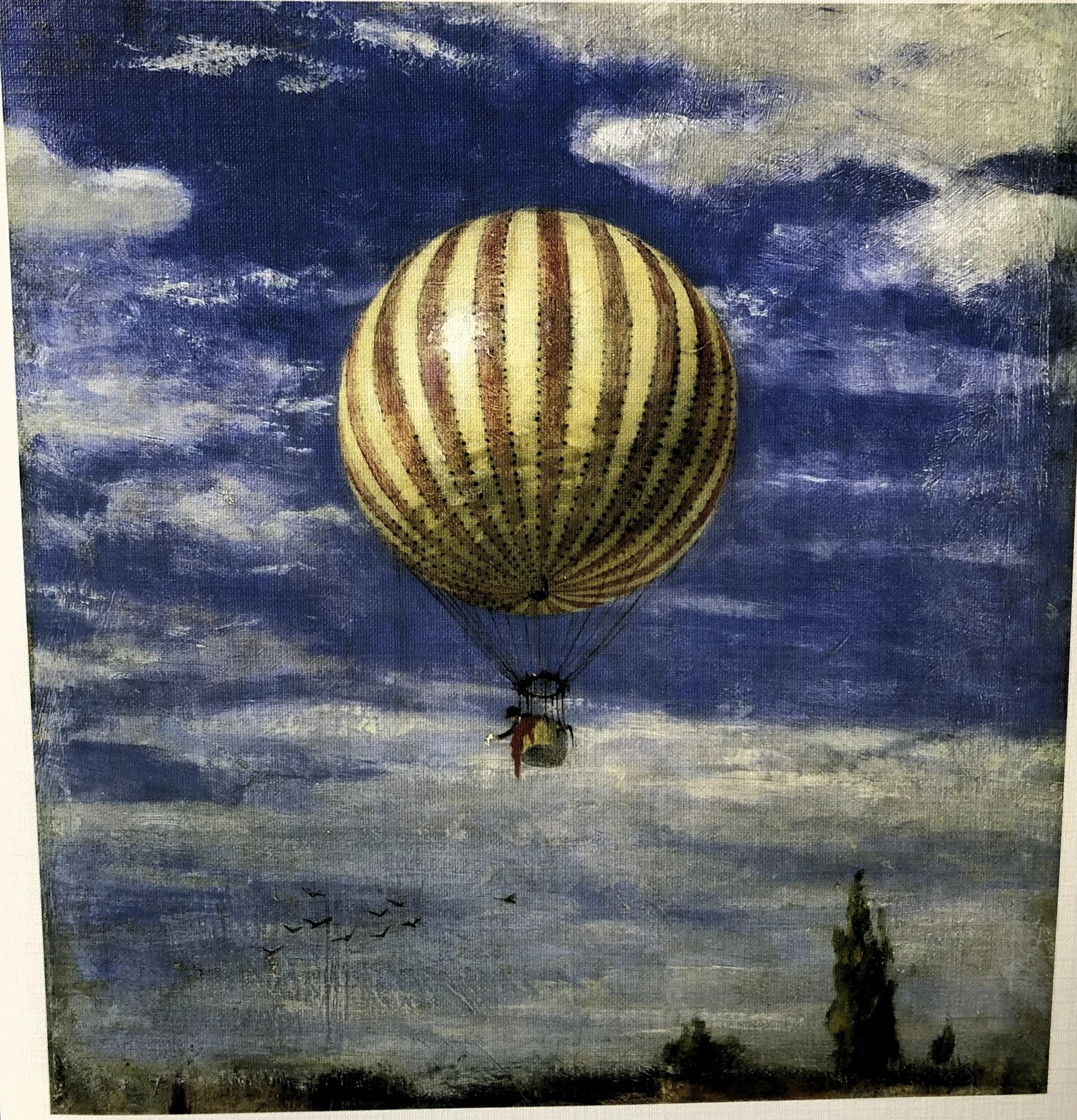
THE BALLOON
Pál Szinyei Merse
- Artist
- Pál Szinyei Merse (1845–1920)
- Date
- 1878
- Dimensions
- 42 x 39 cm
- Medium
- Oil on canvas
- Location
- Hungarian National Gallery, Budapest
In 1878 Szinyei witnessed his brother-in-law leave the wedding of his sister, Mária Probstner, in a balloon and then set off on a grand journey to Western Europe and the Far East. Under the influence of this strange, inspiring experience the painter took up his brush to capture this charming and by no means ordinary scene radiating cheerfulness and optimism, which besides its endearing jauntiness also reveals deeper feelings and thoughts.
Free with the Wind
In these years Szinyei Merse lived on his estate at Jernye, preoccupied with farming affairs, and the long-awaited trip to Venice did not come about. With a few exceptions he hardly painted at all. He suffered several tragedies: his father died, and he lost his sister and two daughters. Grief became his defining state of mind, but the experience of The Balloon lifted him somewhat out of his melancholy. He created one of his most original works, far removed from tradition. The picture’s subtitle — Béla Probster Waves Goodbye to Sáros — refers to a very concrete event, and this unusual journey gave free rein to the artist’s imagination. The depiction of ballooning is a very rare subject in the art of the period, which is perhaps why several researchers believed the painting was inspired by the balloon in Vienna’s amusement park, the Prater. The red-and-white striped balloon rising in the blue sky, competing with the Earth’s gravity, lifts people aloft and triumphantly rules the sky. The intoxication of victory over gravity, physical freedom, is at the same time a symbol of the racing of thoughts, of artistic freedom. The imagery of the painting is almost childishly pure and simple. The miniature top-hatted figure above the red blanket, waving a white handkerchief primly, further heightens the viewer’s sense of freedom.
Going His Own Way
At the end of his years at the Munich Academy, in 1869, Szinyei Merse painted two brilliantly executed studies drawing on experiences from home, masterpieces of plein-air painting, The Swing and Drying Clothes. These pictures already clearly show his unique formal language. The latter picture is also known as Washerwomen and the Young Master. In the garden bathed in summer sunlight the washerwomen hang out freshly washed clothes, while in the foreground the young master watches them. The subject of the picture is the blazing sunlight that turns everything into a phenomenon of light, under whose effect the unified view presents an illusory image of reality. Szinyei had not been to Paris and did not know the Impressionist painters; he could only have seen G. Courbet’s realist pictures and Manet’s very early works at the international exhibition in Munich. Independently of them, in this work he captured the essence of Impressionism.
Ahead of the Taste of His Time
After the years spent at Jernye, at the urging of his father and colleagues he returned to Munich in 1872. There he met his cousin’s circle of landscape-painter friends and liked to go on excursions with them. A member of the company was Zsófia Probstner, with whom the painter fell in love and whom he later married. She also became the model for Woman in Lilac. A year later he made what is perhaps still his most famous picture, Picnic in May. Encouraged by his studio neighbour Böcklin, he set about painting the subject he had been nurturing for years with great energy. After several colour sketches he began work on his large canvas, on which he worked in the studio for several months. His picture tells how the harmony of nature and the buzz of spring release the zest for life of young people on an outing from the city. Man and nature are one: not only in mood but also in the significance of the motifs. The painter shows only as much as can be grasped in a single moment and does not separate the human and natural elements. The undivided unity of the view does not mean, however, that people are merely bearers of colour.
Szinyei took great care over drawing and gave his figures an almost sculptural form. He sought to convey an idyllic state, so he could not consider deeper psychological portrayal, but the colours of the clothes, the postures and facial features of the figures communicate lyrical emotions that heighten the impressions created by nature. The artist may have feared that his picture would not be truly appreciated, for he wrote of it with some irony: “I painted myself into the picture too, lying on my stomach, eating, with my back turned. I confess I was thinking of those critics who would not like my picture.” The brilliantly coloured picture did indeed not achieve the success it deserved; it was attacked both in Hungary and abroad, and the painter, losing heart, gave up regular work for years.
- Picnic in May, 1873. Hungarian National Gallery
- Drying Clothes, 1869. Hungarian National Gallery