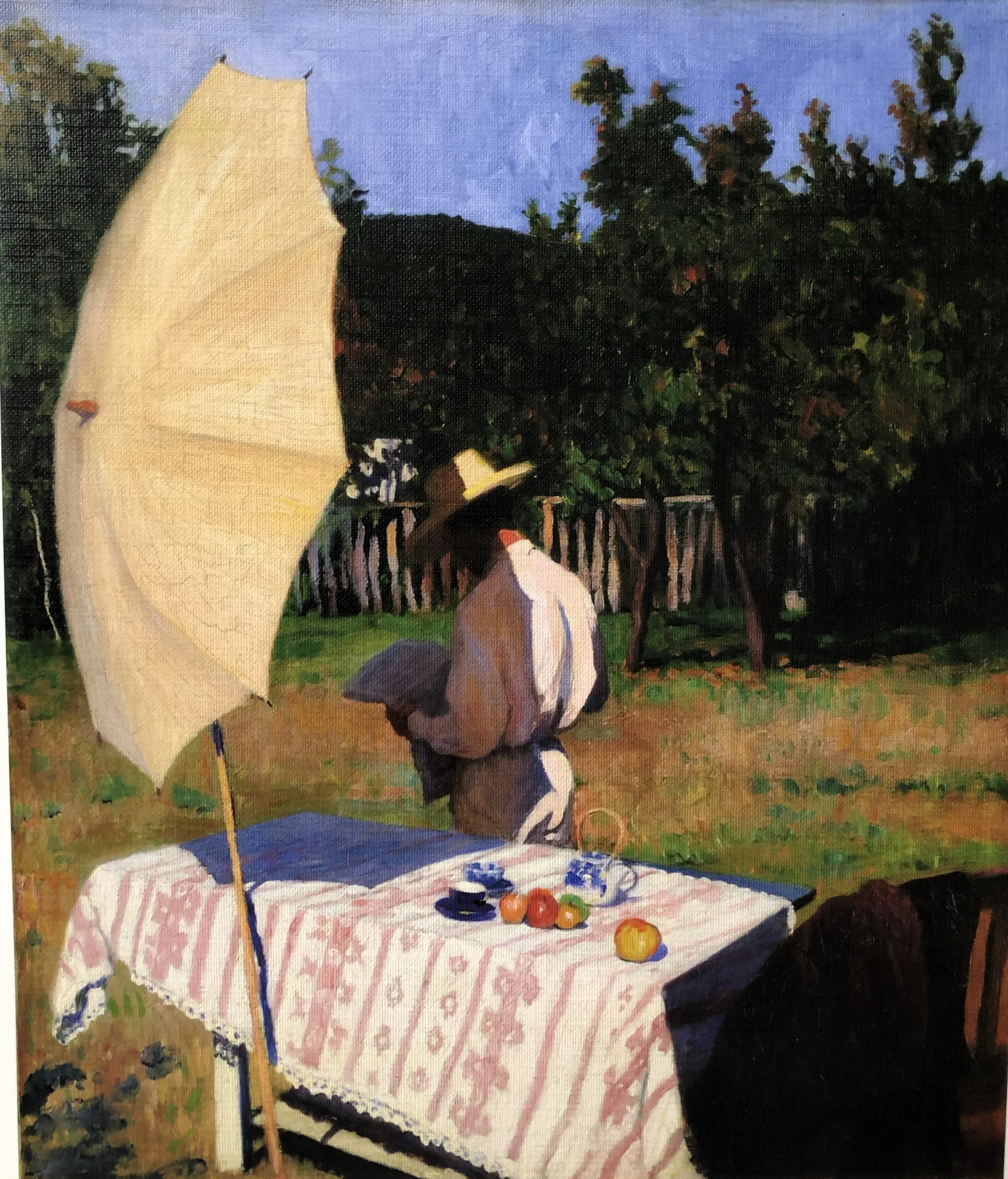
OCTOBER
Károly Ferenczy
- Artist
- Károly Ferenczy (1862–1917)
- Date
- 1903
- Dimensions
- 126.5 x 107 cm
- Medium
- Oil on canvas
- Location
- Hungarian National Gallery, Budapest
We almost feel on our skin the caressing warmth of the autumn sun, hear the birds of the surrounding garden and sense the calm of the man absorbed in reading. Károly Ferenczy’s painting conveys the mood of the peaceful moments of an October afternoon so powerfully that the viewer almost melts into the picture. As we instinctively surrender to this seemingly unadorned work, we do not suspect how consciously considered the effects are that take hold of us. Ferenczy was an artist of intellectual disposition, yet his most successful pictures work precisely through their apparent artlessness, through the self-evident simplicity with which they evoke the harmony of man and nature.
The Nagybánya Artists’ Colony
In the second half of the 19th century Hungarian painting students usually trained at the Munich Academy, where large-format historical paintings in dark brownish colours were then in fashion. It was here that the young painters met and gathered around Simon Hollósy who in the summer of 1896 first travelled to the Transylvanian mining town of Nagybánya (today Baia Mare, Romania) to paint in nature. At that time it was very common in Europe to found an artists’ colony in some region, where artists could then experiment in nature much more freely than at the academies. In Hungarian painting the so-called Nagybánya founders, Simon Hollósy, Ferenczy, István Réti, Béla Iványi Grünwald and János Thorma, opened up to the increasingly widespread Impressionist style. In the course of their studies they had also been to Paris and encountered the new movement at first hand, but at first their colour schemes and brushwork, like their subjects and the way they were posed, were more traditional than those of their French predecessors. Until the early 1900s they often painted biblical scenes in natural settings, where the landscape is almost an equal protagonist of the picture.
Siesta
Nature appears as an important protagonist in Ferenczy’s early biblical pictures too. The same approach prevails in his works from the early 1900s onwards, but in these the weighty religious-literary subjects give way to seemingly uneventful moments of everyday life. He mostly depicts his figures reading alone, or absorbed in themselves even in company. The figures often stand with their backs to us, or the painter depicts their faces only broadly, so their thoughts and feelings remain hidden. There is no underlying meaning or narratable story; these are pictures of the culture of leisure and the freedom of the middle class.
A New Approach
Most of Ferenczy’s works, including October, do not tell a story; it is the view itself that the picture narrates. The emphatic vertical, horizontal and diagonal lines bring movement to the motionless scene. This tension is heightened by effective contrasts of light and shadow and the vivid patches of colour in the picture. One of the most characteristic features of Ferenczy’s approach is that even the depiction of the man standing beside the table laid for an afternoon snack is like a still life. The everyday subject, the almost random cropping and the effects of colour and light raised to the main subject are all characteristics of Impressionism. Although Ferenczy himself avoided this term all his life, his works are the most important Hungarian creations of Impressionist painting.
Vicissitudes and Success
The direct, personal works of the Nagybánya painters were at first considered scandalous by a public accustomed to historical subjects, dignified portraits and saccharine genre pictures. The early 20th century, however, brought such a cultural boom to Hungary that it created more favourable conditions for the fine arts too. Ferenczy and his companions experienced popularity and recognition in their lifetimes, and several even became teachers at the Academy of Fine Arts.
- Károly Ferenczy: Sermon on the Mount I, 1896–97
- Károly Ferenczy: Triple Portrait, 1911