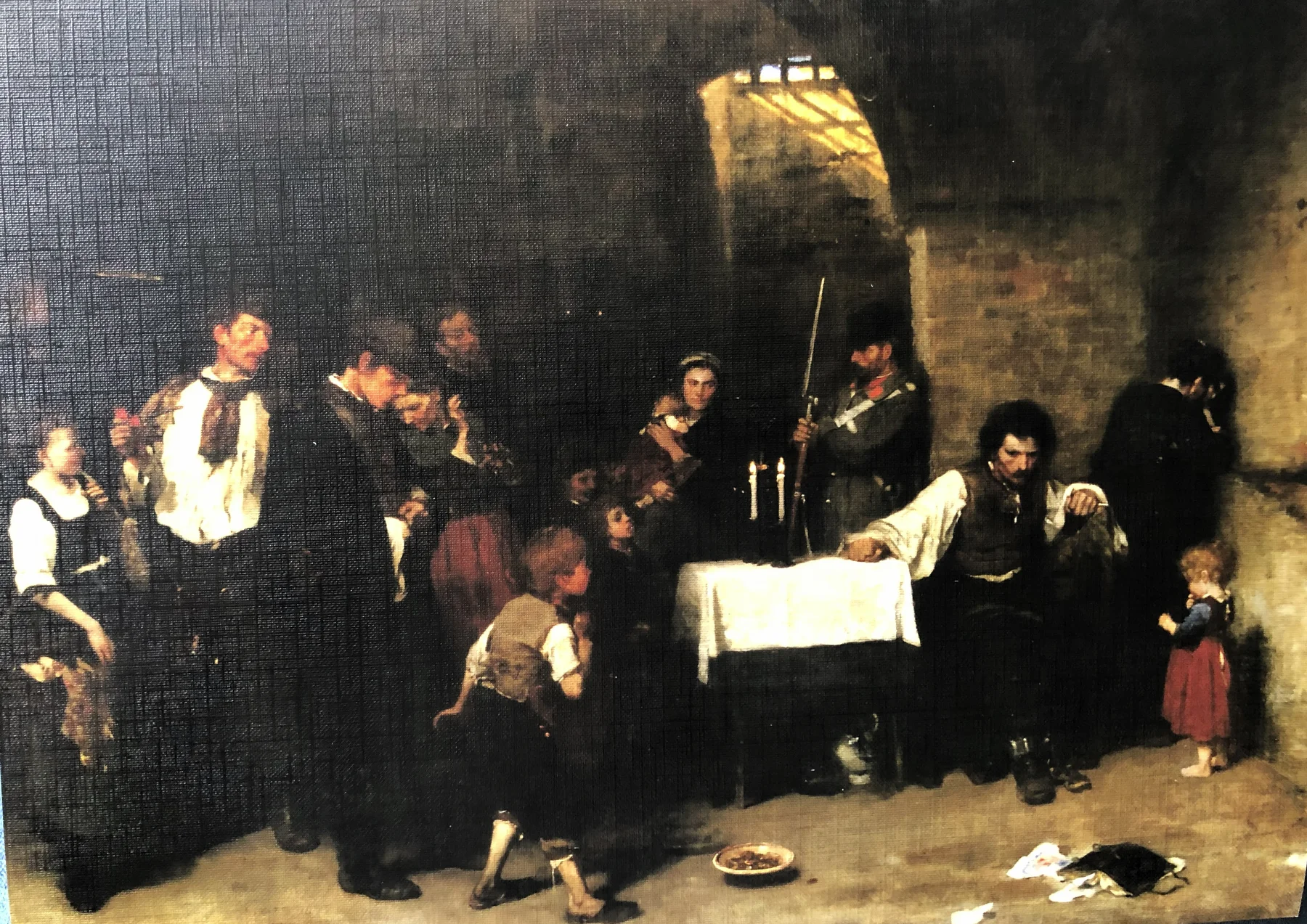
THE CONDEMNED CELL
Mihály Munkácsy
- Artist
- Mihály Munkácsy (1844–1900)
- Date
- 1869
- Dimensions
- 139 x 193.5 cm
- Medium
- Oil on wood
- Location
- Hungarian National Gallery, Budapest
At only twenty-six, Mihály Munkácsy won the gold medal of the prestigious Paris Salon with his dramatic panel painting The Condemned Cell. To this day he can be regarded as one of the most successful Hungarian painters, since after he moved to the French capital to continue his career there, commissions poured in endlessly. He lived his daily life in surroundings furnished with aristocratic splendour, with his distinguished French wife at his side. This seemingly enviable life, however, led through many difficulties, and because of his early success the artist was tormented by doubts and lack of self-confidence until his death.
A New Approach
Munkácsy painted The Condemned Cell when he was very young; it is almost the young artist’s first truly mature work. He began it in the spring of 1869, when he was training with Ludwig Knaus in Düsseldorf. For the Central European viewer the picture combined in a novel way the genre of folk-life painting with the outlaw (betyár) theme so popular at home, served up in the theatrical presentation of Düsseldorf painting. The sympathetic portrayal of the condemned man awaiting execution led many to associate the painting with the suppression of the 1848/49 revolution and war of independence. The public of the Paris Salon, however, could appreciate in it above all the depiction of wild Hungarians of the puszta, exotic to them.
In the Shackles of Success
Munkácsy wanted to achieve the success of The Condemned Cell again, so with minor changes more and more large multi-figure scenes were made in his studio, such as Night Prowlers or The Pawnshop. In them we see his favourite figures again, such as the mother holding her child in her arms, the man with bowed head and the little girl in a red skirt. The last was such a favourite motif of the painter that he even included her in his picture In the Studio. In this painting, which has now darkened considerably, Munkácsy depicted himself with his wife in a typical studio setting. The figure of the little girl on the far left, the only unreal element of the picture, was perhaps meant to fill the void that childlessness, their only unfulfilled wish, may have meant in the Munkácsy couple’s life.
The Devil in the Technique
When painting The Condemned Cell Munkácsy used the bitumen ground fashionable at the time, as in many of his other pictures, because he liked the dramatic effect created by the dark ground. The technique’s popularity was helped by the fact that the black ground intensified the colours, which almost shone out from it, and also gave the pictures a more unified, cohesive effect. Unfortunately the material’s fatal property became clear only years later: it never solidifies, remains forever “in motion” and gradually buries the oil paint within itself, so that the picture gradually darkens and may eventually even be destroyed.
The Parisian Socialite
In 1874 Munkácsy married Cécile Papier, widow of his former patron, Baron de Marches. She furnished a spectacular salon for him like those of the princes of painting in Europe; they received guests and went to costume balls, and the Hungarian papers reported on their luxurious life with the attention due to celebrities. The spectacular settings of this life survive not only in photographs but are also reflected in the host of salon pictures that Munkácsy’s art dealer, Charles Sedelmeyer, sold mainly to wealthy buyers on the North American continent. The ambitious dealer also proved an excellent manager, so Munkácsy soon had to set up a workshop to keep up with the huge demand for flower still lifes, portraits and Dutch-style genre pictures. In the end he found the conditions so oppressive that he terminated the ten-year contract.
The Success of the Christ Trilogy
Munkácsy met Ernest Renan, author of the novel The Life of Jesus (1863), several times. It is probably Renan’s “Jesus” that we see again in Munkácsy’s largest and undoubtedly most successful undertaking, the three-part Passion series. The unparalleled success of Christ before Pilate (1881) and Golgotha (1884) was founded by Sedelmeyer with a touring exhibition visiting several major cities. The two monumental works were bought in 1887 by the American department-store owner John Wanamaker, who treated his customers at Easter by exhibiting the pictures in the foyer of his store. Ecce Homo was made only much later, in 1896, but this late work lacks the force and cohesion to which the first two pictures owe their success.
- Mihály Munkácsy: In the Studio, 1876
- Mihály Munkácsy: The Apotheosis of the Renaissance, large compositional sketch for the ceiling painting of the Kunsthistorisches Museum in Vienna