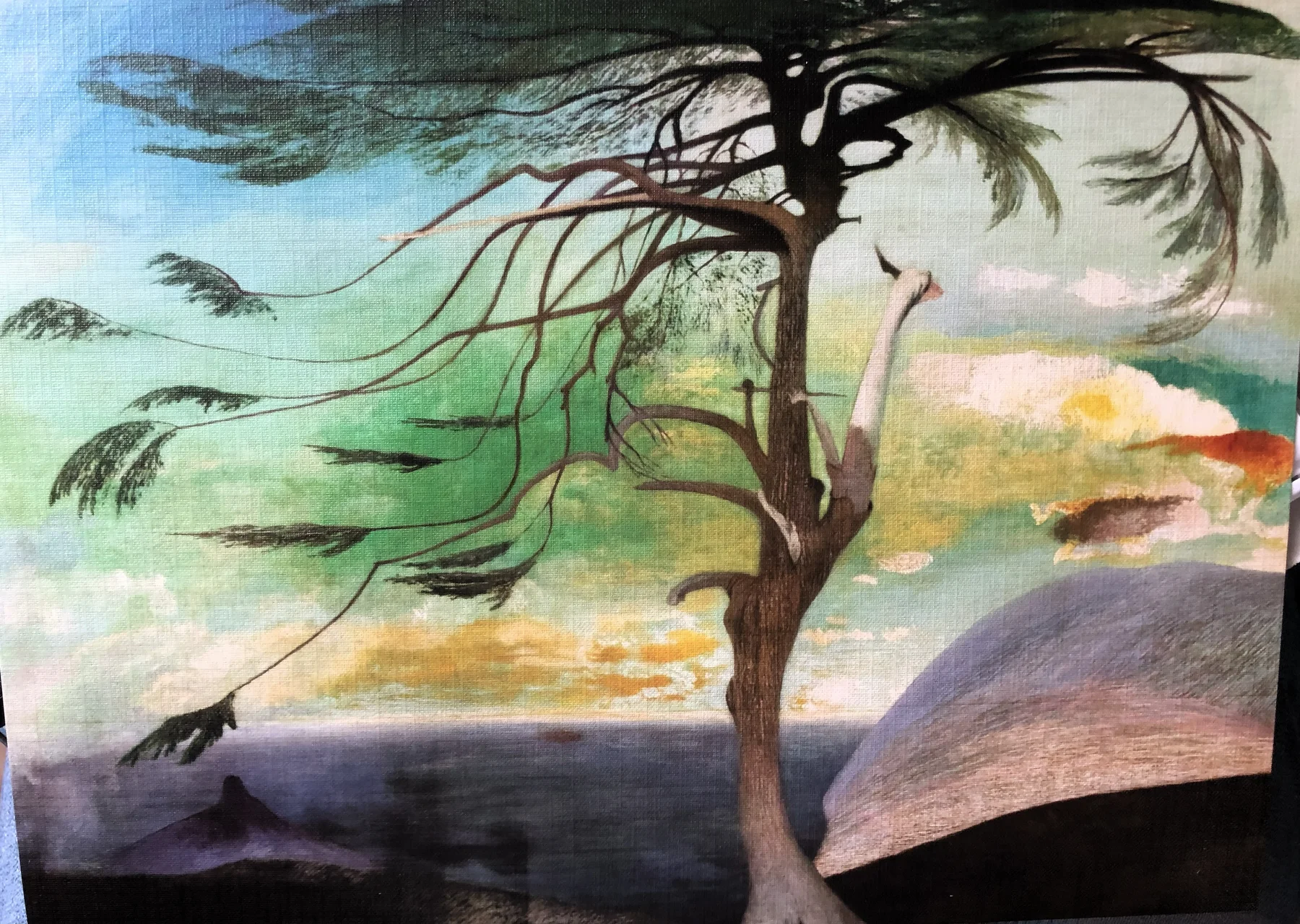
SOLITARY CEDAR
Tivadar Csontváry Kosztka
- Artist
- Tivadar Csontváry Kosztka (1853–1919)
- Date
- 1907
- Dimensions
- 194 x 248 cm
- Medium
- Oil on canvas
- Location
- Janus Pannonius Museum, Pécs (on deposit from the Hungarian National Bank)
Legends, enigmas and the myth of the mad genius surround the figure of Tivadar Csontváry Kosztka. His life cannot be called ordinary, and after his death his works too went on an adventurous journey before winning the recognition they deserved. Today, however, his masterpieces such as Solitary Cedar, Baalbek or The Ruins of the Greek Theatre at Taormina are among the most popular and best-known works of 20th-century Hungarian painting. Beneath its deceptively unusual surface, the art of this painter with his individual imagery testifies to a thorough knowledge of and deep respect for artistic traditions and the beauties of nature.
Landscape as Self-Portrait
In 1907 the ever-restless Csontváry reached Tripoli in Lebanon, where he painted one of the most important motifs of his life, the cedar. He was completely captivated by the 6,000-year-old ancient trees towering 1,800 metres above sea level. The tree, defying the wind alone, radiates such dignity and strength and has such a striking “character” that researchers interpret it as a kind of self-portrait. It reflects the figure of Csontváry, fighting alone, misunderstood, yet triumphant. His work Pilgrimage to the Cedars of Lebanon, on the other hand, is usually interpreted as a wishful image, in which the monumental tree again personifies the painter, while at its feet ant-sized pilgrims express their reverence with a round dance. The possibilities of interpretation are of course inexhaustible, since the tree of life and the place of pilgrimage are both widespread and familiar symbols.
Orientalism
In the 19th century interest in subjects depicting exotic landscapes and scenes grew livelier. This phenomenon soon made its effect felt in Hungary too. Associated with it are works such as József Borsos’ The Emir of Lebanon, a portrait of Count Zichy posing in the costume of an Arab lord. One of the most renowned Hungarian exponents of Orientalism was Antal Ligeti, who returned from his travels with special depictions of distant landscapes. The impressive cedars had already inspired him, as they did many of his contemporaries. In addition, in the second half of the 19th century photo reports and illustrations were common in illustrated magazines, and interest in the East became fashionable. Costumes, ornaments and some elements of interior decoration and dress betrayed the appeal of the exotic. In other words, Csontváry may have been following a painterly tradition when he felt that the truly great subjects were to be sought in the landscapes of Syria, Egypt and Palestine. His genius lies in the fact that he created an entirely individual transcription of these familiar motifs.
Truth to Nature and Expressive Power
In 1880, when at the call of an “inner voice” he committed himself to painting, Csontváry gave himself twenty years to prepare for the “great task”. He is regarded as a self-taught artist, but he did pursue art studies, and his early drawings are very thorough studies from nature. Not only depictions of people survive from this period. He often studied stuffed animals, rendering them with such accuracy and liveliness that one of his monographers called these works animal portraits. Later, in his landscapes too, we can observe the devoted interest with which he depicted the motif. Because of his overwhelming and individual use of colour and his expressive, arbitrary distortions of forms and human figures, his works nevertheless appear as visions.
The Great Motif
For a long time the Tatra Mountains represented the great motif for Csontváry; one of his most imposing pictures is The Valley of the Great Tarpatak. On his eastern travels he finally saw Baalbek, which he captured on a painting measuring 386 x 716 centimetres. This stunning, monumental work became the artist’s favourite picture, of which he was proud to the end of his life.
- Antal Ligeti: Cedar Grove in Lebanon, 1876
- Cedars in the issue of Vasárnapi Újság of 19 July 1874
- Tivadar Csontváry Kosztka: Baalbek, 1906