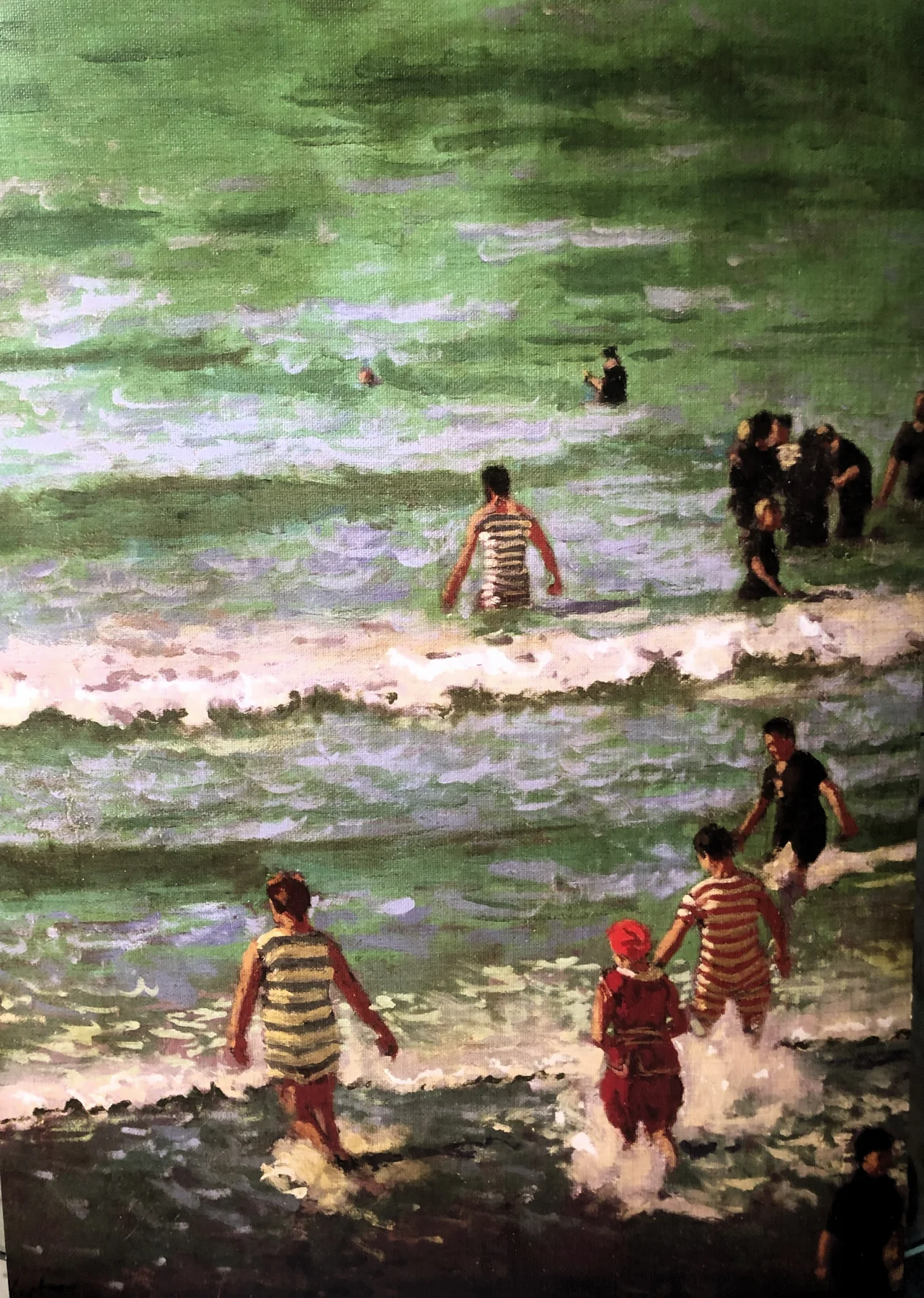
BATHERS, DIEPPE
Walter Richard Sickert
- Artist
- Walter Richard Sickert (1860–1942)
- Date
- 1902
- Dimensions
- 131.4 x 104.5 cm
- Medium
- Oil on canvas
- Location
- Walker Art Gallery, Liverpool, England
Walter Richard Sickert was not a popular artist among contemporary art lovers, but today many critics regard him as the greatest English painter since Turner. Bathers, Dieppe is not one of his most characteristic pictures, but rather a lighter-hearted work by the British Impressionist, who is better known for his darker colour scheme.
A Mural
Sickert regularly visited the fashionable French seaside resort of Dieppe. From 1879 he and his family holidayed in the town every year, and after his divorce at the end of the 19th century he lived there for almost five years. Sickert was an excellent swimmer who loved the sea and often enjoyed the pleasures of swimming. Bathers, Dieppe was one of a series of six large paintings commissioned from him by the owner of the Hotel de la Plage, Monsieur Menton, to decorate the restaurant wall of his Dieppe hotel. Sickert painted six different scenes of Dieppe at 40 francs each, including the paintings Rue Notre Dame and Quai Duquesne, a study of the Cathedral of St Jacques and the picture Statue of Duquesne. The hotel owner was not satisfied with the pictures and almost immediately sold the three paintings above, as well as Bathers, Dieppe, to a young expatriate American musician and painter, Frederick Fairbanks.
On Exhibition
Frederick Fairbanks lent Bathers, Dieppe to the 1903 exhibition of the prestigious Salon des Indépendants in Paris, where it was shown as “Bain de Mer”. The Walker Art Gallery in Liverpool bought the painting in 1935. This acquisition coincided with a Sickert exhibition held at the gallery. In 1941, a year before the artist’s death, his painting was shown at another exhibition, this time at the National Gallery in London. The picture is currently part of the Walker Art Gallery’s permanent collection.
Brighter Colours
By the late 1880s Sickert had become one of the most important London Impressionists with his studies of music halls. He learned his art from the famous American expatriate painter Whistler, but his master’s attachment to a narrow colour range suited his taste less and less, and around the turn of the century he began experimenting with new, fresh colours in his own paintings. Bathers, Dieppe is undoubtedly a light-toned work rich in colour. Sickert’s earlier paintings were made on a much smaller scale, but his Dieppe commissions gave him some artistic freedom on relatively large canvases. No drawing or painted study is known for Bathers, Dieppe. In keeping with the frivolous mood of its subject, carefree sea bathing, the commissioned picture radiates lightness and spontaneity.
The Influence of Degas
In 1883 in Dieppe Sickert met the influential French Impressionist painter Edgar Degas, whose friend and pupil he soon became. As his masterpieces of ballet dancers testify, Degas had a special talent for capturing movement in his paintings. Sickert had to learn from the French master the snapshot-like depiction of movement, and Bathers, Dieppe reveals the development of this ability. The figures in the foreground are just wading into the water; the man in a striped bathing suit on the left is depicted in motion, slightly blurred. White foam splashes the bathers’ lower legs as they set off towards the incoming waves. Sickert put the highlights of the foam of the waves on canvas with thicker, quicker brushstrokes in the Impressionist style.
Mixed Bathing
The recently divorced Sickert vividly conveys the pleasures of men and women bathing together in France, while in England characteristic Victorian prudery ruled out any such form of social contact. In the foreground a few bathers — among them a woman in a red bathing costume between two men — walk into the sea, while in the lower right corner a small figure in a black bathing suit is just coming out of the water. In the middle of the right side of the picture a few people, also in black bathing suits, stand chatting in waist-deep water.
The Depiction of Perspective
The three men in striped bathing costumes setting off into the water adopt a similar posture, forming a triangle with their arms, while they themselves are the vertices of a larger triangle. This device gives structure to the seemingly randomly arranged groups. The two diagonal lines running from the lower left corner towards the upper right corner, along which three separate figures each are depicted in perspective foreshortening, serve a similar purpose. With these loosely handled diagonals running from the shore into the sea Sickert creates perspective. Without them, or without some point of reference, the viewer would not be able to perceive the depth of the picture, since the horizon is not visible and the shoreline cannot be made out in the foreground either.
- Dieppe at the turn of the 20th century
- Whistler in his London studio (back, centre)
- Walker Art Gallery, Liverpool
- Edgar Degas