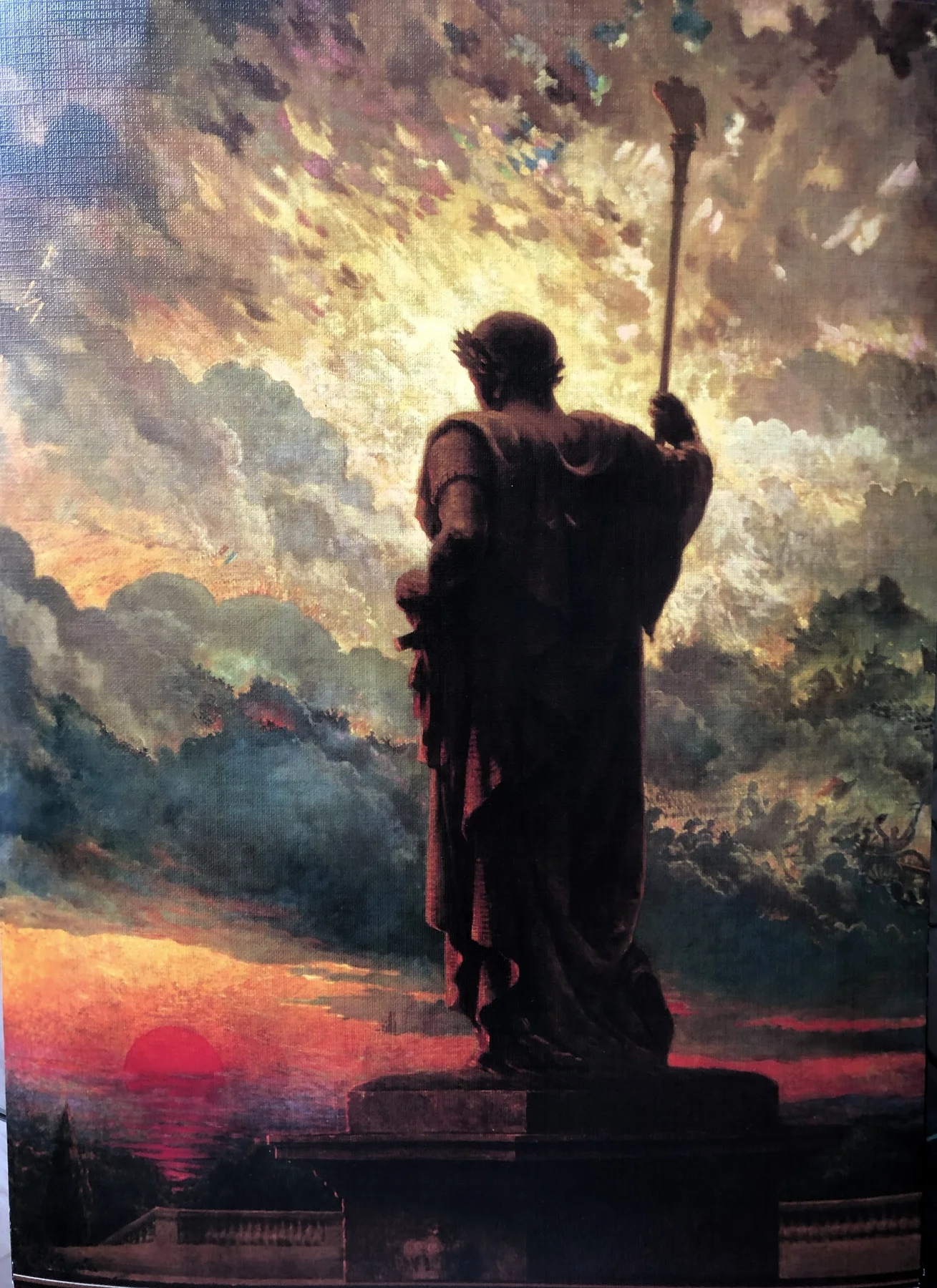
THE EMPEROR
James Carroll Beckwith
- Artist
- James Carroll Beckwith (1852–1917)
- Date
- 1912
- Dimensions
- 304.8 x 228.6 cm
- Medium
- Oil on canvas
- Location
- Smithsonian American Art Museum, Washington, D.C., USA
This passionate picture was made in 1912 by a nostalgia-prone New York painter who loved Europe’s cultural heritage. In the twilight of his life Carroll Beckwith travelled through Italy and France, painting studies of formal parks and old statues. His picture of the Paris statue of the emperor named in the title symbolises the passing of worldly glory.
The French Connection
Beckwith loved Europe. After the unsuccessful sale of his New York studio he travelled to Italy in 1910 and lived there for the next four years. He visited France, where he devoted much of his time to studying the statues of formal parks and gardens, taking particular pleasure in drawing and painting the statues of Versailles (mostly in a more realistic style than in The Emperor).
The Little General Writ Large
François Frédéric Lemot’s (1772–1827) statue of 1808, The Triumph of Napoleon, did not stand at Versailles but in the Orangerie wing of the Tuileries Palace in Paris, which Napoleon had fitted out as his main residence after seizing power in 1799. How the statue came to be there is an interesting story.
Napoleon’s museum director, Vivant Denon, following in the wake of the Grande Armée’s conquests in Europe and Egypt, seized countless treasures, including the four huge Corinthian horses of St Mark’s Square in Venice. He envisaged a grandiose statue for the top of the Tuileries triumphal arch: Napoleon in ancient dress, driving the Italian steeds in his triumphal chariot. When the work was unveiled, however, Napoleon burst out angrily: “What? Put up a statue to myself?” The chariot could stay, but the statue was banished to the garden.
Imperial Coronation Regalia
Lemot’s statue presents Napoleon in two lights. His toga resembles that of a Roman emperor, while his other accessories are those he wore at his coronation in December 1804. The gold laurel wreath and sword symbolise the heritage of Charlemagne’s ancient dynasty, and the imperial sceptre topped with a golden eagle (the emblem of Charlemagne and the Roman emperors) alludes to his sovereign power. (The coronation regalia also appear in well-known pictures by David, Ingres and Gérard.) Napoleon’s monogram, the letter “N”, can be seen on the stylised crown of the pedestal.
An Ethereal Vision
In his painting Beckwith pays careful attention to traditional composition: he draws his vertically depicted monument in front of the horizon (the red line of the sky), moving it slightly off-centre, and keeps the heavy marble block low, thus balancing the huge vault of the sky.
The overall effect of the painting recalls the works of the German Romantic painter Caspar David Friedrich, in which the outlines of solitary figures stand out against the evening sky. In fact, however, the artist truly gave free rein to his imagination in depicting the ghostly line of soldiers half-hidden by clouds piled up by the smoke of battle.
When Beckwith painted The Emperor, exactly a century had passed since Napoleon’s army reached its greatest strength, some 600,000 men, shortly before the disastrous campaign against Russia in 1812, during which two-thirds of the imperial armies were destroyed, and the remaining forces later suffered decisive defeat at Waterloo. The troops depicted in the painting probably represent an entire army corps of 20–30,000 men, complete with artillery and cavalry. The line of lightning may allude to Napoleon’s rapid campaigns or to the Roman-style depictions of lightning on the imperial insignia.
Artistic Connection
In the 1870s Beckwith’s roommate in Paris was a renowned American painter, John Singer Sargent, with whom he formed a lifelong friendship. Both studied under the portrait painter Émile Carolus-Duran, who for a short time employed Beckwith as his chief assistant. Carolus-Duran’s rather loose, free painting style did not suit Beckwith’s innate perfectionism, so in 1875 the American artist enrolled at the École des Beaux-Arts, where he was taught stricter rules of handling line, form and colour, which he also passed on to his New York students.
- Emperor Napoleon Bonaparte, 1812
- The royal palace in the Tuileries Garden
- Vivant Denon
- Friedrich: Two Men by the Sea