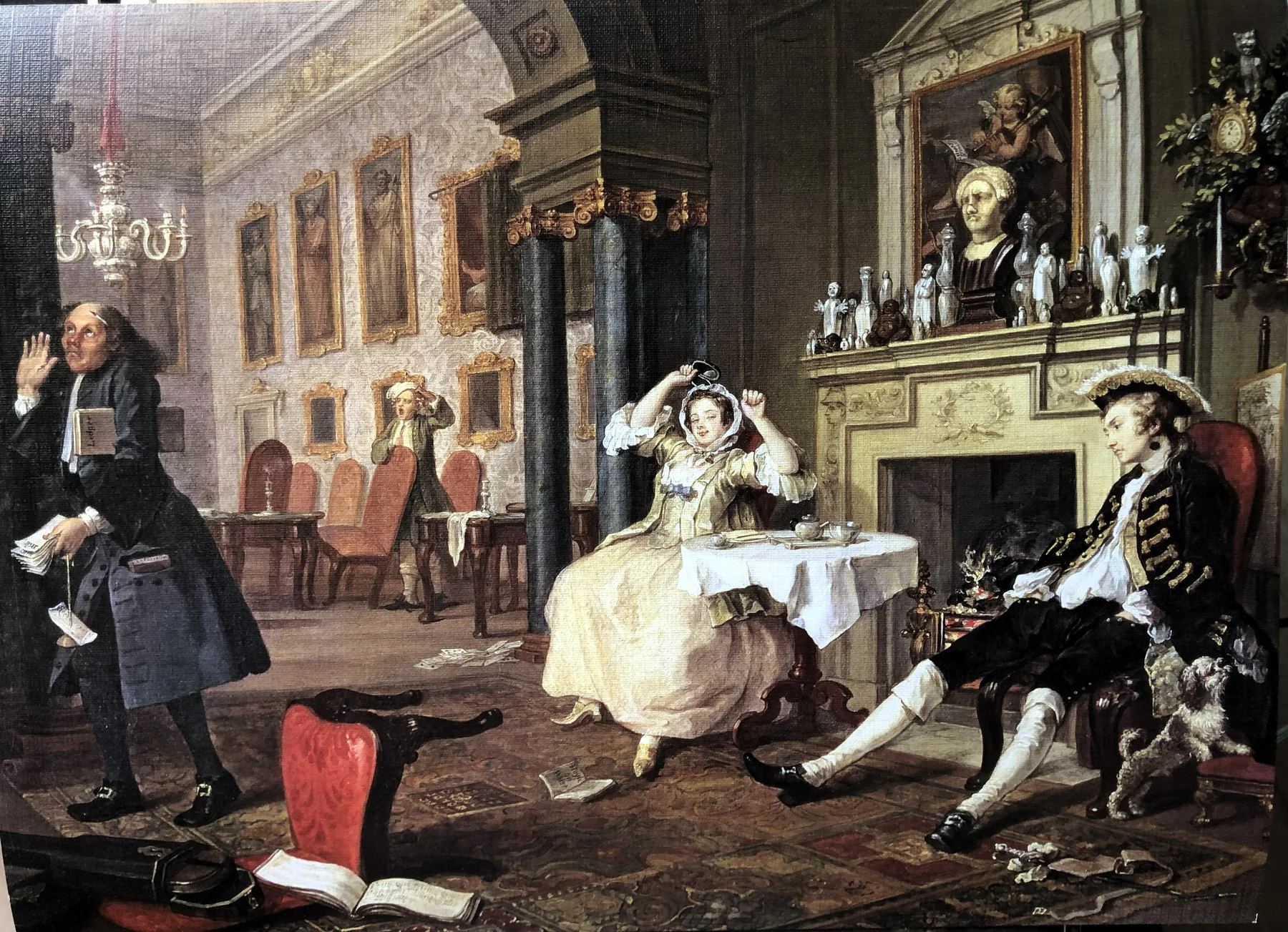
MARRIAGE A-LA-MODE: II. THE TÊTE À TÊTE
William Hogarth
- Artist
- William Hogarth (1697–1764)
- Date
- 1743
- Dimensions
- 90.8 x 69.9 cm
- Medium
- Oil on canvas
- Location
- National Gallery, London, United Kingdom
A witty, sharp-eyed, ruthlessly outspoken chronicler of his own time, William Hogarth was an innovative, original artist. His works present an interesting period of British history with vibrant liveliness, insight and often ironic humour. In his enormously popular satirical engravings and paintings Hogarth invites the viewer on a comprehensive tour of Georgian London, from the fashion-aping drawing rooms of aristocrats to scenes of excessive drinking. He sought to make his works serve as a lesson “to a future age, in which the present public mood, fashions and customs may perhaps have changed”. Marriage A-la-Mode: II. The Tête à Tête is the second piece of a six-part satirical, moralising cycle of paintings — in Hogarth’s words, “modern moral subjects”. The series is a parable of the marriage of convenience, then the subject of heated debate. The first scene is set in the palace of Earl Squander, where the aristocrat marries his son to the daughter of a wealthy city merchant. In this second scene we see the newly married viscount and his wife in their ostentatious drawing room, weary of their overindulgent life and showing no interest in each other. The sad moral tale continues in the fifth scene with the husband’s murder — the culprit is the wife’s lover, a lawyer named Silvertongue — and the series ends with the sixth painting, the wife’s suicide (lower left picture).
Stories of Morality
The idea of paintings on modern moral subjects occurred to Hogarth in the early 1730s, as a way of boosting his income. By then he had already made several small group portraits on commission, but he did not earn much money from them. According to his new idea he wanted to present a dramatic, tragicomic story through a series of paintings rich in nuanced, fine detail. With his choice of subjects Hogarth drew attention to inequalities between classes and sexes. His series Marriage A-la-Mode was preceded by the sad tale of A Harlot’s Progress (1732) and the satirical A Rake’s Progress (1735). Engravings were made of both series of paintings, and the prints were sold in large numbers, bringing Hogarth international fame. His “painted narratives” were an immediate and enormous success with all social classes — even those he caricatured. Hogarth tried to sell the original paintings of Marriage A-la-Mode, but this was less successful. The pictures were finally auctioned in 1751, where they were bought by a collector named John Lane, and later passed to his nephew. In 1797 the series was bought for his collection by the insurance broker and collector J. J. Angerstein, whose collection was acquired by the National Gallery in London in 1824.
The Unhappy Couple
Hogarth’s exceptional artistic, narrative and satirical abilities come together in Marriage A-la-Mode: II. The Tête à Tête. Everything we see indicates that the viscount’s arranged marriage is in ruins. The untidy room bears the traces of the previous night’s revelry, although the clock has already struck noon. The viscount has returned exhausted from his night’s debauch — the woman’s cap sticking out of his pocket (which the dog is sniffing) shows that he has been with his mistress. His sensuously stretching wife casts a mischievous glance at him: the overturned chair and the open instrument case suggest that her companion left the scene in a hurry. Their prudish steward leaves the room raising his arm at the sight of the chaos, holding a pile of unsettled bills in his other hand — only one paid bill is filed — foreshadowing the household’s looming financial troubles.
Symbols of Satire
Hogarth obsessively reworked Marriage A-la-Mode again and again, adding new details to the scenes until the last moment, so that every picture, ornament, book and statue to be found in the painting carries meaning. The painting above the fireplace depicts Cupid among ruins. The bust with a broken nose in front of it is a symbol of impotence. The Chinese porcelain figures on either side of the bust and the kitschy wall clock to the right of the fireplace testify to the couple’s bad taste. The book titled Regeneration peeping out of the prudish servant’s pocket is a typical Hogarthian swipe at Puritan religious zeal.
Lifelike Depiction
It was essential for Hogarth to present his figures convincingly, as lifelike people. To achieve the spontaneous, natural effect of his paintings — in contrast to the customs of the time, that is, copying the works of the old masters or making sketches — Hogarth developed a distinctive technique based on visual memory. This consisted in committing a scene or “snapshot” to memory and developing a kind of visual shorthand, reduced to an easily recalled system of lines, in his own words “retaining in my mind the lines of such objects as best serve my purpose.” The artist could thus recall his scene at will, so that his figures came to life with natural ease on the painted canvas. The writer Henry Fielding (1707–1754) wrote of Hogarth: “…it is high praise to say of a painter that his figures breathe, but in Hogarth’s case this is even truer than one might think.”
- Hogarth: Marriage A-la-Mode: VI. The Lady’s Death
- Hogarth: A Rake’s Progress II: The Levée