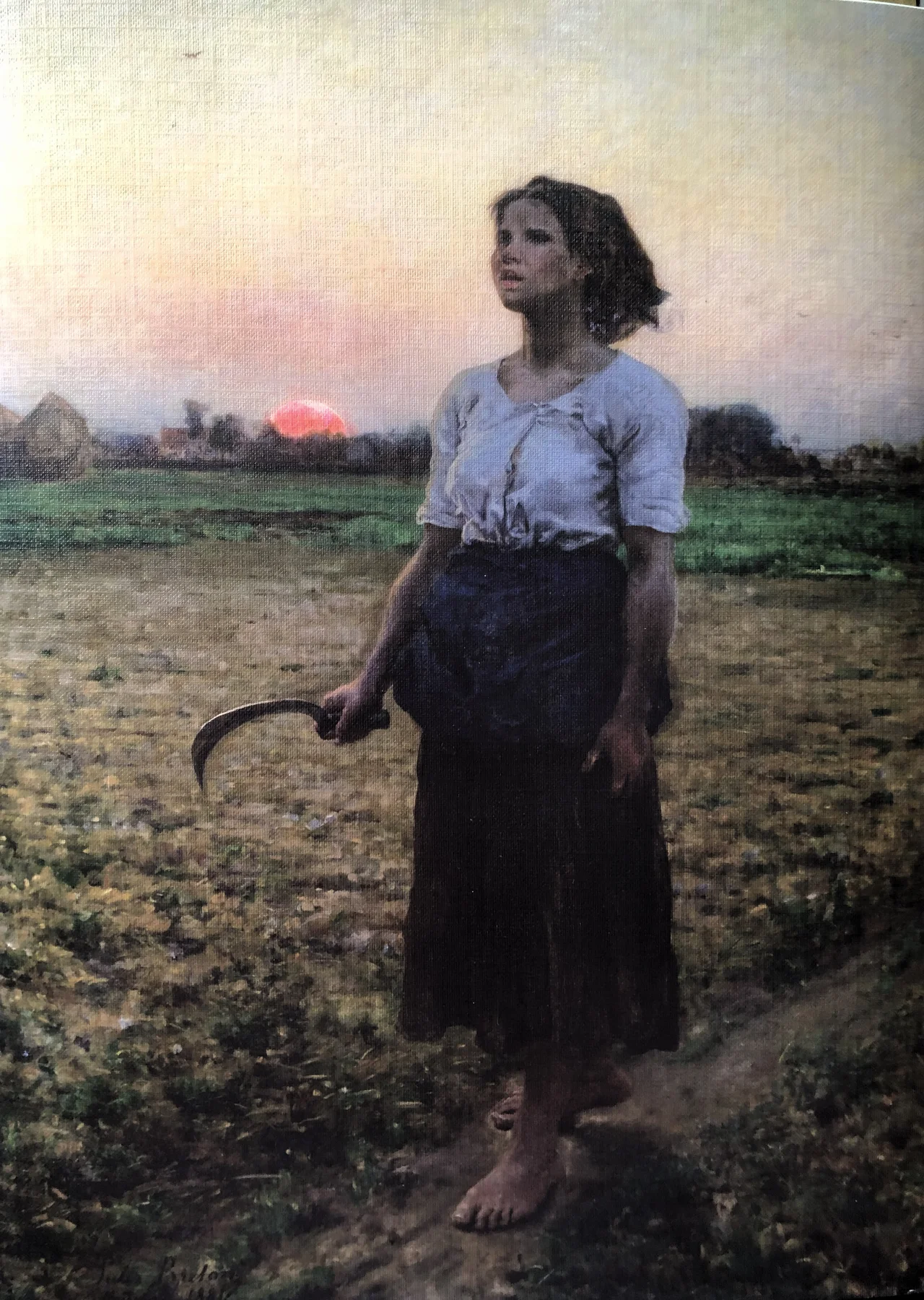
THE SONG OF THE LARK
Jules Adolphe Breton
- Artist
- Jules Adolphe Breton (1827–1906)
- Date
- 1884
- Dimensions
- 110.6 x 85.8 cm
- Medium
- Oil on canvas
- Location
- The Art Institute of Chicago, USA
In The Song of the Lark we see a peasant girl crossing a field barefoot, sickle in hand, to begin her day’s work. The rising sun casts soft orange-red rays over the landscape, and larks can be seen in the pale sky. This is one of Jules Breton’s best-known and most characteristic paintings. In his own time the artist was famous for his moving depictions of peasants working in the fields; in his pictures he showed the hardships of their daily lives while endowing them with poetic beauty and almost heroic traits.
Heroic Figures
Breton’s finely detailed paintings of rural subjects celebrate the values of work, family and home, his realistic style blending with an idyllic depiction of the “simple life”. Although the female figure in The Song of the Lark is barefoot and in worn clothes, she holds her head proudly. Despite her hard lot, the lovely girl is marked by dignity. As in many of Breton’s later works, the foreground of the picture is filled by the main figure with her emphatic presence and sculptural appearance, accentuated by the sun rising behind her, sharply outlining her contours. Her feet stand firmly on the ground, her arms are strong, her hand grips the sickle firmly. In his autobiographical writing Breton mentions his “strong attraction to nature, to the heroic deeds of everyday life and to the beauty of peasant life.”
Love of the Land
At the end of the 19th century Jules Breton was one of France’s most famous painters and one of the most popular and successful artists of his time. He began painting at a time when France was entering the age of industrialisation, so with his wonderful scenes of traditional French peasant life he represented a kind of permanence in a rapidly changing world.
Breton grew up in Courrières, a small village in the Artois region of northern France. Although he was only four when his mother died, he had a happy childhood in a close and loving family; he was brought up by his father, his maternal grandmother and his uncle, Boniface Breton. From his village roots grew his love of the countryside and his native region, which had a great influence on his art.
Social Sensitivity
When he was studying in Paris in his twenties, the young Breton experienced at first hand the aftermath of the bloody revolution of 1848, which prompted him to paint two powerfully realistic pictures. Misery and Despair (1849) and Hunger (1851) are open social commentaries on the conflicts and the agonising plight of France’s poor. Both works were shown at the exhibition of the prestigious Salon, but because of their political message they provoked heated debate.
Soon afterwards Breton turned to the idyllic depiction of peasant life, which brought him fame. Practical considerations also played a part in this change of style, since it made his works more acceptable to the Salon and potential patrons. In addition, his passion for landscape painting received new impetus when he returned to Courrières, where he later settled.
Realistic Depiction?
Breton paid great attention to evoking the local features of his beloved native region in wonderful detail. During his academic training in Belgium and Paris he developed his innate talent, while the attraction to painting outdoors he showed even as a young man made him particularly sensitive to depicting the countryside, working people and the fleeting effects of light.
At the same time it is undeniable that while Breton’s landscapes are realistic, he presents peasant life through rose-tinted glasses. His figures appearing in picturesque landscapes are clean, well fed and dignified. These works form an interesting contrast with the less idealised village scenes of the period: whereas Jean-François Millet’s The Gleaners (1857), for example, shows the exhausting side of agricultural work, in Vincent van Gogh’s The Potato Eaters of 1885 a sad peasant family eats its miserable supper at a cramped table.
Breton confesses in his diary: “I have always been drawn to Beauty and believed that the aim of art is to express Beauty… If as a private person I am often pessimistic, as an artist I am, on the contrary, boundlessly optimistic.”
A Symbol of Hope
Breton’s optimism is also reflected in his choice of the symbolic motif of The Song of the Lark: the lark is traditionally a symbol of hope, happiness and good fortune. Although the bird is just a tiny dot in the upper left corner of Breton’s splendidly painted sky, it draws our eye as we follow the line of the peasant girl’s raised head. To its right a few more larks fly in the sky.
- Breton: The Gleaner (1877)
- Millet: The Gleaners (1857)
- Breton: The Recall of the Gleaners
- The Artois region, Breton’s native land