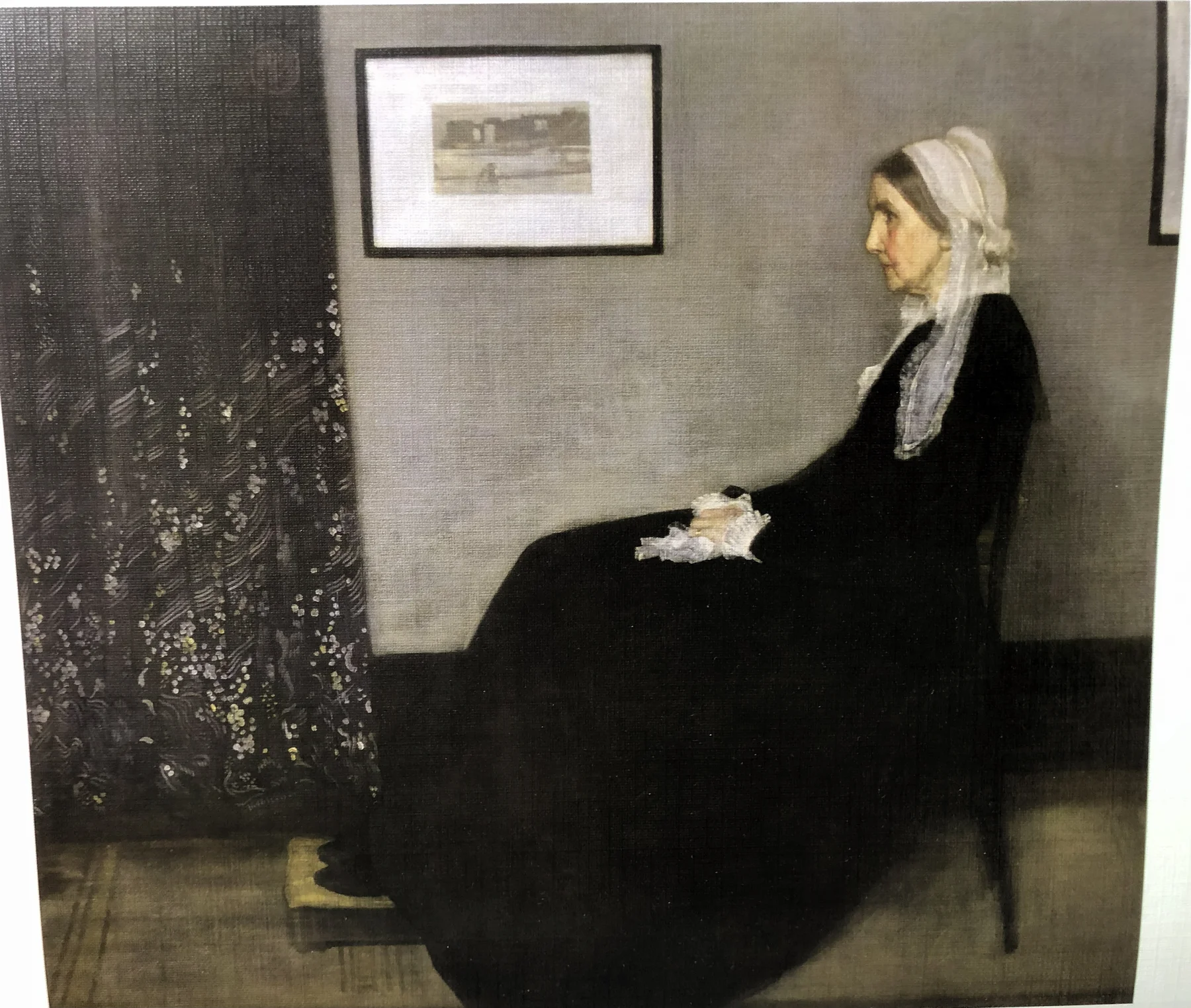
ARRANGEMENT IN GREY AND BLACK NO. 1 (PORTRAIT OF THE ARTIST’S MOTHER)
James McNeill Whistler
- Artist
- James Abbott McNeill Whistler (1834–1903)
- Date
- 1871
- Dimensions
- 144.3 x 162.5 cm
- Medium
- Oil on canvas
- Location
- Musée d'Orsay, Paris, France
Painted in dark colours on the basis of precise observation, with finely nuanced tones of grey and black, Arrangement in Grey and Black No. 1 is one of the most famous works by an American painter who did not even live in the United States. Whistler’s picture, better known as Portrait of the Artist’s Mother, is one of the most important paintings of the late 19th century.
A Simple Subject
The model for Arrangement in Grey and Black No. 1 was Whistler’s mother. Whistler said that he wanted not merely to depict her face on a particular day but also to give her a kind of dignity. More importantly, he wanted to distance himself from any sentimentality about the subject of the picture. He did not consider his feelings essential, so he “stripped the picture of all significance”, as he later put it. From the painter’s point of view, then, it does not matter whether we see an anonymous mourning woman in the picture or the artist’s mother.
Emphasising that he was interested in the aesthetic quality of his works rather than their subject, Whistler unusually gave his paintings the titles of musical genres, such as harmony, symphony or nocturne. The White Girl (1864), for example, is accordingly Symphony in White No. 2. Similarly, The Falling Rocket (1878) is also titled Nocturne in Black and Gold.
If the painting is not about the artist’s mother, and we want to know what Whistler wanted to express with the portrait, we need only look at the painting’s original title: Arrangement in Grey and Black No. 1. The artist’s aim was to take further what he had learned while studying masters such as the great portrait painter Velázquez. Whistler showed an extraordinary interest in the science of colour. In the 1860s he made many studies using different shades of white; by 1871 he had perfectly mastered the techniques of painting with different shades of grey and black too. Whistler also wanted to convey a special musical mood in his paintings.
A Tonal Composition
In this restrainedly simple portrait Anna McNeill, Whistler’s mother, sits impassively, her hands folded in her lap and her feet resting on a footstool. Her dress is black, and she wears her hair drawn back under a white lace cap. Although Whistler painted his mother in profile, like a relief, the artist nevertheless managed to capture the sitter’s personality — the old woman seems somewhat stern but dignified. Although Whistler wanted to keep us from forming an opinion about the sitter, a tender, extremely human portrait of his mother becomes evident to us. And in this special Whistler picture the mood and the manner of painting fit the subject perfectly.
Looking at the picture, we can observe the folds and creases of the black dress, but we can also see how carefully Whistler painted the pale grey background of the wall surrounding the figure. The figure standing out sharply from the dull, evenly toned surface is a hallmark of Whistler’s style. Although broken by the grey, finely patterned curtain, the skirting board below and the two pictures carefully framing the figure, the entirely grey background is nevertheless practically empty.
Strict Harmony
The artist uses restrained colours and pale tones to create a harmonious unity in this tightly composed study in shades of grey and black. Whistler studied painting under Charles Gleyre in Paris, where he was strongly influenced by the pictures of the French realist painter Courbet, and later by the works of Velázquez, above all his portraits. Although the title of Whistler’s picture is musical and Impressionist, the technique itself recalls realism. The detail of the print on the wall proves that Whistler painted very realistically but changed the colours to subdue the painting, thereby creating a strict harmony of grey, black and white.
Exhibition No. 1
Whistler painted the elegant Arrangement in Grey and Black No. 1 in 1871. It was first exhibited at the Royal Academy in London the following year. The French government then bought it in 1891 for the Musée du Luxembourg for 4,000 francs. It was once exhibited in the Louvre too, and it can now be seen in the Musée d'Orsay in Paris. In 1994–95 the National Gallery of Art in Washington, the Tate Gallery in London and the Musée d'Orsay jointly organised a major retrospective of Whistler’s works — and this famous portrait was also shown.
An Artistic Friendship
The English Impressionist Walter Sickert (1860–1942) met Whistler in England as a young man. Whistler invited him to become his assistant in 1882, and in 1883 sent him to Paris to accompany the painting Arrangement in Grey and Black No. 1, since that year it was exhibited at the Paris Salon. Whistler gave him letters of introduction to the famous painters Manet and Degas, thus creating a great opportunity for the young artist.
- Velázquez
- Whistler’s picture, Nocturne in Black and Gold
- Courbet’s painting had an enormous influence on Whistler