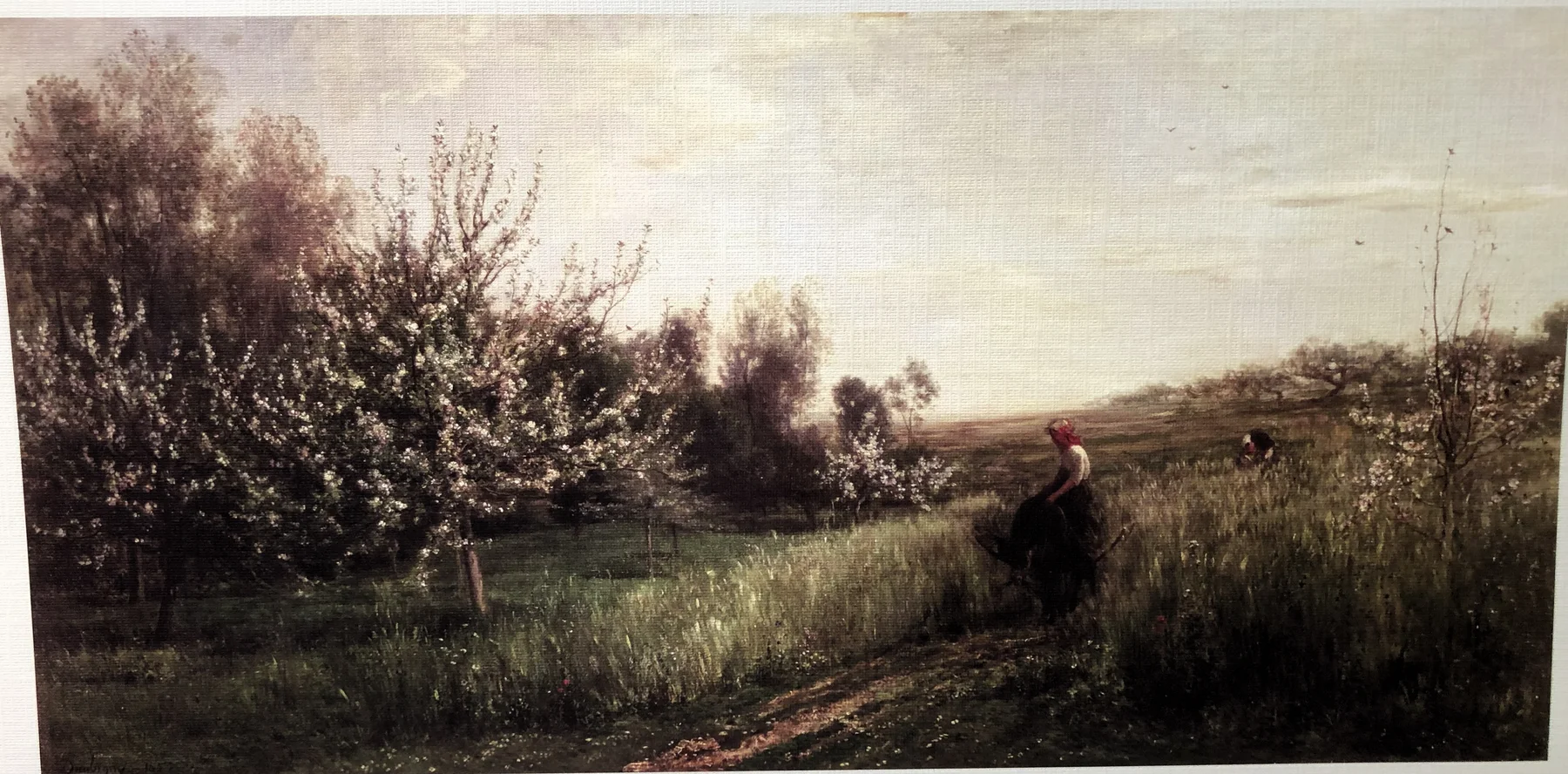
SPRING
Charles-François Daubigny
- Artist
- Charles-François Daubigny (1817–1878)
- Date
- 1857
- Dimensions
- 96 x 193 cm
- Medium
- Oil on canvas
- Location
- Musée des Beaux Arts, Chartres, France
Charles-François Daubigny was a talented French painter who played a significant part in the development of 19th-century landscape painting. His peaceful landscapes of simple beauty formed a link between the classical naturalism represented by Corot and the next generation of landscape painters associated with the names of Monet and Sisley, the Impressionists, who placed the emphasis on presenting the transience of phenomena in their depiction of nature.
Greater Freedom
In 1857 Daubigny made a trip on the River Oise aboard Le Botin, a small ferryboat converted into a covered, floating studio. This was the first such trip, followed by many more on the Seine, the Marne and the Loire, as he painted riverside scenes. This change in his working method gave him greater freedom of movement and at the same time opened a new, distinctive period in his development as a landscape painter.
Thanks to this artistic freedom he could work as he pleased directly in nature, in places that would otherwise have been difficult or awkward to find. He moored his boat and then chose a favourable vantage point on the riverbank — as he did for his painting River Scene with Ducks (1859), in which Le Botin can clearly be seen — or walked with his equipment until he found a suitable spot in the area. Although we do not know exactly where it was made, Spring, painted in 1857, depicts a simple village scene, an orchard bordered by a footpath.
Spring in Paris
Spring was first shown at the Paris Salon of 1857, and in the same year it was bought by the Minister of the Interior for 3,000 francs. In 1874 Spring entered the French National Museum and later became part of the Louvre collection in Paris. The painting was then transferred to the collection of the Musée d'Orsay before moving to the Musée des Beaux-Arts in Chartres.
Short Brushstrokes
Daubigny was influenced by landscape painters such as Corot, which is clearly reflected in the carefully worked depiction of nature in his early works. By 1852, however, he was already criticised for his superficial technique and sketchy details, which marked a gradual shift in the style of his landscapes. By the time he painted Spring in 1857, Daubigny was one of the landscape painters who tried to capture the fleeting moments of nature on canvas, taking an important step towards Impressionism, the dominant art style of the late 19th century. Daubigny’s short, quick brushstrokes, light tones and scenes that then seemed unfinished helped create a more evocative atmosphere in his seemingly simple depictions of beautiful French landscapes.
A Natural Feeling
In 1857 a critic praised Daubigny’s work with these words: “he imitates nature with his soul”. Spring expresses Daubigny’s sincere feelings for the French countryside through the depiction of a seemingly dull, uninteresting landscape with a huge pale blue sky and drifting clouds. The blossoming apple trees on the left signal the arrival of spring. The line of the treetops and the path bordering the orchard point to the main figure of the painting, a young peasant girl riding on the back of an ox or donkey. Further away, following the line of the path, a vaguely outlined figure bends down to pick something up from the ground. In contrast to monumental, wide-panorama landscapes, Daubigny preferred more restrained, intimate rural genre scenes. With yellow and short, delicate vertical brushstrokes he highlights the tips of the grass lining the footpath, lit by a weak ray of spring sun, while bright white dots of paint of various sizes lend depth to the blossoming trees. Daubigny later returned to the subject in Apple Blossom (1873) and Orchard in Bloom (1874).
A Creative Friendship
According to contemporary records, Daubigny met Jean Baptiste Camille Corot (1796–1875, pictured) in 1852. Both were committed to landscape painting and shared a great passion for nature. Corot, “the poet of the landscape”, consciously worked from nature; by his own account he sought first form, then tonal values and harmony, and finally colour. Daubigny formed a close friendship with the older artist, and they went on several painting tours together. When Daubigny died in 1878, in accordance with his last wish he was buried next to Corot in the famous Père Lachaise cemetery in Paris.
- Daubigny: On the Loire
- Musée des Beaux-Arts in Chartres
- Daubigny: The Seine at Mantes