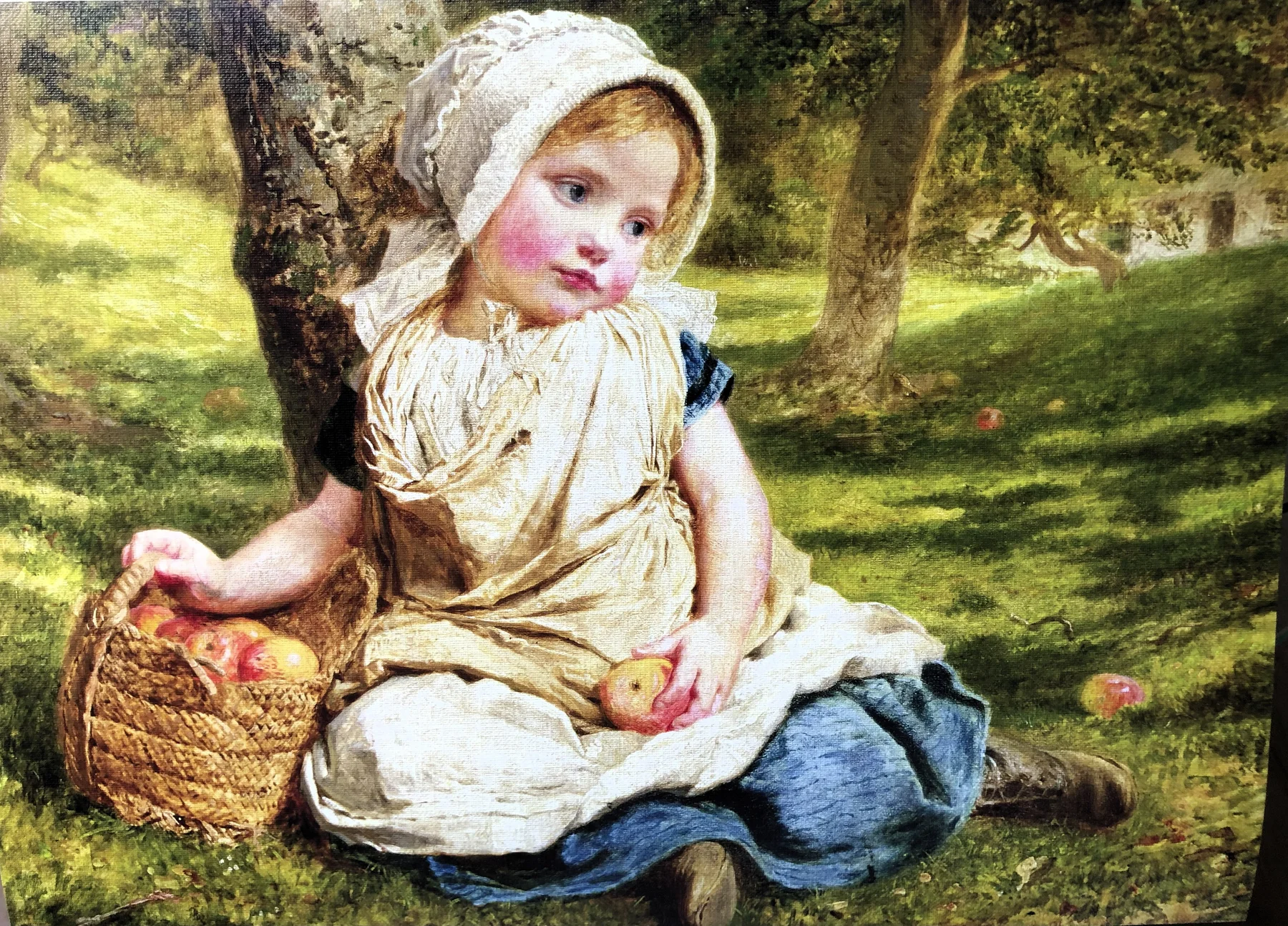
FALLEN FRUITS
Sophie Anderson
- Artist
- Sophie Anderson (1823–1903)
- Date
- c. 1855
- Dimensions
- 43.2 x 53.3 cm
- Medium
- Oil on canvas
- Location
- Private collection
A masterpiece of Victorian child-portrait painting, Fallen Fruits is a sentimental picture that amazes the viewer with its unparalleled detail and dazzling colours. The rosy-cheeked little girl gathering apples in the picturesque orchard was a characteristic figure of the nostalgic scenes of everyday life that enjoyed great popularity in Victorian England.
A Country Girl
Sophie Anderson (née Gengembre) was born in Paris, the daughter of a French architect and his English wife. She spent most of her childhood in the French countryside; even then she loved to draw. Largely self-taught, she planned to study portrait painting in Paris, but this was prevented by the revolution of 1848, from which she fled with her family to America, where they settled. Anderson’s special attention to rural landscapes and botanical details shows in most of her paintings. Most of her pictures depict children and women in idyllic outdoor settings.
A Photographic Style
If we examine Fallen Fruits, one of the first things that strikes us is the meticulous precision with which Anderson painted every detail of her picture, from the weave of the little girl’s basket and her worn shoes to the gnarled bark of the tree trunks and the tips of the blades of grass. She was known to take great care over the vivid depiction of drapery, as can be seen perfectly in the creases of the little girl’s dress. Since the artist strove to present nature as lifelike as possible, critics associated her with the Pre-Raphaelite painting movement, which was becoming increasingly popular in the 1850s.
Sentimental Charm
Pictures evoking nostalgia for childhood were particularly fashionable in the Victorian era; Anderson’s success lay in her ability to combine technical precision with deep emotion. In Fallen Fruits the freshness and innocence of youth radiate from the charming little girl’s longing expression. The patches of light filtering through the trees give her skin an almost saint-like glow. Her figure perfectly embodies idyllic childhood and the Victorian ideal of girlhood: idleness, obedience and beauty.
A Pair of Paintings
Anderson painted Fallen Fruits around 1855, a year after moving from America to England. Around 1849 in America she had married a moderately successful English painter, Walter Anderson. The dates of Sophie Anderson’s works are hard to pin down, since she rarely changed her style, but critics believe that she painted Fallen Fruits at roughly the same time and from the same young model as No Walk Today, which we know for certain she finished in 1855.
Fallen Fruits is usually regarded as the rural companion piece to No Walk Today. The latter depicts a child from a well-to-do family dressed in fashionable clothes, looking sadly out of the window of their home because the rainy weather has prevented her walk. By contrast, in Fallen Fruits the little girl can wander freely among the apple trees in the bright sunshine. She wears a light dress, and her cheeks are flushed from the fresh air. The artist depicted both little girls in the same pensive pose, looking down to the left, but there is no question which of them she thought had the more enviable life.
Artistic Connection
Anderson’s precision, her sensitivity to small details (especially in depicting nature) and her nostalgic choice of subject relate her to the Pre-Raphaelite painters. The art movement, which began as a secret “brotherhood” and reached the height of its popularity in the 1850s and ’60s, was founded by Dante Gabriel Rossetti (pictured with his family), William Holman Hunt and John Everett Millais in response to the frivolous art of their time, which they traced back to the theatrical style of the Italian Renaissance painter Raphael. The Pre-Raphaelites wanted to return English painting to a “true depiction of nature”. They paid great attention to every small detail of their paintings — from foreground to background — used vivid, pure colours, turned to more serious romantic or religious subjects and always painted from direct observation.
- The French Revolution of 1848
- Walter Anderson: Stitching