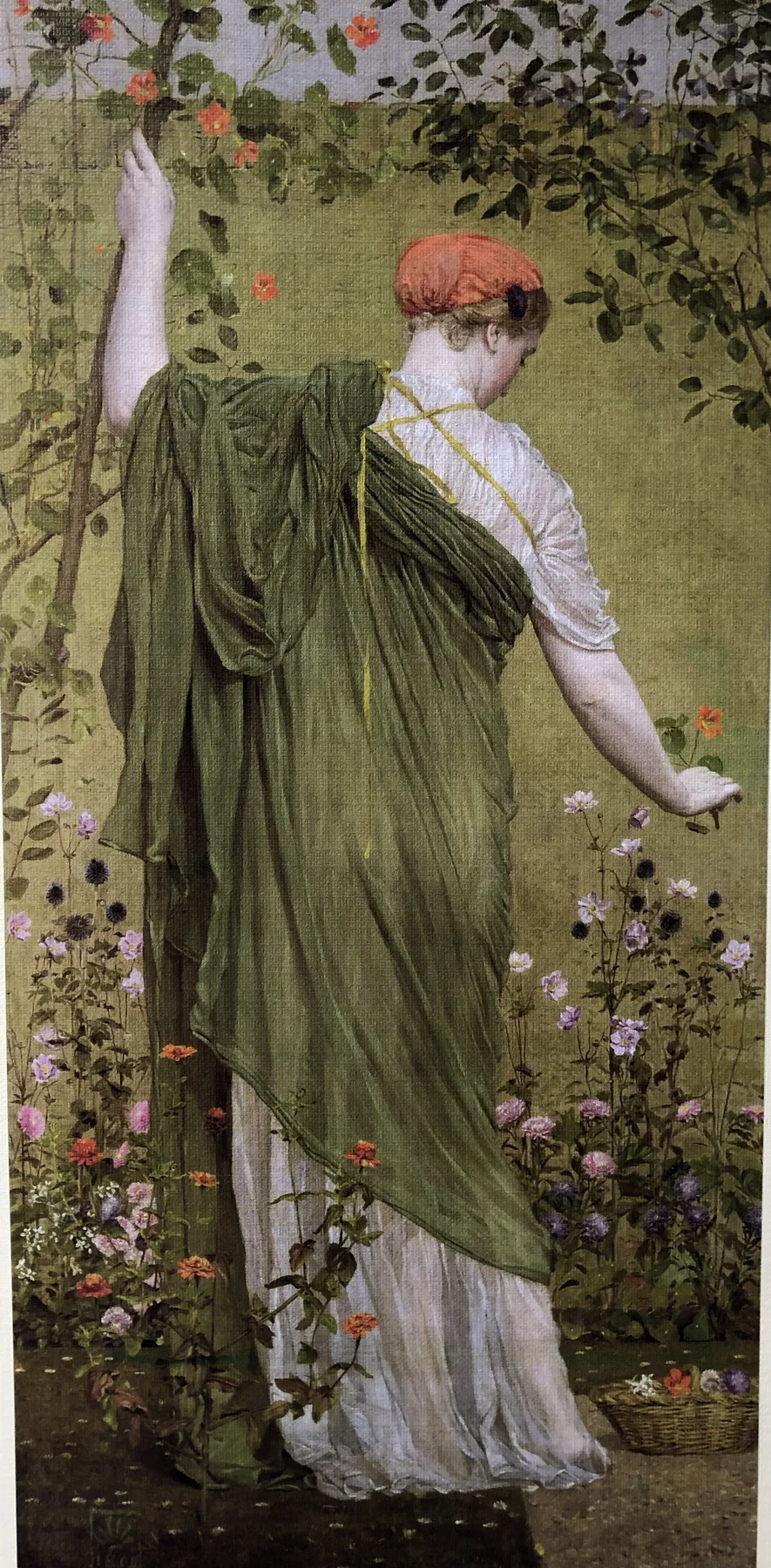
A GARDEN
Albert Moore
- Artist
- Albert Moore (1841–1893)
- Date
- 1869
- Dimensions
- 174.6 x 87.9 cm
- Medium
- Oil on canvas
- Location
- Tate Britain, London, United Kingdom
Moore was one of the mysterious and controversial personalities of the art world in the mid-19th century. The avant-garde artists of the time regarded him as a misunderstood genius, while others simply saw him as an excellent painter who liked to depict dreaming young women in classical settings; the best example of this is his painting A Garden. Moore, however, was much more than a creator of delicate, elegant pictures. Throughout his life he devoted his artistic energies to the search for ideal beauty, wanting to discover the secrets of aesthetic perfection and record them on his canvases.
Art for Art’s Sake
Moore came from a large family of acclaimed artists and craftsmen and had exceptional creative abilities from a young age. He was an original thinker; in his mid-twenties he formed radical theories about the role of art.
Moore believed that the two main requirements of art were beauty and decorativeness. Unlike the paintings of his time, his pictures contained no biblical or literary references, told no stories and carried no moral messages. In the words of the Victorian poet Swinburne, his works were “confined to the worship of beautiful things simply because they exist.”
Classical Inspiration
As in Moore’s best-known paintings, the influence of ancient Greek art can be clearly felt in A Garden. Moore was a great admirer of Phidias’ Parthenon sculptures, which had come to the British Museum early in the century through the intervention of Lord Elgin. The painter regularly went there to see them. He drew the figures enthusiastically, and in ancient Greek sculpture he was particularly captivated by the glorification of female beauty. He delighted in the falling lines of the statues’ drapery, which symbolised the artistic beauty he tried to depict in his paintings. Those who visited his studio in Fitzroy Street in 1869 could see models in floating robes playing badminton, while Moore made sketch after sketch of their graceful movements.
Aesthetic Considerations
As the sketches and notes for A Garden and the full-size cartoon of a nude show, Moore worked out a system of right angles, interlocking curves and diagonal lines, a kind of geometric ideal, for his painting. He adjusted his female figure to this ideal; he changed the acute angle formed by her left arm into a right angle.
Since his youth Moore had an excellent feel for mathematics and geometry. As a teenager he worked as a technical draughtsman with a family friend, and later he took on several architectural decoration jobs. The geometric rules of technical drawing helped him develop the system also reflected in his paintings.
A True Perfectionist
Even as a small child Moore strove for perfection. According to one of his biographers, at the age of four he “could copy the leaves of any plant and repeated the drawings until he could complete the picture from memory.” When he began painting, he first made thorough studies of his figures and the drapery they wore, then created the full-size cartoon, which he reworked according to his “ideal” aesthetic theories. This thorough planning allowed him to paint quickly and deliberately. Later he advised his pupils: “If necessary, think for an hour about a single brushstroke, but put it on the canvas the moment your decision is made.”
The Unrecognised Genius
Moore did not think it important to explain his ideas, so many of his contemporaries did not understand his art. His pictures were shown only reluctantly at the Royal Academy exhibitions (he was never admitted as a member of the institution), and even then in obscure corners or, in the case of his ambitious painting of 1866, The Shulamite, at an unreachable height above a door. When Moore died in his London studio in 1893, his family and close friends resented how little recognition he had received during his life. A few months after his death an exhibition of some hundred of his paintings and drawings was held at the Grafton Gallery in London, announced as follows: “a tribute… in view of the great loss English art has suffered.”
Artistic Connection
In the mid-1860s in London Moore met the American-born painter James Abbot McNeil Whistler (1834–1903). Their friendship was surprising, since the notoriously sharp-tongued and aggressive Whistler was Moore’s opposite. The two painters held similar views on many artistic questions, among them that art should exist for its own sake rather than carry literary or moral ideas.
- One of the Elgin Marbles
- A biblical painting by Moore: The Shulamite (1864–66)