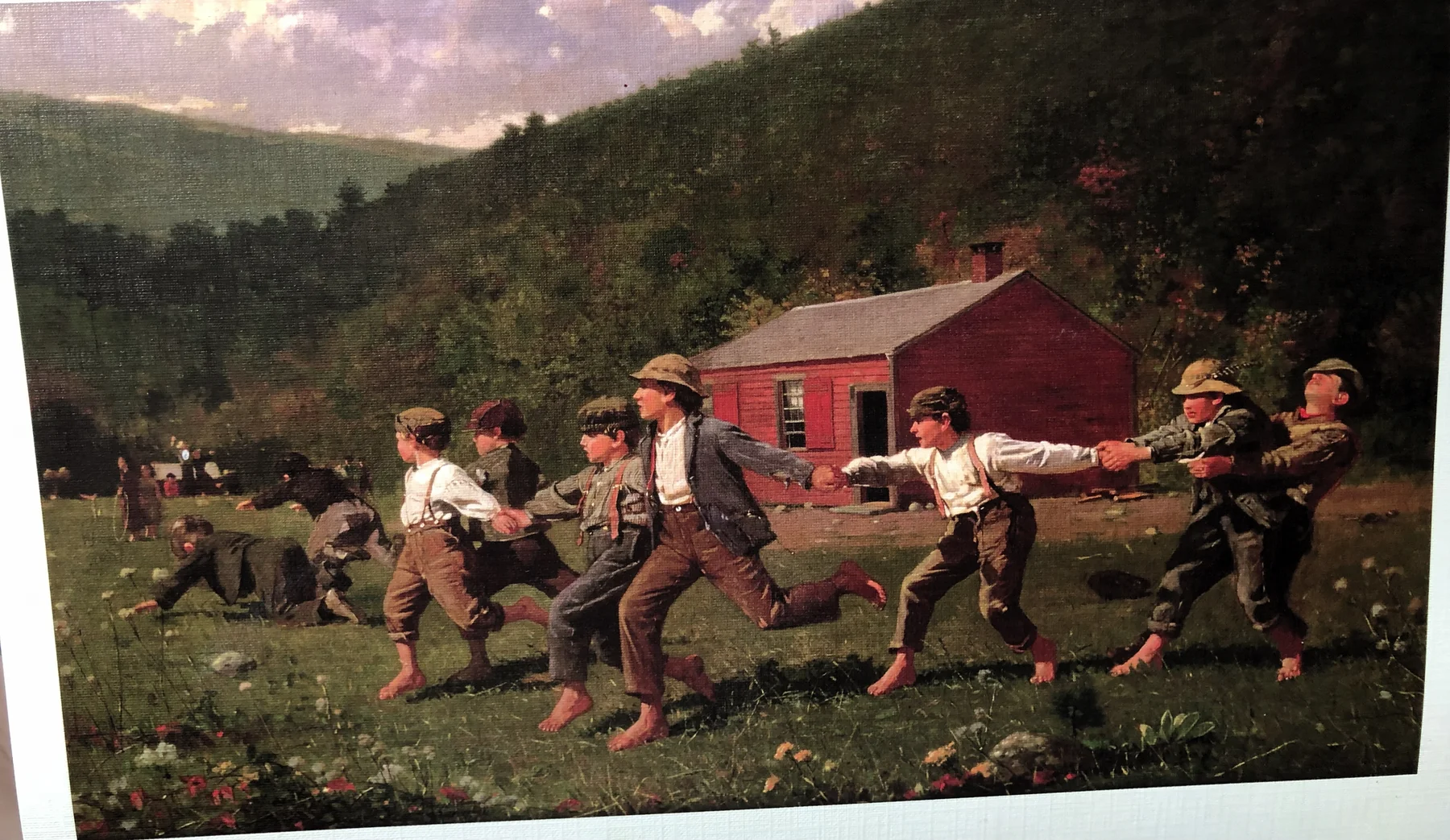
SNAP THE WHIP
Winslow Homer
- Artist
- Winslow Homer (1836–1910)
- Date
- 1872
- Dimensions
- 56.5 x 92.7 cm
- Medium
- Oil on canvas
- Location
- Butler Institute of American Art, Youngstown, Ohio, USA
Radiating childish innocence and rural charm, Snap the Whip is one of the best-loved paintings in America. “There is a captivating freshness in its sincerity and naturalness,” one critic said of it. A realist to the core, Winslow Homer was an excellent observer who also filled his paintings with content. “When you paint, try to put down exactly what you see,” he once told a young, aspiring fellow artist. “Whatever else you have to offer will come out anyway.”
On the Ground of Realism
Homer’s realism owed much to his training as a commercial illustrator. The artist grew up in Cambridge, Massachusetts, and served a three-year apprenticeship in a lithographic workshop. In 1859 he chose the freelance life in New York, where he soon made illustrations for the newly founded Harper’s Weekly magazine. At the magazine he could develop his skills by creating simple yet effective compositions, thanks to the printing process using wooden blocks, which allowed images to be produced in large numbers. Homer’s tasks included designing the patterns for the woodblocks, which craftsmen carved and put under the press.
War and Change
In 1861 Harper’s Weekly commissioned Homer to record the Civil War in pictures. One of his most successful war oil paintings, Prisoners from the Front (1866), is a powerful portrayal of character using classical frieze motifs.
In the post-war years a nostalgic mood pervaded the nation’s art and literature, often expressed in depictions of childhood experiences, such as Mark Twain’s Tom Sawyer and Louisa May Alcott’s Little Women, or many of Homer’s pictures, such as The Country School (1871), Noon Recess (1873) or Boys in a Pasture (1874). The 1870s brought enormous social changes in America. The rural way of life was finally replaced by urbanisation, and transport developed by leaps and bounds. In this dizzyingly rapid transformation, painters who depicted simple rural life found a receptive market for their works.
The Game
We do not know where the scene in Snap the Whip takes place. It could be Long Island or upstate New York, or equally the Adirondack Mountains, one of Homer’s favourite places. In fact the location does not matter; Homer is interested here not in topographical details but in a universally valid reality.
In front of a small country school a group of boys plays a lively outdoor game. Holding hands, the participants try to break the weakest link out of the line. Homer arranged the children in three separate groups: the three boys on the right try to stretch the line, the four in the middle resist tightly, while the two tumbling on the left have already dropped out of the game.
Behind the boys, in front of the tree-covered hillside, stands the schoolhouse. With the two stiffly posed girls in the background — who have evidently not been included in the game — the artist alludes to more than just the male-dominated society of his time. The motionless background, recalling pastoral scenes, creates a dynamic contrast with the boys’ energetic line.
Several pairs of opposites act on the viewer in the composition: movement and stillness, power and rebellion, freedom and restriction, inclusion and exclusion. The boys’ line might even symbolise the reunited nation: it must move forward together, in harmony, without the danger of discord and dropping out. The line of boys recalls ancient friezes; the artist realised their arrangement and postures with the greatest possible geometric precision.
The Genius of Light
As is typical of Homer’s paintings, the sun here too is high in the sky, drawing sharp, firm outlines around the relief-like figures. Homer preferred working outdoors to working in his studio and had an excellent feel for rendering effects of light and shadow. On one occasion he put it this way: “Outdoors the sky is one source of light, to which are added the light reflected from objects and the direct light of the sun: in this flood the details almost merge.”
From the date of the painting we can suspect the influence of contemporary French painters. During his trip to France in 1866–67 Homer lived in Paris, where he could see the works of another realist painter, Courbet, and perhaps also the pictures of Manet, another master of the depiction of light. Although Homer’s art shows certain affinities with the Impressionists — he liked to paint what he saw, not what he knew — he differed completely from them in his conception of light. While for the Impressionists light gives form, for Homer it follows form, obeying the mass and precise outlines of objects.
“Almost Crudely Simple”
The cheerful mood of Snap the Whip worked like a balm for most Americans, but not for everyone. The famous Anglophile writer Henry James criticised the painter harshly: “[Homer] is almost crudely simple, repellent to our eyes, and yet we like something in him. What is it? For us it is not his choice of subject… He presents the least characteristic details of the least interesting landscapes and confidently treats them as if he were laying before us a picturesque view, a panorama of Capri or Tangier, and his perseverance is undoubtedly crowned with success.”
Just as Snap the Whip depicts rural America at the peak of social change, so it marked a turning point in Homer’s own life. The following year he switched to watercolour, whose use he likewise developed to a high level.
- Homer: Prisoners from the Front
- Homer’s woodblock
- Adirondack Mountains
- Henry James