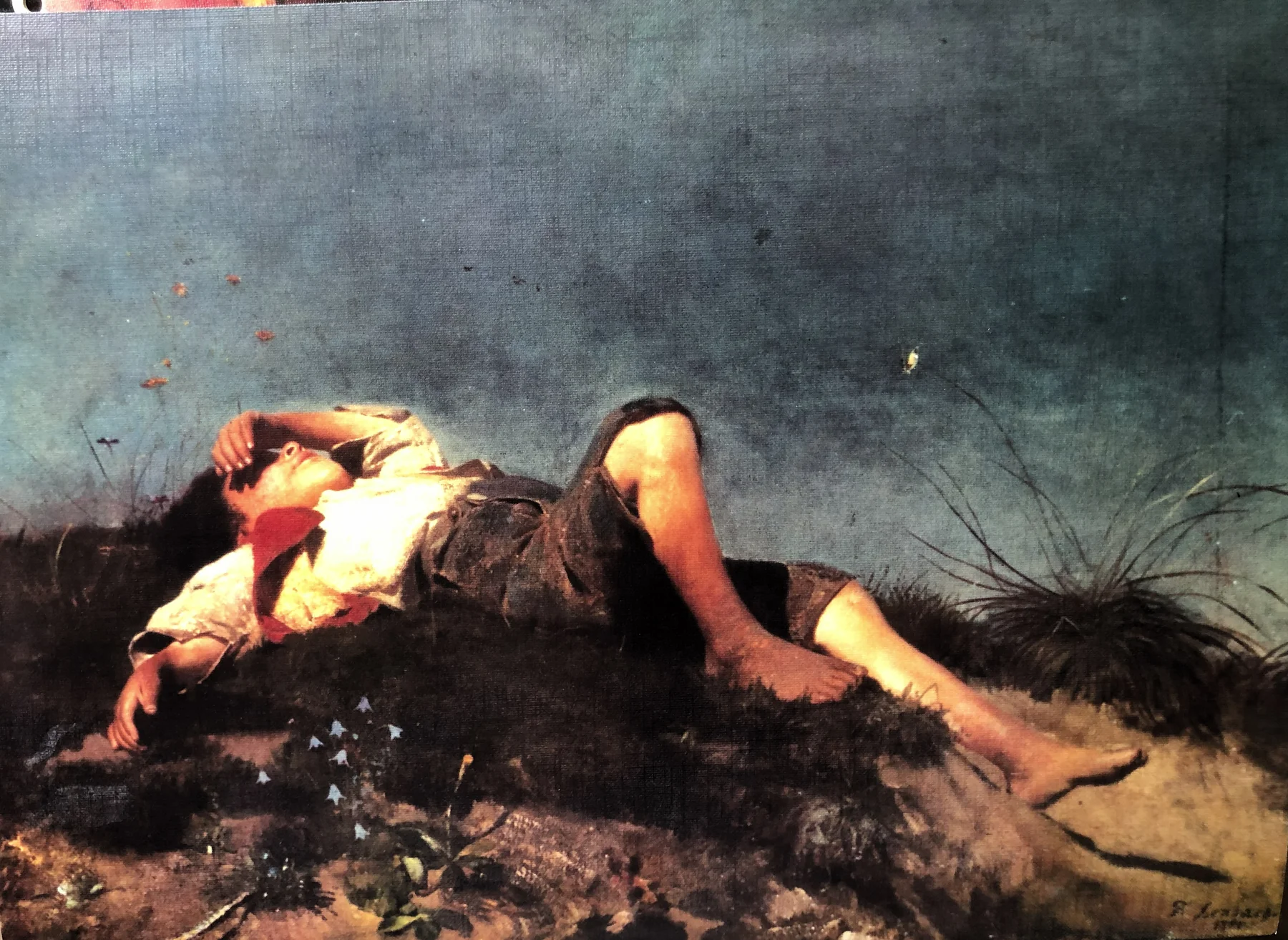
SHEPHERD BOY
Franz von Lenbach
- Artist
- Franz von Lenbach (1836–1904)
- Date
- 1860
- Dimensions
- 107.7 x 154.4 cm
- Medium
- Oil on canvas
- Location
- Schack Gallery, Munich, Germany
At the beginning of his career Franz von Lenbach painted several summer landscapes depicting peasants and shepherd boys during his travels in Italy and in his home region around Schrobenhausen in Bavaria. None of them, however, captures the poetic beauty of a hot summer day as perfectly as this picture of a little boy lounging on a grassy hill. The sun beats down from the dazzlingly clear blue sky, a gentle breeze stirs the grass and wildflowers, and insects buzz overhead. The boy lies on his back on the ground, one arm stretched limply to the side, the other shading his eyes from the rays as he gazes dreamily at the sky. The painting radiates warmth, peace and heavenly calm.
Early Style
Lenbach painted Shepherd Boy in 1860, at the age of 24, after a trip to Italy with his teacher at the Munich Academy, Karl Theodor von Piloty. On the basis of the series of open-air oil paintings and pencil sketches made there, he painted this picture and other works after returning to Germany.
The young Lenbach was introduced to plein-air painting, that is, working outdoors instead of the traditional studio work, by an artist friend of his elder brother, Johann Baptist Hofner. From the age of 16 Lenbach spent every summer drawing and sketching in Hofner’s company under the fresh, open sky of the Bavarian countryside. This experience also played a part in shaping his early painting style, when he drew inspiration from the poetic beauty of nature.
Shepherd Boy is the high point of Lenbach’s early artistic career and in a sense also its final station. Shortly afterwards he switched to an entirely different style and subject. He exchanged his palette rich in vivid colours for darker, more sombre shades and began copying the works of the old masters Titian, Veronese and Velázquez. From 1868 he turned to portraiture and became one of the most famous portrait painters of his time.
Genuine Charm
The appeal of Shepherd Boy stems largely from its serene realism. Lenbach was regarded as a forerunner of the renowned Munich realist school, who, using the sweeping, flowing brushstrokes and rich palette characteristic of the movement’s style, created strongly realistic works that were also rich in elements of mood. He spent a long time in front of the canvas, changing the colours and shades several times. Every detail of the picture was worked out with great care and deliberation — the boy’s bare feet, muddy only up to the ankles, his worn clothes, the sun-bleached ochre hill and the huge sky, which Lenbach originally painted a lighter blue and then darkened at the edge of the horizon, merging into the soft grey veil of dusk.
One half of the pleasantly balanced composition is occupied by the huge summer sky, whose colour the artist applied with energetic brushstrokes and a passion for colour. The blue of the sky is echoed in the delicate petals of the wildflowers in the foreground. The soft curve of the boy’s body follows the arc of the grassy hillside from left to right. The limbs too radiate a kind of lazy charm, right to the tips of the fingers and toes.
A Wealthy Patron
Lenbach showed Shepherd Boy at the international exhibition in Munich in 1863, where it was criticised somewhat for its “commonplace realism”. Shortly afterwards the painting was bought by an influential figure of literary life, the renowned collector Count Adolf Friedrich von Schack. Schack made it his main aim to support lesser-known and (in his view) undervalued artists of the time, and bought only works by German-speaking painters. Shepherd Boy was an unusual acquisition, since Schack rarely appreciated “realist” pictures, but perhaps he was taken by the poetic charm of this painting. He wrote of the picture: “life unfolds before our eyes in the grass and among the flowers on a sultry summer day… as if we could see and feel the blinding light of the sun and wanted to join the boy to experience the warmth of the midday sun’s rays.”
In the same year Lenbach received his first major commission from Schack: he was to make copies of paintings by old masters. Fulfilling the request, he returned to Italy and Spain, and this work occupied him until 1868. Several of the copies are still part of the Schack Collection and are masterpieces in their own right. After Schack’s death in 1894 the collection passed to the German Emperor Wilhelm II; today it is owned by the Bavarian state and exhibited in the Schack Gallery in Munich.
- The Red Umbrella, one of Lenbach’s summer landscapes
- Johann Baptist Hofner: The Shepherdess
- Schack Gallery