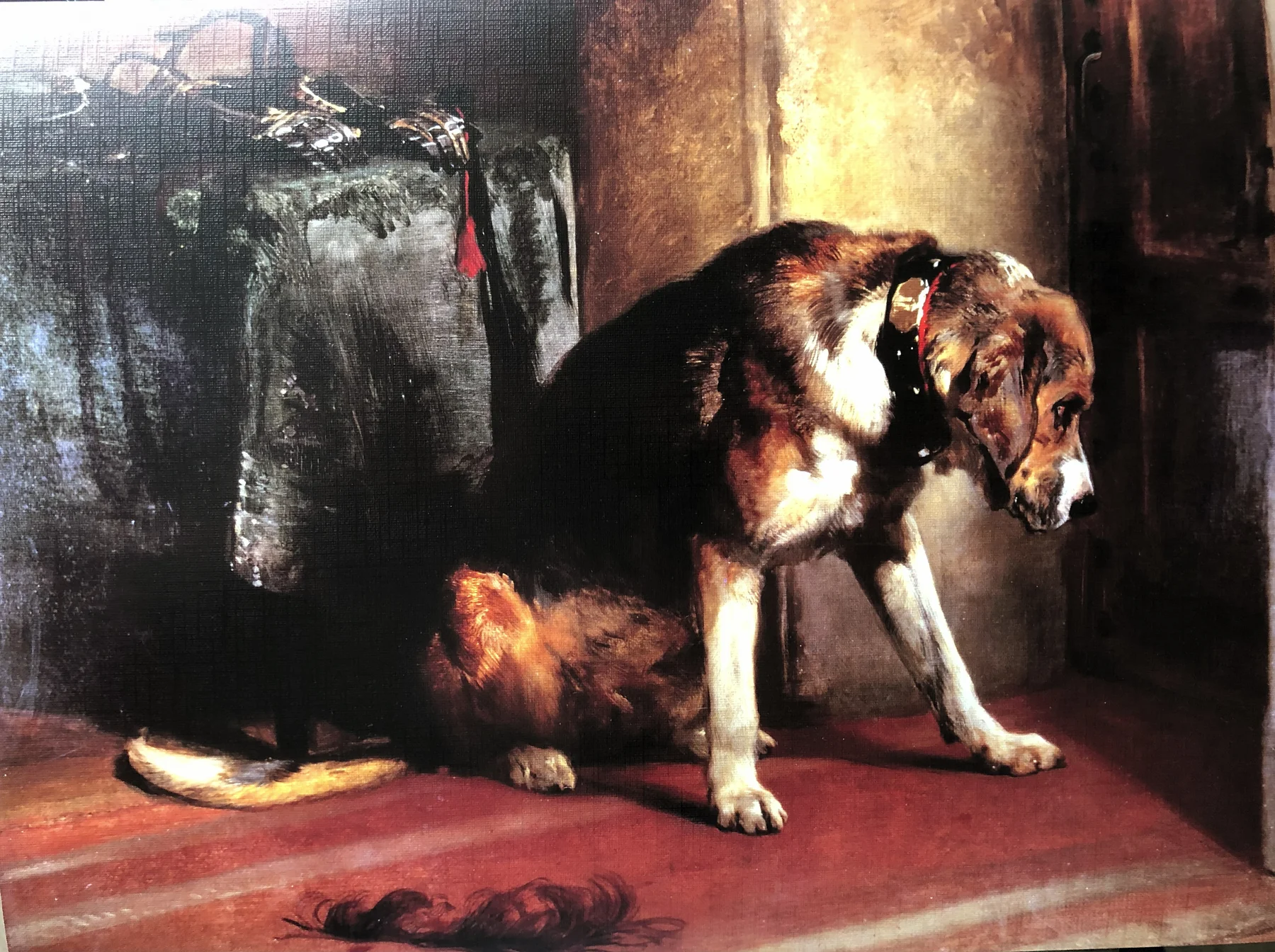
SUSPENSE
Sir Edwin Landseer
- Artist
- Edwin Landseer (1802–1873)
- Date
- 1834
- Dimensions
- 69.8 x 90.8 cm
- Medium
- Oil on panel
- Location
- Victoria and Albert Museum, London, United Kingdom
Edwin Landseer, whose artistic talent was evident even in childhood, was once one of the most famous figures of British artistic life. Today his animal portraits seem somewhat sentimental, but in the mid-19th century his pictures of domestic and wild animals enjoyed great popularity, and Landseer was Queen Victoria’s favourite painter.
Painter of Royal Pets
Edwin Landseer will always be remembered as an animal painter, but his outstanding artistic talent also made him capable of changing style: he painted historical scenes and landscapes and also excelled in sculpture and engraving. Queen Victoria was particularly enchanted by the painter’s almost uncanny ability to evoke the spirit and character of her pets. Landseer made many such pictures, painting among others Victoria’s little spaniel Dash and Albert’s Italian greyhound, Eos. Landseer was also the creator of the painting Windsor Castle in Modern Times, a cheerful picture of the royal couple from the early period of their marriage. This family portrait shows the royal couple in the company of their pets. In the picture the calm, happy royal couple is seen at home with their first child, the Princess Royal, “Vicky”, and their beloved dogs.
Man’s Best Friend
When Landseer painted Suspense and many of his other animal pictures, he wanted to project a special sense of virtue and nobility onto the animals. In this period of British art so-called genre painting was spreading. Pictures of this type usually depicted scenes drawn from everyday life and often took anecdotal forms. Landseer was an excellent storyteller, and although it seems strange today, he preferred to present these complex pictorial parables with animals. He adored animals, especially dogs, so this may have seemed an obvious choice for him. In Suspense the greyhound completely dominates the painting, which owes its dramatic effect to the characterisation of the dog. Landseer tended to endow his animals with human qualities, to “humanise” them, and wanted to show that they are capable of understanding people and have similar feelings. With the domestication of dogs they were often given human roles and regarded as members of the family — it is not unusual for dog owners to discover human traits in their pets. Knowing this, it is questionable whether Landseer really painted only what he saw.
Anatomical Studies
The English painter Benjamin Robert Haydon had a great influence on Landseer when he was learning to paint as a child. The older painter encouraged the young talent to study anatomy. By the age of 13 Landseer was already dissecting animals to develop his knowledge and understanding of their bodily structure. Landseer’s hard work as a child and his developed powers of observation paid off. By 1820 the teenage artist’s naturalistic technique was already admired by such excellent French painters as Théodore Géricault and Eugène Delacroix. Although Landseer’s brushwork in Suspense is quicker and the picture less finished than several other works, his artistic virtuosity is clearly shown in the depiction of the dog’s coat, from the dazzling patch of light on the animal’s chest to its drooping chocolate-brown ears.
A Simple Composition
Landseer was capable of creating more complex compositions too, but Suspense captivates the viewer with its charming simplicity. The artist was in the habit of giving his genre pictures witty, often sly titles to steer the viewer towards the effect he desired. Although it is titled Suspense, at first glance the painting reveals little excitement or tension. Landseer the storyteller, however, invites us to “read” the painting and provides clues for doing so. The dog sits with its neck drawn in in front of the closed door on the right. In the immediate foreground of the picture lies a plume that may have fallen from a helmet, and around it we can discover drops of blood on the carpet. The faint parallel lines of the carpet lead the eye towards the closed door, but we also notice the empty glove on the table and pieces of riding equipment. The meaning of the word “suspense” in the title becomes clearer as we realise that the dog’s master has been wounded and has probably been carried into the room behind the closed door. For the patiently waiting faithful dog time has stood still, while its master’s life perhaps hangs by a thread.
Three years later he painted one of his most famous pictures in a similar spirit, The Old Shepherd’s Chief Mourner. The Victorian critic John Ruskin described the painting as “one of the most perfect poems or pictures which modern times have seen”. Like Suspense, the composition of this painting follows the same pyramidal structure. The mourner of the title, a dog faithful even after death, rests its chin on the coffin of its recently deceased master.
- Landseer: Windsor Castle in Modern Times
- Benjamin Robert Haydon
- Landseer: The Old Shepherd’s Chief Mourner