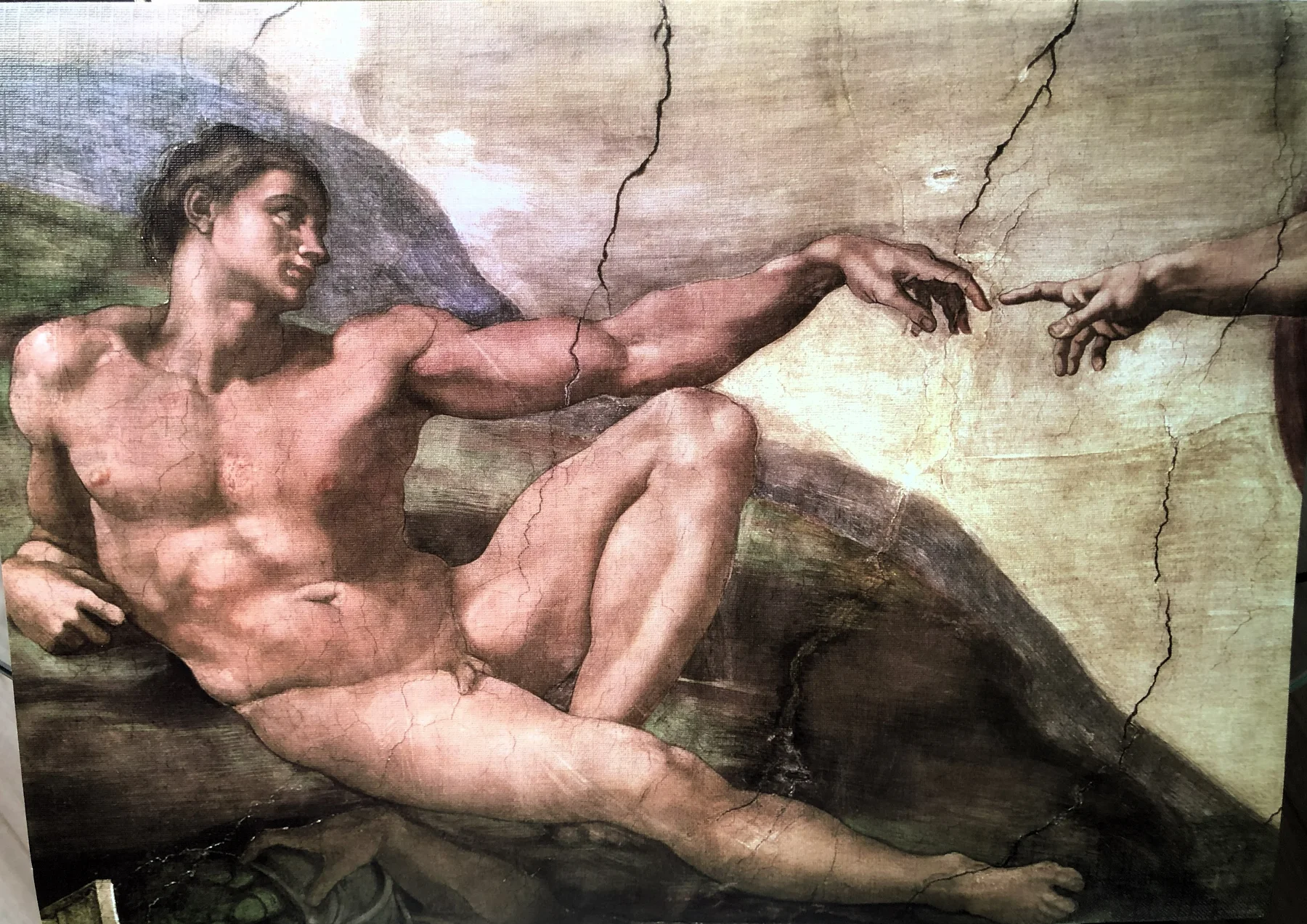
THE CREATION OF ADAM (DETAIL)
Michelangelo Buonarroti
- Artist
- Michelangelo Buonarroti (1475–1564)
- Date
- 1511 (the entire Sistine Chapel ceiling, 1508–1512)
- Dimensions
- 280 x 570 cm
- Medium
- Fresco
- Location
- Sistine Chapel (Vatican Museums and Galleries), Vatican City, Rome, Italy
A master of depicting the human body, Michelangelo had the astonishing ability to breathe life into his carefully observed figures. This can be seen in the fresco The Creation of Adam, where, with his unparalleled draughtsmanship and technique, Michelangelo recorded the moments of the creation of the first man. The image showing the moment before the fingers of God and Adam meet has become an eternal icon.
A Papal Commission
Michelangelo’s genius was recognised in his youth, and several popes provided him with commissions during his life. In 1505 Pope Julius II summoned him to Rome and commissioned him to design his tomb, but Michelangelo quarrelled with him and left the city without finishing the work. In May 1508, however, the artist and the pope met again, and Julius II offered Michelangelo a contract to decorate the ceiling of the Sistine Chapel. Instead of the original decoration depicting a starry sky, the pope envisaged a fresco showing the 12 apostles, but Michelangelo had another, more ambitious plan and asked the pope for a free hand.
Michelangelo’s masterpiece The Creation of Adam was one of nine panels telling the story of the Creation. The arrangement of the frescoes followed the architectural structure of the Sistine Chapel and grew into a work radiating complete harmony, despite featuring more than 300 figures in all.
Painting on the Ceiling
Although he had learned the technique under Domenico Ghirlandaio (1449–1494), Michelangelo had very little experience of fresco painting. Fresco is a kind of mural in which paint thinned with water is applied to fresh, wet plaster. The artist has to work quickly and accurately before the plaster dries and the paint becomes part of the wall. Moreover, the Sistine Chapel commission was not for wall painting but for ceiling painting. Once the tall scaffolding spanning the full width of the chapel had been erected, Michelangelo had to work lying on his back painting upwards, or standing and leaning back, his neck stretched for long hours. He made the ceiling frescoes single-handed over four years. When this incredible work was unveiled in 1512, the artist’s contemporaries were overwhelmed by the dazzling creation.
A Punishing Pace
Michelangelo made a detailed sketch in red chalk of every scene and figure before transferring his designs to the wet plaster of the ceiling. He painted the panels in sequence from the entrance wall of the chapel to the altar. Because of the pope’s illness and various political disputes the work had to be suspended for 14 months. When he resumed, he worked at an even more punishing pace. He finished the panel of The Creation of Adam in just two to three weeks. He worked across the picture from left to right: first he began the figure of Adam, incising the outline of his head directly into the wet plaster, then shaping the forms with firm, broad brushstrokes. He applied the paint thinned with water to the wet plaster with a brush made of pig bristles instead of the fine squirrel- or ermine-hair brush then in use.
The Hand of God
When he resumed work on the Sistine Chapel ceiling, Michelangelo decided to simplify the picture areas, so the scale of the Creation of Adam panel is larger than that of earlier depictions, such as the Flood. One of the central panels, The Creation of Adam is the most powerful and dynamic work on the ceiling, in which God creates Adam, the first man, in his own image. God, the embodiment of power and majesty, is carried across the sky by angels. His outstretched right arm and index finger urgently seek contact with Adam’s limp fingers. Michelangelo, the master of depicting the human body, paints Adam already as a developed man in the perfect form of youth, but still lifeless. Reclining in a relaxed pose, Adam seems to find it difficult to meet God’s outstretched finger. He rests his left arm on his raised left knee as he waits for the life-giving divine spark.
Despite Adam’s weak posture, the scene looks wonderfully balanced thanks to the dynamism and energy of God about to create the first man. Seen from below, The Creation of Adam immediately catches the viewer’s eye even among the other wonderful frescoes. At the centre of the picture is neither God nor Adam, but the space between their fingers, further emphasised by the mirroring of the arms reaching into the void. The recently restored ceiling shows more of the original colours — as if white light were streaming from behind the centre of the picture, illuminating the dramatic scene of creation.
Artistic Connection
The two geniuses of Florence, Michelangelo and Leonardo da Vinci, did not like each other. In 1504 a competition was announced for the two artists: each was to depict a battle scene on the wall of the Florentine council chamber. Michelangelo’s fresco design was titled The Battle of Cascina. The two artists, however, were called away by other tasks, so the frescoes remained unfinished.
- The Vatican palace housing the Sistine Chapel
- Ghirlandaio: Self-portrait
- Photograph of the ceiling with The Creation of Adam