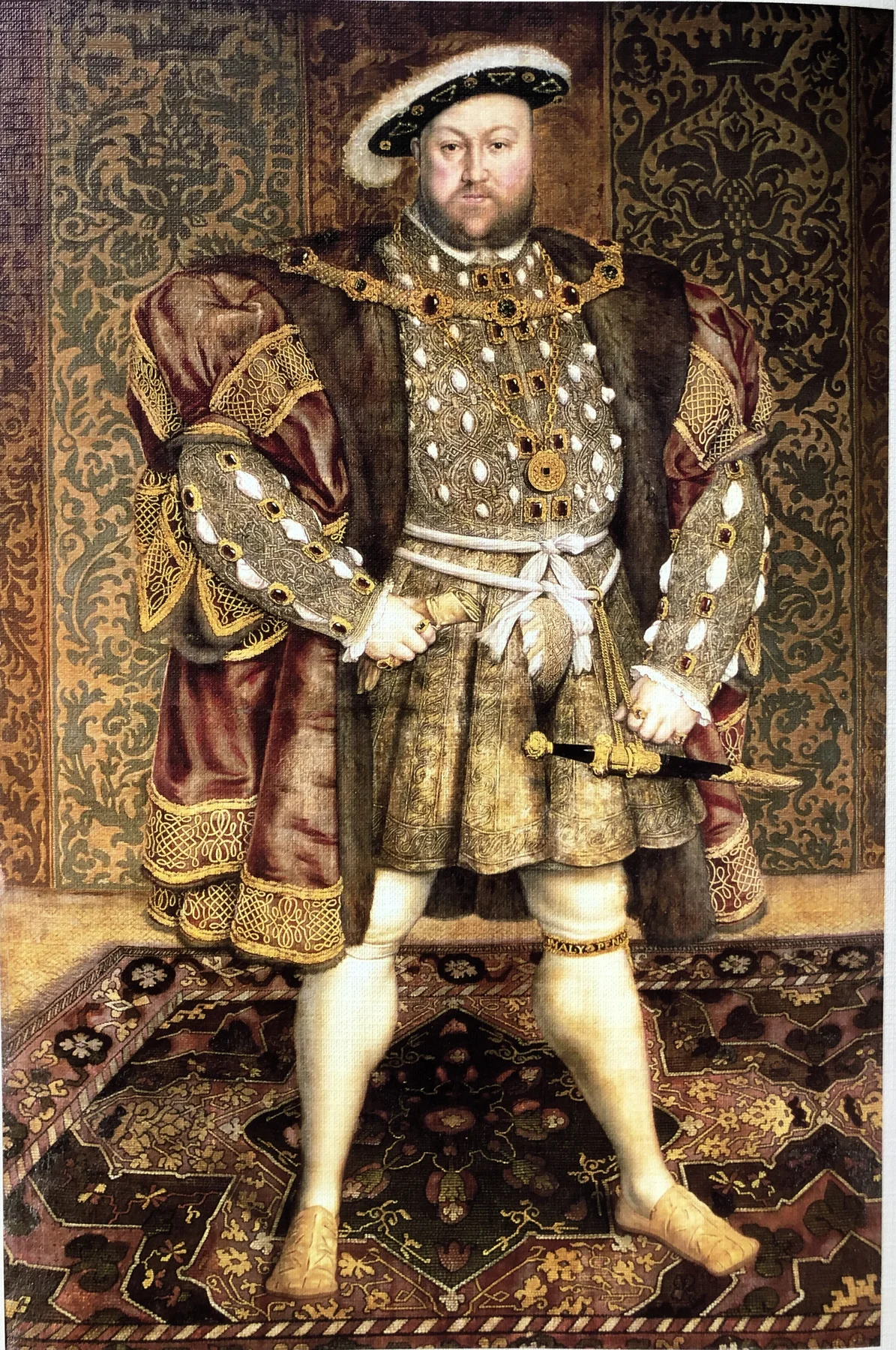
PORTRAIT OF HENRY VIII
Hans Holbein
- Artist
- Hans Holbein (1497/98–1543)
- Date
- Between 1537 and 1538
- Dimensions
- 217 x 142 cm
- Medium
- Oil on canvas
- Location
- Belvoir Castle, Leicestershire, United Kingdom
King Henry VIII of England commissioned his court painter, Hans Holbein, to make a mural of himself and his family for his privy chamber in the Palace of Whitehall in London. The picture, the first full-length, large-scale depiction of an English monarch, served the purposes of dynastic propaganda. With his wife, Jane Seymour, and his parents, Henry VII and Elizabeth of York, at his side, the king stands with hands on hips and feet firmly planted, his gaze directed straight at us, secure in the knowledge of his unquestionable power. Although the fresco was destroyed in a fire, the king’s portrait has survived in several copies. Some were painted several decades after the original. Although they differ in background decoration and details, they all present the image of an arrogant ruler radiating force.
The King Is in Trouble
The Whitehall fresco was born at a critical time. First, Henry faced widespread discontent over his religious reforms. After declaring himself head of the Church of England in 1534, he ordered the closure of the country’s monasteries (1536–40), a step that provoked the rising of 1536 known as the “Pilgrimage of Grace”. At this point, more than ever, he badly needed to restore his authority and popularity. On the other hand, there was the threat of civil war. If no male heir were born, his eldest daughter, Mary (by his first — divorced — wife, the Catholic Catherine of Aragon), could have inherited the throne. His second wife, Anne Boleyn, who had miscarried a son, was executed in 1536. In June 1537 it emerged that his new wife, Jane Seymour, was pregnant, carrying the possibility of a son and heir who could carry on the Tudor blood. Filled with these hopes, Henry commissioned the mural.
A Princely Setting
Henry’s legendary craving for wealth showed itself not only in fine clothes and jewels but also in palaces: by the end of his reign he owned fifty of them. Built as his official residence, Whitehall stretched over 9.3 hectares along the Thames. Henry’s inner sanctum was his privy chamber in Whitehall: here he wrote his letters, ate his private lunches and dinners and received his courtiers, and here too Holbein’s mural, about 2.7 x 3.6 metres, was placed. The central part of the group portrait was occupied by the image of a stone pedestal bearing inscriptions lengthily glorifying Henry VIII’s political triumphs.
A Copy for Posterity
In 1698 the painting was sadly lost in a fire, when a careless maidservant was drying clothes over an open flame. Fortunately, however, a Flemish painter, Remigius van Leemput (one of Anthony Van Dyck’s collaborators), had made a copy of the fresco in 1667. The background of Leemput’s work probably shows the Whitehall room in rich architectural detail, with recessed wall niches, gilded columns and splendid Turkish star Ushak carpets.
By then, however, several full-length portraits of Henry already existed, each depicting the king and the ornate background slightly differently. The earliest (and probably most authentic) copies are now in the collections of the Walker Art Gallery in Liverpool and Petworth House in Sussex. Painted on panels of Baltic oak, these works were probably made one or two decades after the fresco was destroyed. Several paintings date from the reign of Elizabeth I (1558–1603), while the present version — at Belvoir Castle — can be dated somewhat later, to 1610–1620. None of the copies can be linked to Holbein’s name; their only known creator was Hans Eworth, who made the versions found at Chatsworth House in Derbyshire and Trinity College, Cambridge. Why were so many copies of the painting made?
The Cult of Henry
Henry VIII probably used the first copies as diplomatic gifts. The later versions were probably commissioned by aristocrats to express their loyalty to Henry and his descendants.
In the first decade of Elizabeth’s reign the cult of Henry flared up. Elizabeth’s predecessor on the throne, Queen Mary, was a Catholic who had abolished Henry’s religious reforms (and had hundreds of Protestants executed), but now the pendulum swung back. Elizabeth again received visitors in front of the fresco in her privy chamber, and by cultivating Henry’s memory she assured people that the king’s ordinances had once again become law.
The Image of Power
Although the individual copies differ from one another, we can also discover common features, the most important of which is the king’s posture. A preparatory drawing in the National Portrait Gallery shows the king in three-quarter profile, but Holbein evidently broke with this pose and presented the monarch fully frontally, an unusual solution at the time.
He painted the king without his regalia, the sceptre and orb, although the Garter can be seen on his left leg. The puffed cloak with slashed sleeves emphasises his already corpulent build and fearsome appearance. The codpiece protruding between his stubby, jewelled fingers symbolises his manhood.
- Holbein: Anne Boleyn (left) and Jane Seymour
- Henry VIII, in the Walker Art Gallery
- Belvoir Castle