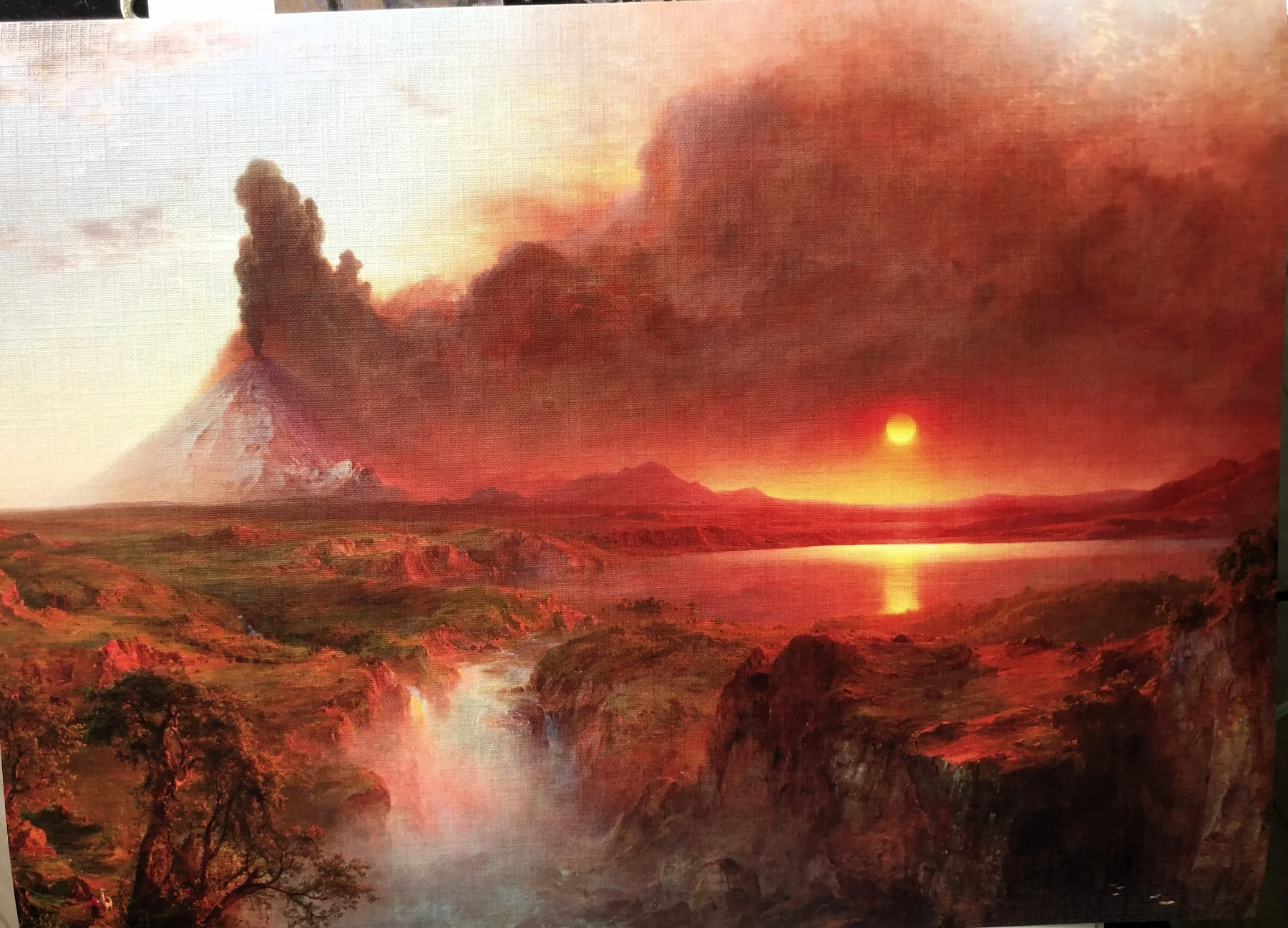
COTOPAXI
Frederic Edwin Church
- Artist
- Frederic Edwin Church (1826–1900)
- Date
- 1862
- Dimensions
- 130 x 173 cm
- Medium
- Oil on canvas
- Location
- Detroit Institute of Arts, Detroit
In the late 1850s Frederic Edwin Church won wide acclaim with the wonderful, richly detailed landscapes he captured on large canvases. His finest paintings, including Cotopaxi, are dramatic depictions of vast, untouched wilderness and at the same time offer a glimpse into his Romantic view of nature. He painted the waters, rocks, mountains and volcanoes of immense regions, often creating a special atmosphere in his pictures.
Ten Years in the Making
In the 1850s Church left North America in search of exciting landscapes. Inspired by the travel writings of the Prussian explorer Alexander von Humboldt, he visited Ecuador in South America twice, first in 1853 and then in 1857. These journeys produced two of his major works, The Heart of the Andes and Cotopaxi. In 1853 Church made an early oil sketch of the Cotopaxi volcano, followed by further sketches and oil paintings, [among them a picture] with a view of Cotopaxi (1857).
Church’s second trip to Ecuador differed considerably from his earlier encounter with the Cotopaxi volcano. On this journey, on which he was accompanied by a fellow painter, Louis Rémy Mignot, he saw the volcano again in continuous eruption, the mountain spewing smoke, stones and debris. The sketches and studies made on this trip depict a much more turbulent and dramatic landscape, largely thanks to the volcano towering and smoking in the distance.
Church’s artistic reputation was founded on his large canvas Niagara (1857), after which he was commissioned by the New York investor and patron of the arts James Lenox to paint Cotopaxi. The artist drew on his many sketches to depict the enormous power of the smoking monumental volcano. The painting was finished in 1862, almost ten years after Church first travelled to the volcano.
Majestic Dimensions
Cotopaxi was exhibited in New York in 1863, a year after it was finished. The huge canvas was greatly admired for its majestic dimensions and fine details, and it is still counted among Church’s best works. At its London showing in 1865 the critic W. P. Bayley described the painting in these words: “In this deeply impressive scene we see a solitary mountain that has kept its present form since the last movements of the crust, when the Earth was thousands of years younger than it is today.” Cotopaxi can now be seen in the galleries of the Detroit Institute of Arts in Michigan.
Richly Detailed, Sweeping Views
Church’s exotic, dramatic landscapes of the South American Andes, including Cotopaxi, faithfully convey the wonder and awe one might feel on seeing such a scene. With his superb artistic abilities Church was able to conjure up his wide panoramas with almost photographic detail. While admiring the majestic proportions of Cotopaxi, at the right edge of the picture we can observe the fine details of the trees dotting the huge rocky outcrop, almost lost in the vast space. The bird flying in the sky, depicted with white strokes at the bottom of the painting, is almost dwarfed by the steep cliffs. The rocks bathe in the orange glow of the dazzling sunset, and the light falling vertically on them emphasises their height and majestic beauty. On the other side of the gorge, in the left corner of the painting, the bright green patches of paint of the trees create the impression that every leaf has been painted separately.
If we examine the area between the trees more carefully, two figures — a peasant woman and a white llama — can be made out as they trudge along the path. Church paid great attention to tiny, fine details, so it is worth taking a closer look at the picture and admiring the artist’s exceptional achievement.
A Deep and Wide Panorama
The wide horizontal picture helps create the spectacular panorama. Sky and land share the canvas in equal proportion, but the chasm yawning before us is so deep that it seems as if the bottom edge of the painting had been cut off. The viewer’s eye travels around the scene. Above the huge, foaming waterfall the mist reflecting the sunlight links the foreground with the quiet lake. Our gaze moves from the top of the huge crag diagonally along the edge of the gorge, from right to left, towards the real subject of the painting, the volcano towering on the horizon. The splendid view spans such a space that Cotopaxi is almost lost in the landscape. As the dark plume of smoke pouring from its crater takes shape before us, the whole composition comes together. The painting shows enormous depth, and the structure of the picture is masterfully built. The astonishingly powerful depiction of nature projects an almost apocalyptic vision before our eyes, yet the painting is so precise and balanced that we are left in no doubt that the artist has presented this monumental landscape faithfully to reality.
Artistic Connection
Frederic Edwin Church was the only pupil of the influential American landscape painter Thomas Cole (1825–1870). Cole founded the first American school of painting, the Hudson River School, which got its name later. He described his pupil as “the finest draughtsman in the world” — and Church was not yet 20 at the time.
- Thomas Cole
- Church: The Heart of the Andes (1859)
- The Olana house