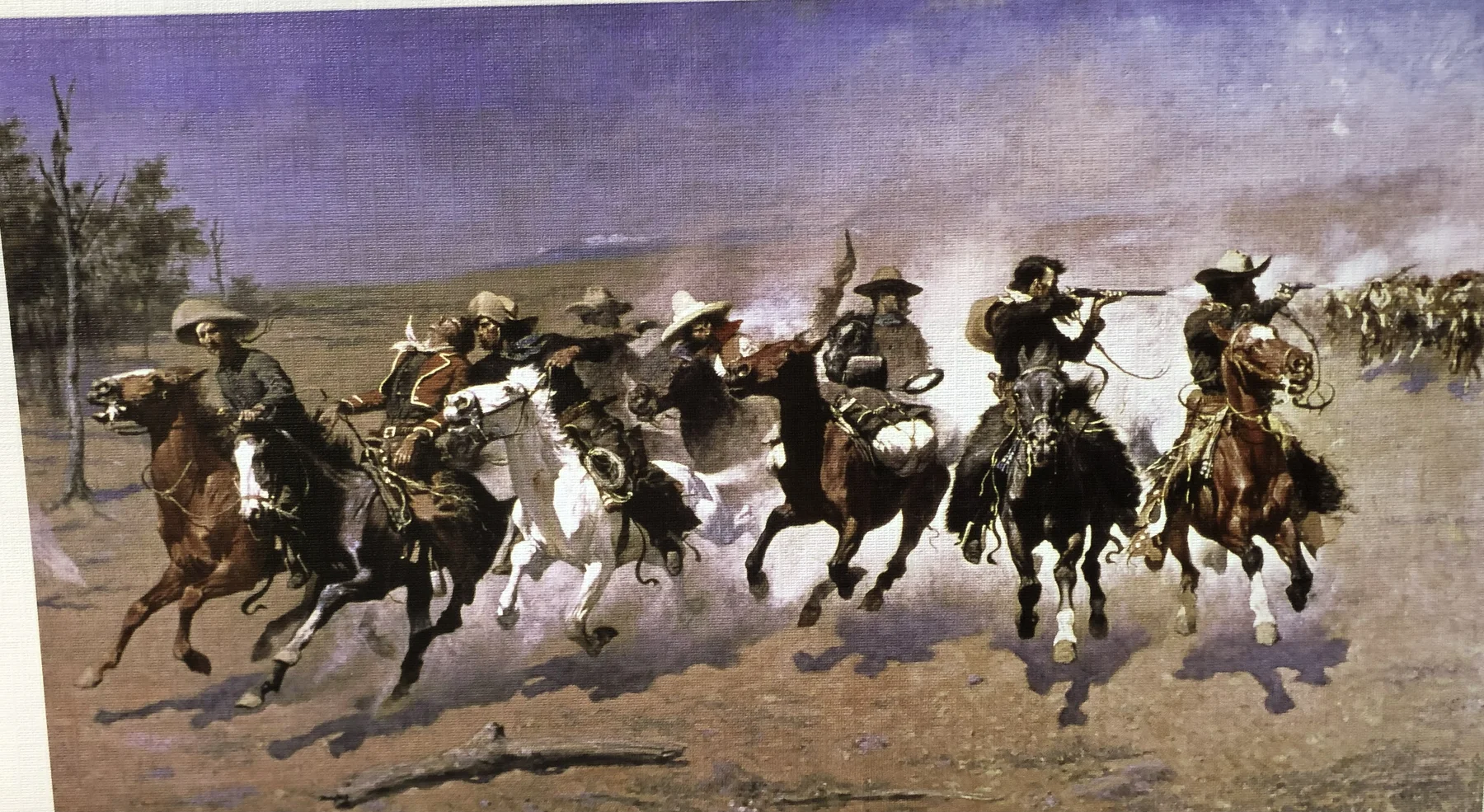
A DASH FOR THE TIMBER
Frederic Remington
- Artist
- Frederic Remington (1861–1909)
- Date
- 1889
- Dimensions
- 122.5 x 213.5 cm
- Medium
- Oil on canvas
- Location
- Amon Carter Museum, Fort Worth, Texas, USA
Frederic Remington was an extremely successful illustrator, painter and sculptor, the most outstanding American visual artist at the turn of the century. Enjoying the acclaim of both critics and the public in his own time, Remington is still best known and loved for his pictures revealing the exciting world of the vanishing Wild West; horses, cowboys, soldiers and Indians play the leading roles in his dramatic scenes. While the artist depicted frontier life in his pictures, the transcontinental railroad linking the west and east coasts also meant that his nostalgic depictions already symbolised a passing era.
“A Cowboy Picture”
In early 1889 Remington received a commission from a wealthy industrialist named Edward Cogswell Converse for a powerful Wild West picture showing a life-threatening situation. Remington, who spent most of his life in New York, first travelled to Montana in 1881; there he began painting the romantic Wild West scenes dear to him. During his many visits to the western regions between 1885 and 1888 he kept a diary of his experiences, drew sketches and took photographs of American cavalrymen pursuing Apaches. Wanting to record everything with the utmost accuracy and authenticity, he asked his friend Powhatan H. Clarke to send him chaps worn by ranchers: “I have received an important commission for a cowboy picture and I need lots of chaps.” The “cowboy picture”, which was titled A Dash for the Timber, was finally painted on a huge canvas.
Success
A Dash for the Timber quickly established Remington’s reputation. He sent the painting to the autumn exhibition of the National Academy of Design in New York in 1889, where it not only won the acclaim of the critics but also proved the most popular work of the show. Remington described his success like this: “My picture A Dash for the Timber was praised to the skies in the press — every paper had a good word for it.” From 1893 the painting stayed in St. Louis, at first exhibited in the Museum of Fine Arts, then moved in 1909 to the City Art Museum. In 1945 the canvas was bought by a collector named David Findlay, who sold the picture to Remington’s close friend and admirer of his works, Amon G. Carter. Since Carter’s death in 1955 A Dash for the Timber has enriched the collection of the Amon Carter Museum in Fort Worth, Texas, where it can still be seen today.
Speed and Energy
Frederic Remington worked as an illustrator for popular magazines such as Harper’s Weekly and the Century Illustrated Magazine. He perfected his realistic painting style during the 1880s and reached the peak of his art with his dynamic masterpiece A Dash for the Timber, made in 1889.
The lively scene owes its energy largely to the accurate depiction of the galloping horses. The artist painted the horses with hooves lifted into the air, conveying their rapid gallop well. Remington captured the exciting moment with unparalleled authenticity. Only a few years earlier Eadweard Muybridge had published his famous series of photographs proving that at certain moments all four legs of a galloping horse leave the ground.
Remington brings the heat of the sun to life with shades of yellow and orange, while with crimson and blue he creates the sharp shadows cast on the ground by the horses’ legs and bodies. The artist often used muted colours, but the bright red of one rider’s jacket and another’s scarf suggests haste and danger.
A Cinematic Scene
Remington’s painting A Dash for the Timber is a work made for the cinema screen: the scene set on the dusty prairie anticipates the familiar world of later Western films. The canvas is filled by retreating mounted cowboys trying to escape the pursuing Indians as quickly as possible into the relative safety of the trees sketched on the left — to which the picture’s title refers. The great momentum, however, carries the eight riders almost straight towards the viewer.
One of the cowboys has been shot and is supported by the rider beside him. The colour of his short red jacket matches his limply hanging bleeding hand, with which he has just let go of the reins. Four riders also let go of the reins, but they do so deliberately, turning in the saddle to fire their pistols and rifles at the pursuing group. The horses’ faces, ears laid back, nostrils flared and eyes terrified, betray wild energy, and every sinew of their muscular legs is strained in the gallop. By the time A Dash for the Timber was made, westward expansion was largely complete, but Remington nostalgically recorded the myth of the Wild West in this and later paintings.
- Cavalrymen’s Breakfast on the Plains, another of Remington’s Wild West pictures
- Replica of Remington’s studio