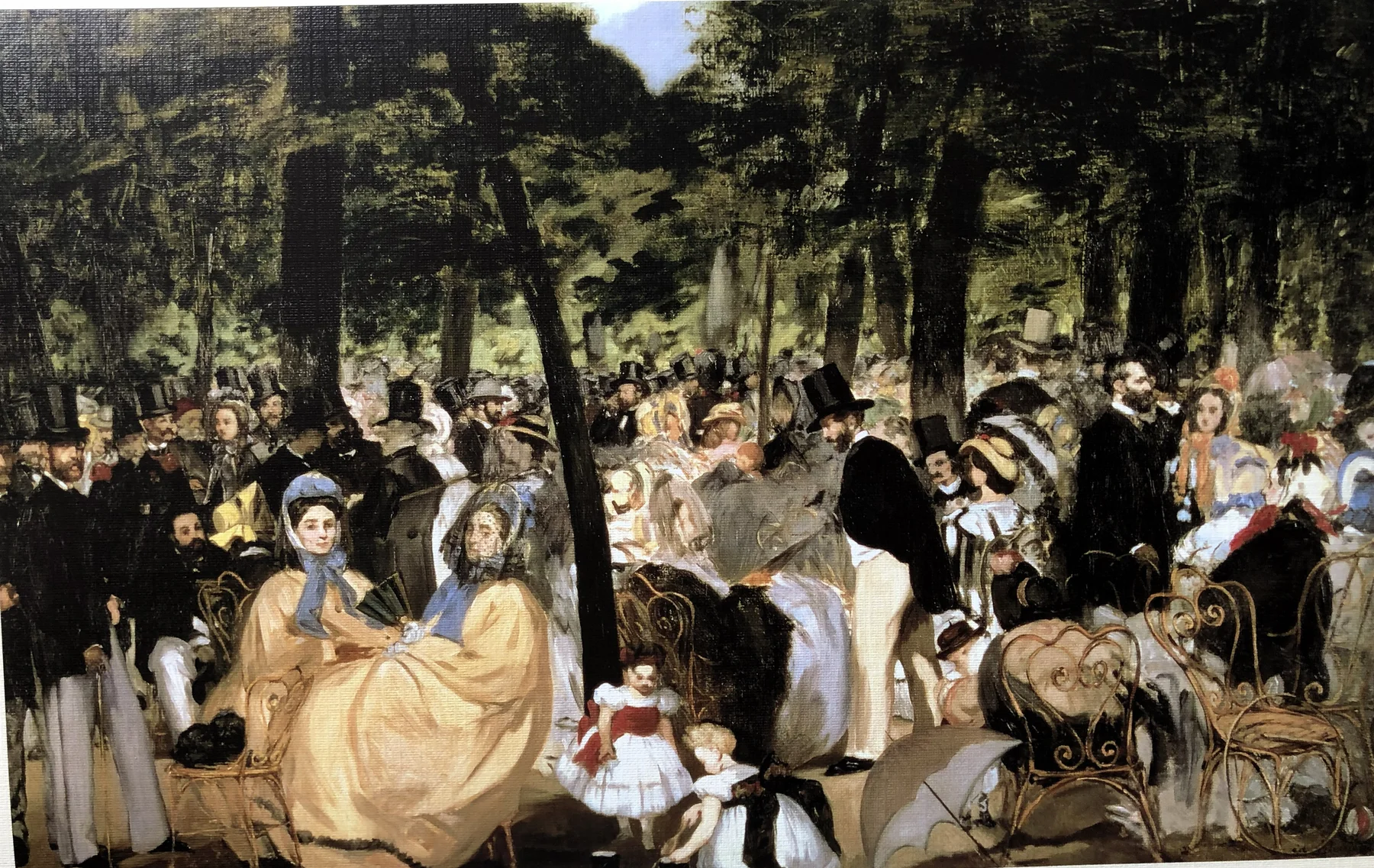
MUSIC IN THE TUILERIES GARDENS
Édouard Manet
- Artist
- Édouard Manet (1832–1883)
- Date
- 1862
- Dimensions
- 76.2 x 118.1 cm
- Medium
- Oil on canvas
- Location
- National Gallery, London, England
The vibrant scene of Music in the Tuileries Gardens evokes the mood of music, laughter and lively conversation. A snapshot of the fashionable Parisian lifestyle of the mid-1800s, it was Édouard Manet’s most ambitious and at the same time most controversial work to date. Unashamedly modern in subject and style, the painting at once provoked the disapproval of contemporary critics, inspired a whole generation of artists and heralded the birth of a new art style.
Fashionable Paris
In Manet’s time the Tuileries Gardens were a fashionable place of entertainment for the middle class and the upper bourgeoisie. In this open-air salon they gathered to share their thoughts, show off their latest fashionable clothes and listen to the military band that played there in the afternoons. Manet was no stranger to this privileged world. A regular visitor to the gardens, his artistic interest was aroused by the lively spectacle, so in the summer of 1862 he began taking his easel and paints with him to capture what he saw.
An Unfavourable Reception
Music in the Tuileries Gardens was first exhibited at the Galerie Martinet in Paris in 1863. At a time when high art took its models from historical heroes painted in the classical style, Manet’s work seemed a flamboyantly contemporary and frivolous creation. The critics had never seen a picture like it and recoiled from what they saw as a vulgar and scandalous disregard for the accepted rules of painting. “This art is not healthy,” declared one, while another threatened violence if the picture were not removed from the gallery.
Quick, Loose Brushstrokes
The critics were outraged not only by what Manet painted but also by the style in which he worked. Seen close up, Music in the Tuileries Gardens looks like a motley jumble of colours blurring into one another, seemingly thrown onto the canvas at random by the artist’s brush. This quick, loose painting style, however, was Manet’s method of depicting reality as he saw it. As his close friend, the writer Émile Zola, explained, the “simple, indeterminate patches of paint” begin to make sense and bring the lively, animated scene to life only when the viewer steps back from the painting. By the artistic norms of the time this style was completely unacceptable.
A Startling Contradiction
Music in the Tuileries Gardens gave Manet a reputation as a kind of rebel. Yet he was far from wanting to defy tradition; on the contrary, he often drew inspiration from the works of the old masters. He particularly admired Diego Velázquez, and his reclining nude Olympia (1863) is a direct tribute to Titian’s Venus of Urbino (1538). He always sought the approval of the Academy and strove to have his works shown at the exhibitions of the Paris Salon. Nevertheless Manet could not deny his true artistic ambitions; in fact he was a painter who still lived in the past but already looked to the future.
Visual Allusions
Many motifs in the painting point to Manet’s true modernism. One need only look at his choice of colours to understand his intentions. He painted the two female figures in the left foreground almost exclusively in Naples yellow and cobalt blue. These colours had only recently become available to artists. Naples yellow was unknown in northern Europe until the early 1700s, while cobalt blue, discovered by Louis Jacques Thénard at the Sèvres porcelain factory, appeared only at the beginning of the 1800s. By giving the two figures a prominent place Manet openly embraces his artistic conception, much criticised by others, and almost boasts of it.
Defying the Past
Even the chairs occupied by the ladies point to changing times. The gardens’ original wooden benches had been replaced a year earlier, in 1862, by wrought-iron chairs, a material increasingly widely used in the industrialising world.
Familiar Faces
The work’s most important feature, however, is its cast of characters. The painting gives a key role to presenting contemporary French cultural life: it features the controversial composer of Jewish origin Jacques Offenbach (pictured), the famous still-life painter Henri Fantin-Latour, the painter and critic Zacharie Astruc, and Théophile Gautier, a member of the bohemian circle of writers and painters.
A Decisive Influence
The most important figure in the picture, however, is the French poet Charles Baudelaire, seen behind the woman on the left, directly in front of the widest tree trunk. Baudelaire was a close friend of Manet and had a great influence on him. He often spoke of “the spectacle of fashionable life” and encouraged Manet to strive to capture contemporary Paris in his paintings. This advice freed Manet from the constraint of convention, but at the same time drew upon him the full weight of the anger of its followers.
Although most viewers stood baffled before almost every detail of Manet’s painting, there were some on whom the picture had a great effect. When Claude Monet visited the Galerie Martinet in 1863, he is said to have stared at the picture spellbound, while his later fellow Impressionist Frédéric Bazille remarked that “such a visit is worth a whole month of painting.” As his small group of Impressionist followers began to spread their wings, it seemed that the artist, who could hardly be called a rebel, had started a kind of revolution.
- The Tuileries at the end of the 19th century
- Manet: Olympia