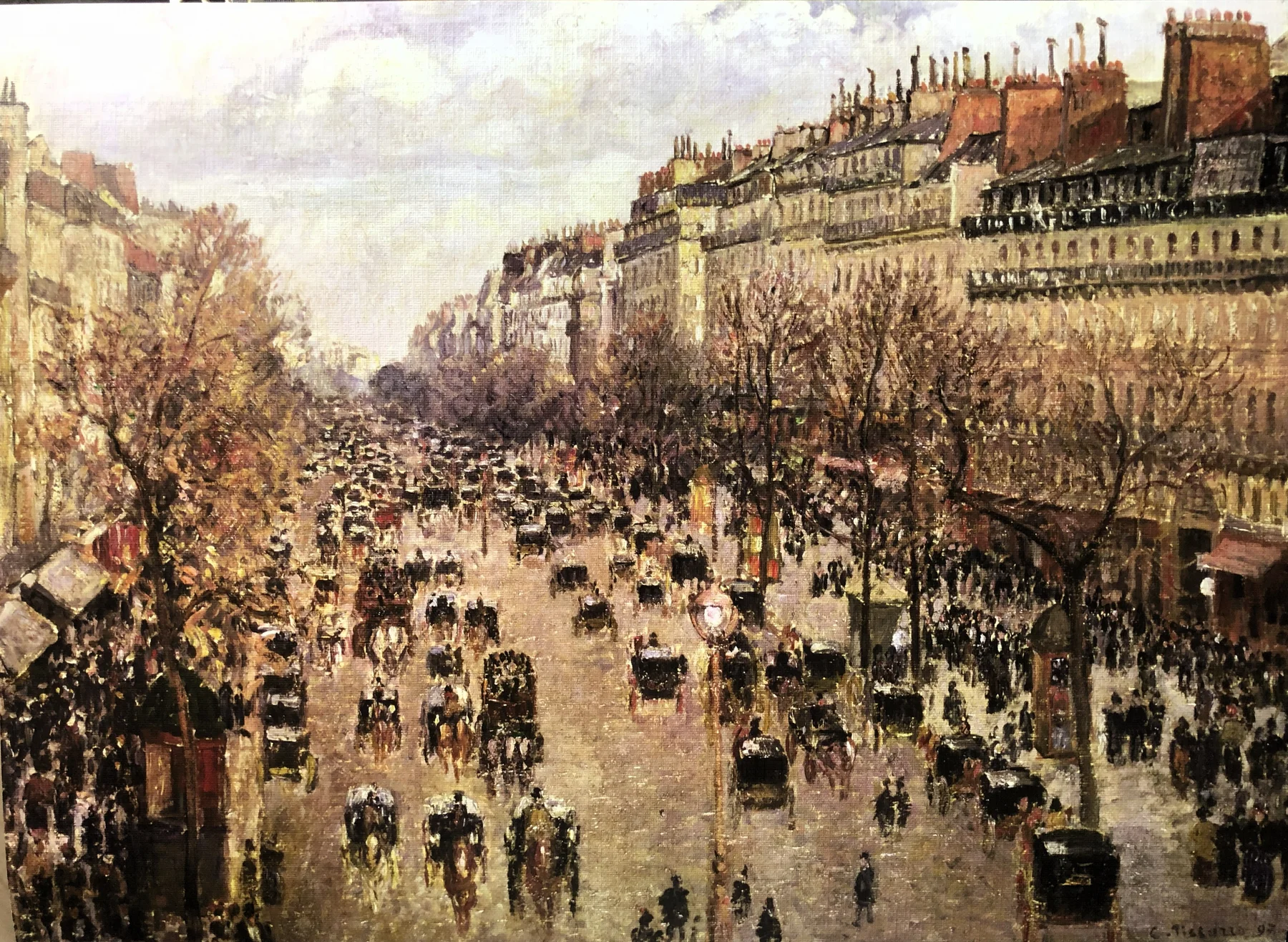
THE BOULEVARD MONTMARTRE, AFTERNOON SUN
Camille Pissarro
- Artist
- Camille Pissarro (1830–1903)
- Date
- 1897
- Dimensions
- 74 x 92.8 cm
- Medium
- Oil on canvas
- Location
- Hermitage Museum, St Petersburg, Russia
Between the winter and spring of 1897 Camille Pissarro captured the Boulevard Montmartre in Paris in 14 paintings from his high-up hotel room, at different times of day and in different weather conditions. In The Boulevard Montmartre, Afternoon Sun, depicting bustling city life, the sun breaks through the clouds and its light sweeps across the trees and rooftops. The painting faithfully illustrates the artist’s special ability to create atmosphere, his talent for depicting movement and his brilliant compositional technique.
City Life
As his eyesight deteriorated in the last decade of his life, Pissarro, who had earlier made open-air landscapes, began painting city scenes from hotel rooms and apartments, depicting the streets of Paris, Rouen and two bustling port cities, Dieppe and Le Havre. From his room at the Hôtel de Russie, which overlooked all the great boulevards of Paris, Pissarro continued to explore ways of capturing impressions of light and colour. Now, however, he felt he had to paint several pictures of one scene in order to discover and convey the changing effects of light and weather as fully as possible.
Like Monet at the time, Pissarro made series of paintings; he worked on several pictures at once, temporarily setting aside those that did not match the changes in light, weather and his mood at that moment. The artist worked with incredible speed and great skill. As in the whole Boulevard Montmartre series, in this painting too the firmly drawn image of the street lined with trees and imposing buildings, depicted in perspective foreshortening, [forms] the powerful yet simple composition. The sketchily painted human figures and carriages recall the world of photographs blurred by movement, a feeling further heightened by the artist’s quick brushstrokes. Compared with earlier, his colours had by then become paler and more muted; his favourite colours were greens and blues.
Country Scenes
Throughout his career Pissarro never stopped experimenting. He became known for his paintings of rural French life, especially the landscapes painted in and around Louveciennes and the works made in Pontoise near Paris. He was a simple, sincere observer who produced sketches in abundance. He always explored his subjects thoroughly so that he could paint faithfully what he saw. Through his observations landscapes and objects became fixed in his memory, and he perceived light as inseparable from the things it illuminated. With relatively few colours and delicate or firm brushstrokes he vigorously painted intimate scenes such as The Climbing Path, L’Hermitage, Pontoise (1875) and Landscape at Chaponval (1880).
The Great Experimenter
Pissarro clearly painted the road surface with a pointillist technique. After meeting Georges Seurat in 1884, Pissarro abandoned the complex, sprawling brushstrokes of his Impressionist period and began experimenting with his younger colleague’s “Divisionist” technique of tiny dots. Followers of the movement, which became known as Neo-Impressionism, applied dots of contrasting colours to the canvas, which the eye perceives as a single shade. Not long afterwards he more or less abandoned this method too, feeling that it hindered him in depicting movement and impressions, but its influence remained perceptible in his art.
Impressionist to the Core
Although Pissarro is less well known than other famous painters of the period — such as Monet, Degas or Manet — his craftsmanship and inventiveness deserve attention. His works are much more interesting and impressive than many think. His commitment to independent group exhibitions and his landscapes placing great emphasis on special light effects and weather conditions make him, to some extent, the most characteristic Impressionist. When he moved to Pontoise near Paris in 1872, he gathered a small group of painters around him. He was an excellent teacher who, with his own method, encouraged his pupils to paint patiently from nature. These lessons led Cézanne to change his outlook. He later said of Pissarro: “I regarded old Pissarro as a father, someone I could turn to at any time, like God.”
A Love of Life
Pissarro never lost his enthusiasm and receptiveness for the colourful whirl of life bustling around him, which he captured on his canvases with ease and affection. His mature works testify to his sympathy for peasants and workers and are often also means of expressing his radical political views, radiating simplicity and strength in contrast to the meticulous detail of his earlier pictures. Towards the end of his life critics too began to recognise him, and in the course of the 20th century he was regarded as one of the leading figures of the Impressionist movement.
- The Boulevard Montmartre in the Morning, Grey Day, 1897
- Pissarro: Landscape at Chaponval, 1880
- Cézanne: Pissarro
- The Hermitage Museum