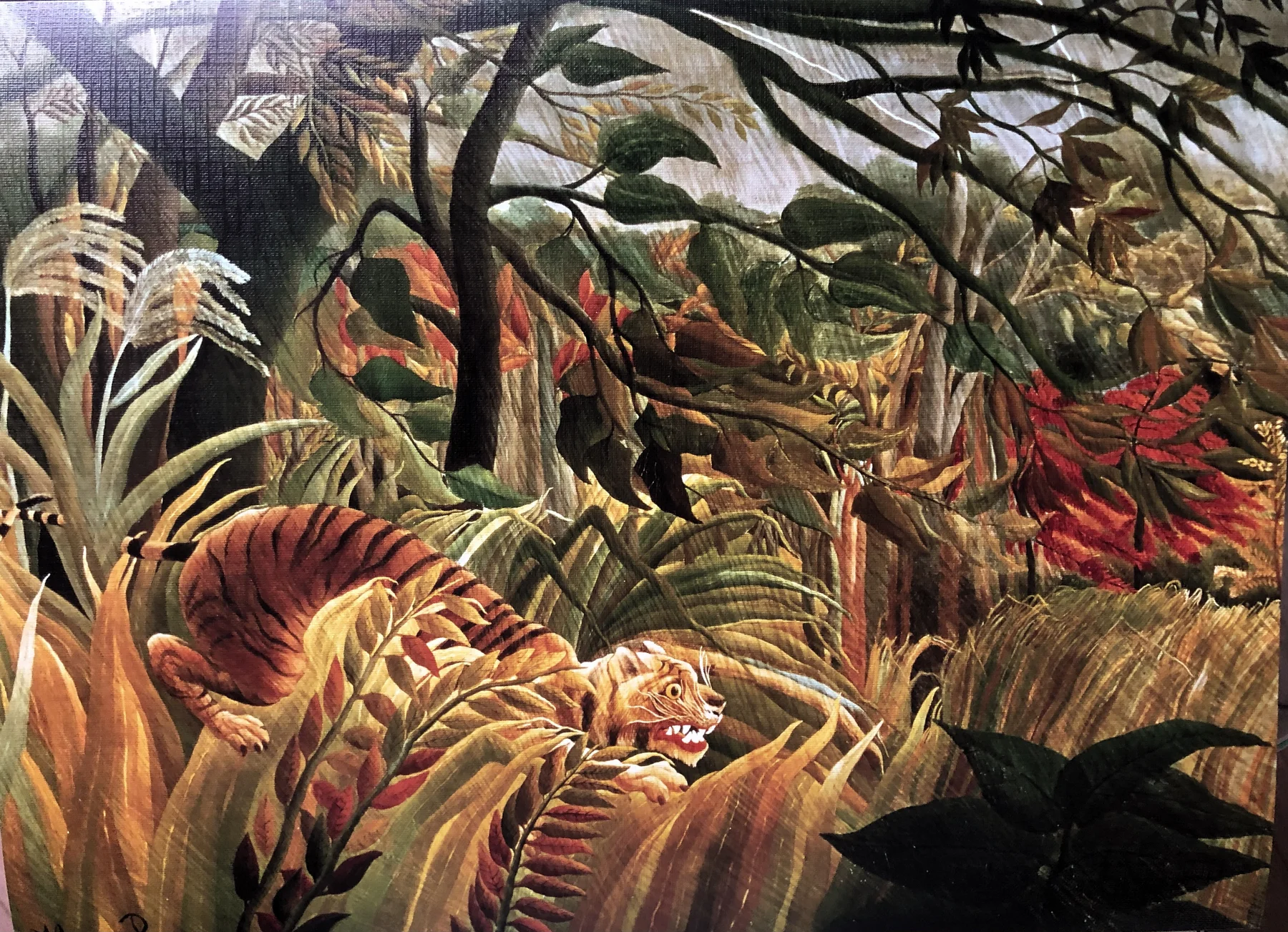
TIGER IN A TROPICAL STORM (SURPRISED!)
Henri Rousseau
- Artist
- Henri Rousseau (1844–1910)
- Date
- 1891
- Dimensions
- 129.8 x 161.9 cm
- Medium
- Oil on canvas
- Location
- National Gallery, London, England
Henri Rousseau’s captivating yet ominous painting Tiger in a Tropical Storm (Surprised!) depicts a snarling tiger stalking its prey among lush vegetation while a tropical storm rages all around. The picture is at once enthralling and terrifying — a spine-chilling fantasy world into which the artist escaped from the monotony of drab everyday life.
A Unique Style
When the 47-year-old Henri Rousseau exhibited his first jungle painting, Tiger in a Tropical Storm (Surprised!), at the Salon des Indépendants in 1891, he was already sharply criticised. Ever since he first appeared — after a late start — on the Paris art scene in 1886, his works had been constantly mocked by critics. Although this painting was ridiculed for its amateur technique and childlike naivety, it also won his first recognition. At that time the artist was still working full time at the Paris customs office. Felix Vallotton, the young painter and critic, wrote of him: “His tiger surprising its prey must be seen… it is better to take as an example or to debate the most deeply rooted conviction or childlike naivety than extraordinary expertise.” This was only the first step on Rousseau’s long, slow road to recognition, when he was finally regarded as an artist truly blessed with original, individual expressive power and a special imagination.
Armchair Travel
Tiger in a Tropical Storm (Surprised!) was the first of Rousseau’s many richly coloured, meticulously worked jungle pictures — although he returned to the subject only ten years later. Although his lifelike portraits gave rise to the general belief — which he himself never denied — that during his military service he had been to the subtropical regions of Mexico, in reality he never left France. Rousseau lived a quiet, monotonous everyday life, from which he could escape through his art. One critic and collector of his time called him a “Sunday painter”. He drew inspiration from a jungle world imagined from the accounts of well-travelled soldiers he met through his work and from book illustrations. He also regularly visited the botanical garden in Paris and made sketches of the lush vegetation. As he once told a critic: “When I go into the hothouses and see the strange plants of exotic countries, I feel as if I were dreaming.”
Naive Appeal
Rousseau’s innocent, fresh imagination eventually won over his critics — including the avant-garde artist of the time, Picasso, and later the Surrealists. In 1908 Picasso held a famous banquet in his honour. Many viewers said that Rousseau painted like a child, but his works in fact reveal extraordinary sophistication.
Like many of his works, Tiger in a Tropical Storm (Surprised!) is flat; it is as if foreground, middle ground and background were on a single plane, like a theatre curtain. Although this painting is more animated than many of his later jungle pictures, it nevertheless has a kind of static quality that creates a strange sense of stillness. Every single detail was made with meticulous care and draws attention. The overall effect is a seductive fantasy world where time stands still.
Romantic Influence
The tiger creeps forward in front of this lavish jungle curtain almost as if floating on top of the grass. Rousseau painted the animal vividly and sensitively, the arch of its back conveying its powerful movement; the viewer’s gaze is drawn to the whole animal, especially its wide-open eyes and snarling mouth.
It can be noted that the posture of Rousseau’s tiger is almost identical to that of the snarling animal in the Romantic painter Delacroix’s pastel Tiger and Snake. Rousseau admired the Romantic style of the late 18th and early 19th centuries, its precision, vivid use of colour and strong drama, all of which are also basic elements of his jungle paintings.
Artistic Connection
The Surrealist artists — including Max Ernst (pictured) and Magritte — celebrated Rousseau. In his works they saw the opening of a new realm of artistic possibilities. The Surrealists believed in the power of imagination, in dreams that set the spirit free and in their creative power. Rousseau loved to rely on his fantasy; his paintings were characterised by a bold, simple style and a dreamlike quality. He thus became a perfect example of the type of artist the Surrealists believed in: the born genius who surpasses the trained artist with his visions.
- Felix Vallotton: Self-portrait
- The botanical garden in Paris today
- Tiger and Snake, a painting by Eugène Delacroix