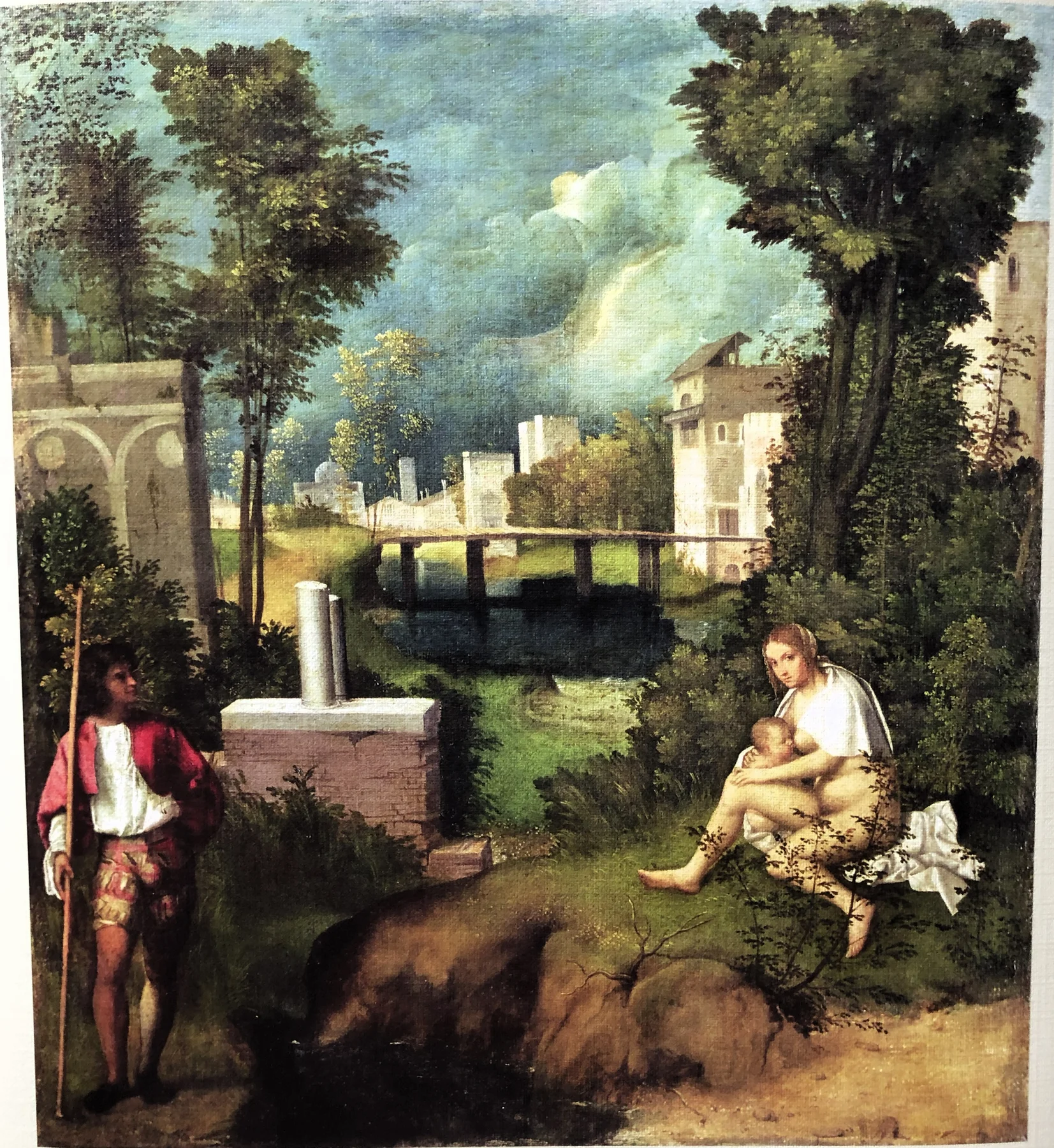
THE TEMPEST
Giorgione (Giorgio Barbarelli)
- Artist
- Giorgione (Giorgio Barbarelli) (c. 1477–1510)
- Date
- Between 1506 and 1509
- Dimensions
- 82 x 73 cm
- Medium
- Oil on canvas
- Location
- Gallerie dell'Accademia, Venice, Italy
Little is known about the life of one of the greatest Italian artists, Giorgione, who worked in the High Renaissance, an age famous for its spectacular creativity. Giorgione did not sign his pictures, so few works can be attributed to him. The first written record of The Tempest dates from 1530, when the Venetian collector Marcantonio Michiel wrote of Giorgione’s painting: “A landscape with a storm, with a soldier and a gypsy woman”. Despite this simple description, The Tempest is still surrounded by mysteries today. The mystery is partly rooted in the original, “poetic” style characteristic of the artist — in his picture he created a heightened poetic mood with an enigmatic and unique meaning.
A Stormy Sky
In the early 16th century the Venetian aristocratic patron of the arts Gabriele Vendramin commissioned a mysteriously atmospheric picture from Giorgione, The Tempest. Experts date its creation to the late period of the artist’s short life, between 1506 and 1509. Sometimes referred to as “The Gypsy and the Soldier” because of its two figures, the work got its better-known title, The Tempest, from the lightning visible in the background.
The Mystery
The enigma of the work lies in the difficulty of interpreting its subject. Giorgione was interested in ancient mythology, but it is not clear which episode the picture refers to. Some critics interpret the scene as the Trojan prince Paris leaving his wife, Oenone, and their child for the Greek beauty Helen. The man seen on the left of the picture has in any case been identified as a gypsy, a shepherd and a soldier. It is also possible that the picture depicts a young mother who has been expelled from the city and on her way has met a friendly wanderer. Others see in the man a symbol of fortitude and in the woman a symbol of charity. As an alternative explanation, it has also been suggested that Giorgione does not illustrate any specific written text.
Landscape at the Centre
Giorgione’s The Tempest marks an exciting starting point in Italian painting of the period. For the first time the landscape takes centre stage in a picture, and the placement of the two figures on either side is strangely peripheral. The dominant colours of nature, the greens and blues, are more subdued but retain their warmth and harmony. Giorgione exploits the possibilities offered by oil paint in presenting the detail and depth of the foliage. The artist also uses the painting technique called sfumato, which creates a veiled effect — almost certainly under the influence of the great Renaissance master Leonardo da Vinci — in which subtle gradations of colour produce softer, more rounded contours of the human body.
Unresolved Tension
The Tempest depicts two figures in a stormy landscape. Since no one can give a definite explanation of the picture’s meaning, a strange tension pervades the work: the centrally placed overcast sky and the mysterious relationship between the man in period dress holding a staff and the almost completely naked woman suckling her small child lend the scene an enigmatic effect. X-ray examinations have revealed that on the left of the canvas, where the man now stands, a bathing woman was originally visible. The presence of the figure hidden beneath the layers suggests that Giorgione changed his idea of the composition at some stage of the work. It is not inconceivable either that he composed his picture while painting.
Four hundred years after the painting was made, the scene depicted still resists attempts at interpretation, although many scholarly theories have appeared. It may seem too modern an explanation for a work made in the early 16th century, but perhaps Giorgione wanted to obscure, to set the viewer an unsolvable riddle. Since no explanation fits the picture completely, there is nothing left but to enjoy the poetic mood the artist created with his delicate brushstrokes.
Artistic Connection
Many of Giorgione’s works were finished by his pupils, probably including the legendary Titian (c. 1488–1576) and Sebastiano del Piombo (c. 1485–1547). His sensual study of the Roman goddess of love, Sleeping Venus (c. 1509, pictured), clearly illustrates the characteristic features of Giorgione’s manner of depiction, the soft, rounded contours of the human body and the lifelike rendering of the shading and fine creases of silk fabrics. It is believed that Titian may have finished the picture by painting the background behind the reclining nude. Besides Titian, many lesser Italian painters — referred to as the Giorgioneschi — followed Giorgione’s poetic style in the early 16th century. The work of the French landscape painter of the following century, Nicolas Poussin (1594–1665), was greatly influenced by one of the greatest artists in the history of the Renaissance.
- Leonardo da Vinci