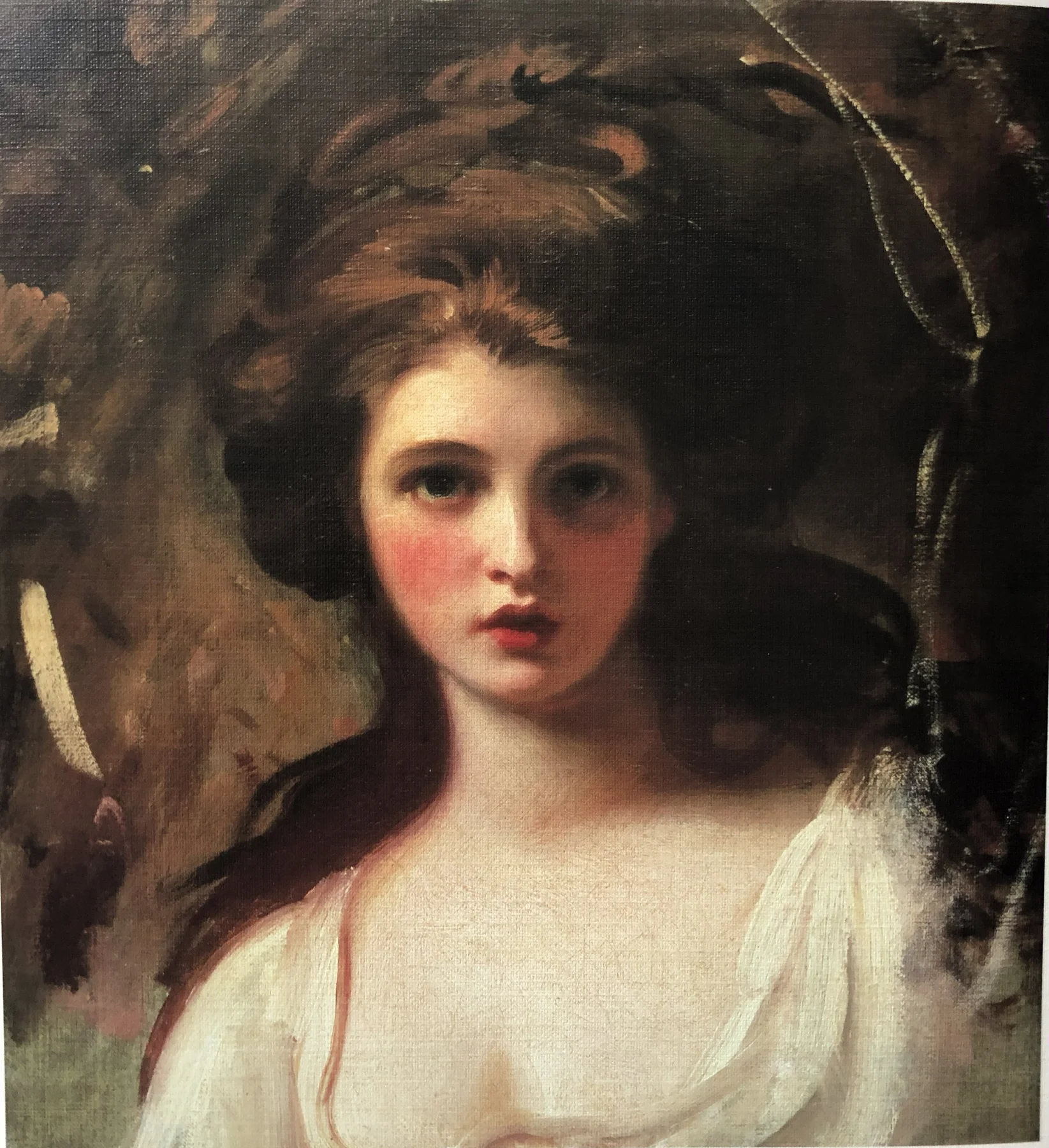
LADY HAMILTON AS CIRCE
George Romney
- Artist
- George Romney (1734–1802)
- Date
- 1782
- Dimensions
- 53.3 x 49.5 cm
- Medium
- Oil on canvas
- Location
- Tate Gallery, London
Between 1775 and 1790 George Romney was the most celebrated portrait painter of late-18th-century England. None of his sitters had as great an influence on him as his adored muse, the “divine” Emma, whom he painted again and again in various theatrical character studies, in this picture, for example, as the bewitching goddess of Greek mythology, Circe. Although Emma also sat for several other portrait painters, it was above all thanks to Romney’s stunning works that she won fame through her unparalleled beauty and rose rapidly up the social ladder, until finally, as Lady Hamilton, she became the wife of a diplomat — and the mistress of Lord Nelson.
London’s Famous Portrait Painter
Known for his quick work and moderate prices, George Romney had a clientele ranging from businessmen to prime ministers, and there was a time when he was more in demand than his chief rival, Sir Joshua Reynolds.
His tour of Italy in 1773–74 strengthened Romney’s admiration for Classicism. This influence, seasoned with strong Romantic features, gave his works an unusually intense psychological charge, further enriched by the excellent handling of colour he drew from studying the works of Rubens and Titian.
Romney’s skill as a portrait painter lay in his ability to depict his sitters lifelike but, if need be, also to show them in a more flattering light. One of his sitters, Lady Newdigate, admitted that in the picture she “was more beautiful than she had ever been in life”. In addition, Romney worked incredibly hard: his diary entries record nine thousand sittings over two decades. The peak was 1783, when sitters came to him nearly six hundred times. At times he grew tired of the daily treadmill; once, for example, he declared that he would “place a cannon at his door to hold back the greedy crowd”.
At heart, however, Romney delighted in painting mythological and Shakespearean scenes and aspired to laurels as a history painter. Thanks to his artistic reputation, fate threw Emma Hart in his path.
Emma Hart
Emma Lyon was born in 1765, the daughter of a Cheshire blacksmith. In her eventful life she moved steadily towards fame. At 13 she joined the Drury Lane theatre company, at 15 she became the mistress of a rich man, and a year later she became pregnant. That year — 1781 — Charles Greville, second son of the Earl of Warwick, took her under his wing, made her his mistress the following January, and it was then that she took the name Emma Hart.
Greville had too modest an income for his lifestyle, so he planned to profit from selling portraits of Emma, and in April he introduced her to Romney. The artist apparently fell in love at once with the pretty, blue-eyed, auburn-haired creature, who, more importantly, was an excellent model, capable of any pose, and whose mobile face proved suitable for expressing the most varied expressions.
In the first four years of their acquaintance Emma sat for Romney at least 150 times, and he painted some 30–50 portraits of her in all. She always played some “role” — she was Joan of Arc, Cassandra, a simple maiden, the embodiment of “Nature”, even a bacchante. Whether in a picture or in the flesh, her beauty drew men like moths to a candle flame, and even a bishop was carried away: “God must have been in a good mood when he created Emma!”
Emma, the Gentle Enchantress
Lady Hamilton as Circe is in fact a study for a full-length portrait. It was once larger — how much larger is not known — and was only later cut down along the line of the head and shoulders.
In the Odyssey Homer describes Circe as an enchantress who on her island turns men into helpless animals with the help of various spells and potions. She tries to detain the hero Odysseus and his sailors too, but with the help of the gods he escapes her clutches. The full-length portrait (also 1782, private collection) depicts Circe in a commanding posture, holding a magic wand in one hand and raising the other as if casting a spell. On the sea glimpsed in the background a lone ship can be seen, perhaps that of Odysseus. Circe’s clinging pink dress is an excellent example of Romney’s mastery of the depiction of drapery, for which he was famous far and wide.
The study of the face shows how quickly Romney must have painted the surrounding areas of the picture with his broad brushstrokes. The merely sketched left arm testifies that he rarely made preliminary studies, preferring to paint directly on the canvas and make corrections afterwards.
Romney’s attention was directed above all to depicting the sitter’s fresh face, whose childlike features contrast strangely with the mature femininity and demonic sexuality of a character such as Circe. Yet perhaps it was in this paradox that Emma’s attraction lay.
Emma, Lady Hamilton
In 1783 Greville’s uncle, Sir William Hamilton, the British envoy in Naples, visited London, where he took a liking to Emma. Greville, who was finding Emma increasingly burdensome, later persuaded Hamilton to take over her care from him, and accordingly sent her to Naples in 1786. Emma eventually fell in love with the ageing Hamilton and, despite the 31-year age difference, married him in 1791. For the wedding ceremony they returned briefly to London, where Emma again sat for Romney. (The enchanted painter wrote to one of his friends, William Hayley: “I shall spend most of the summer painting this wonderful goddess. I cannot describe her otherwise, as I believe she is the most perfect woman.”) After this summer Romney never saw her again. Emma returned to Naples, where she met Lord Nelson, the last great love of her life.
- Charles Greville
- Lady Hamilton as Cassandra
- Lady Hamilton as a Bacchante
- Lord Nelson