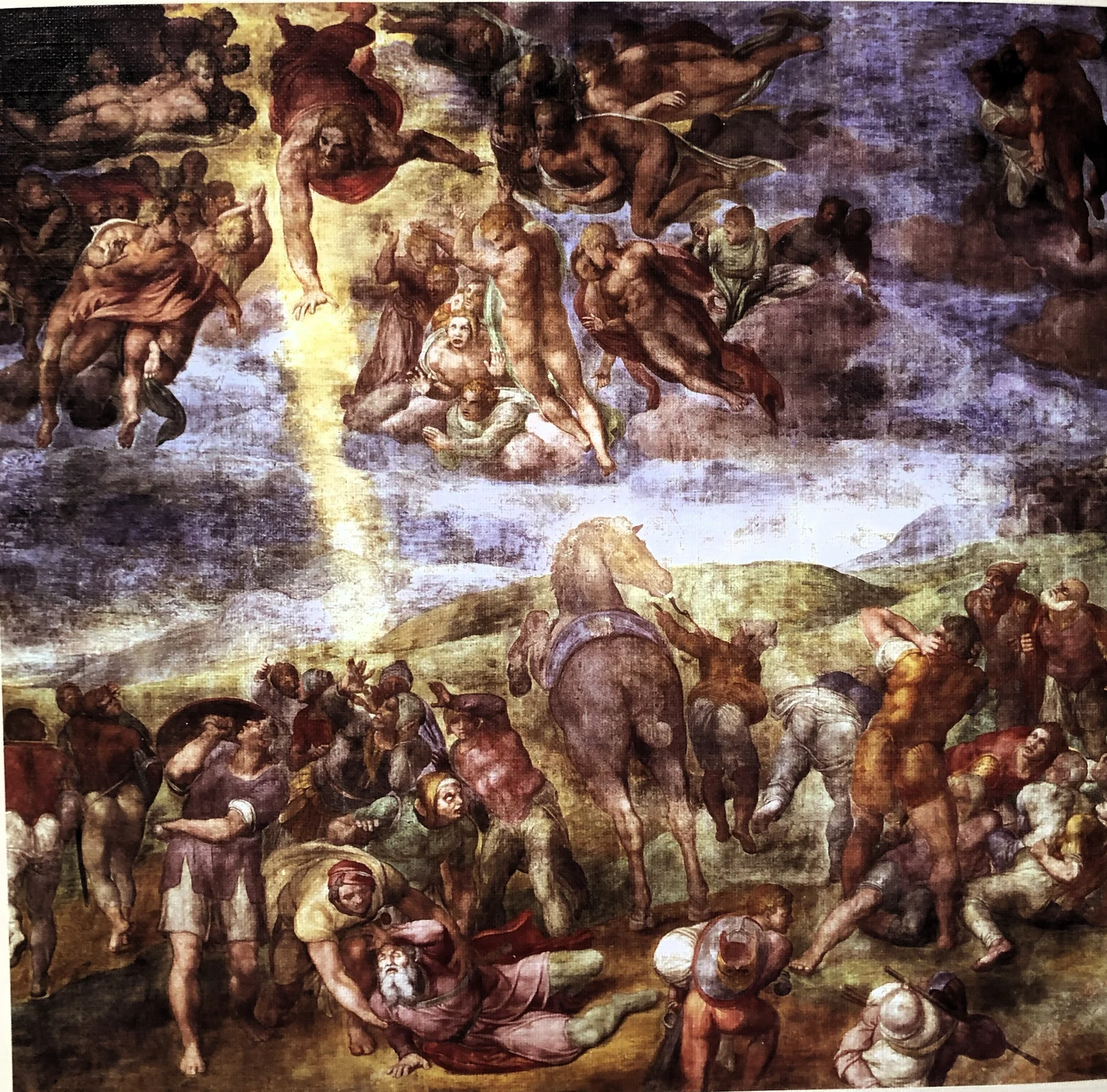
THE CONVERSION OF SAINT PAUL
Michelangelo Buonarroti
- Artist
- Michelangelo Buonarroti (1475–1564)
- Date
- Between 1542 and 1545
- Dimensions
- 660.5 x 625 cm
- Medium
- Fresco
- Location
- Cappella Paolina (Pauline Chapel), Vatican City, Rome, Italy
Since The Conversion of Saint Paul was one of the last paintings by the outstanding genius of Renaissance painting, sculpture and architecture, we can also regard it as a kind of revelation. The fresco, together with another mural, was commissioned by the pope for his private chapel in the Vatican, and these two works not only testify to Michelangelo’s deep faith in God but also represent the powerful ideals of the Catholic Counter-Reformation.
A Decade of Difficulties
The 1540s were a difficult period for Michelangelo. When Pope Paul III commissioned him to paint the frescoes of the Cappella Paolina (Pauline Chapel), the artist had already completed his wonderful masterpieces in the Sistine Chapel: first his dazzling multi-figure ceiling frescoes celebrating human beauty (1508–1512), and later the Last Judgement, his terrible and at the same time sobering vision of the Second Coming of Christ (1536–41).
Michelangelo refused to begin painting the Pauline Chapel frescoes until Pope Paul III had settled the matter of the tomb of Julius II. The monumental work, originally commissioned in 1505, had often been interrupted by other commissions. The artist complained to the pope: “…I paint with my head, not my hands… until the tomb is finished, I cannot do good work.” Finally, in 1542, the pope gave permission for the work to be completed.
While painting The Conversion of Saint Paul, Michelangelo fell seriously ill twice and needed rest. In the late 1540s, when he was working on the fresco The Crucifixion of Saint Peter, he suffered from gallstones. As with the Sistine Chapel frescoes, Michelangelo decided to work on these two new commissions alone, with his own hands, which would have been a difficult task for any other artist, but even more so for a man contemplating his own mortality.
Why Saint Paul?
The apostle Paul was born around AD 5. A Jewish lawyer from Tarsus, he took part in the persecution of Christ’s early followers. When Saul (his name before his conversion) set off for Damascus to capture and punish the Christians, on the lonely road he experienced the wondrous experience of conversion. Michelangelo may have had many reasons for choosing the conversion of St Paul and the crucifixion of St Peter as the subjects of his frescoes. On the simplest interpretation, Paul represented the pope’s namesake, while Peter represented the “prince of the apostles”, from whom all popes derived their descent. But other factors also played a part in the artist’s decision. The Reformation launched by Martin Luther in 1517 had seriously shaken the authority of the papacy, and the Catholic Church responded vigorously with the Counter-Reformation. Enjoying the patronage of Christianity’s holiest power, Michelangelo made the following bold statement: conversion (Paul) and martyrdom (Peter) must be honoured as the fundamental moments of the life of faith.
Blinded by Light
The Conversion of Saint Paul depicts the moment mentioned in the Bible when Saul is converted on the road to Damascus. Michelangelo sets the scene in a barren landscape, where the city walls are only outlined on the horizon. Christ sends forth from his right hand a bright beam of light, which has struck Saul to the ground and temporarily blinded him. One of his companions kneels beside him to help him, another tries to rein in the frightened horse. A soldier fearfully raises his shield, but all three turn away from the beam of light, as if they had sensed its power. Two men press their hands to their ears; we can almost imagine them deafened by the voice of Jesus: “Saul, Saul, why persecutest thou me?”
The sky is split in two by the majestic figure of Christ, the lower part of whose body, depicted in perspective foreshortening, is counterbalanced by his strong arm. Around him float angels who, unlike the fleeing figures below, face him. The two groups, the angels and those with physical bodies, form two ovals balancing each other. The beam of light symbolising divine grace is the only real link between the two worlds of time and eternity.
The horse in the middle of the crowd trying to flee mirrors the central figure of Christ and at the same time completes the dizzying three-way back-and-forth rotation between the figures of Christ, Saul and the horse, with which the artist further emphasises the confusion reigning in the scene. The horse’s symbolic meaning: it represents liberation from the sin of pride, as Saul/Paul is obediently ready to submit to God’s will.
The two frescoes draw attention with their delicate, wonderful colours, which have shone in their former glory again since the most recent restoration (July 2009).
Artistic Connection
Michelangelo Merisi da Caravaggio (1571–1610) is known for his style radiating heightened emotion and for his naturalistic figures depicted in dramatic lighting, which he painted with extraordinary truth to nature. Caravaggio treated the subject of the conversion of St Paul in two paintings made around 1600–1601. In the first (pictured) Christ reaches towards Saul, struck to the ground, the diagonal line of his outstretched arm extended by a soldier’s levelled lance. In the second painting Caravaggio uses a powerful theatrical setting: the young Saul lies at the feet of his horse and groom, his figure enveloped in divine light, whose source the artist cleverly leaves to our imagination.
- Pope Paul III
- Michelangelo: The Crucifixion of Saint Peter