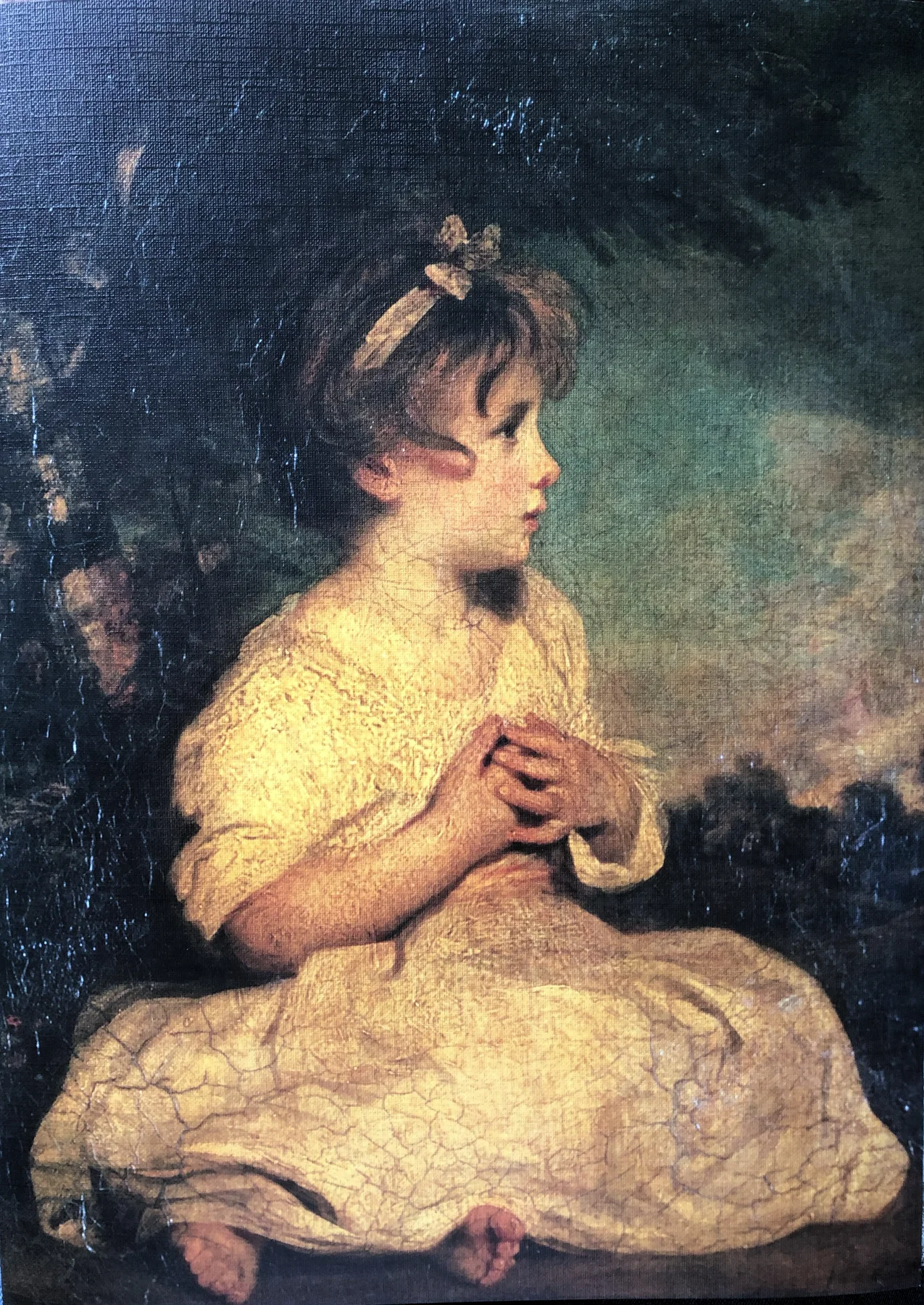
THE AGE OF INNOCENCE
Sir Joshua Reynolds
- Artist
- Joshua Reynolds (1723–1792)
- Date
- c. 1788
- Dimensions
- 76.5 x 63.8 cm
- Medium
- Oil on canvas
- Location
- Tate Gallery, London, United Kingdom
A master of colour, composition and the depiction of the human figure, Sir Joshua Reynolds was one of the most successful British artists not only of his own generation but of all time. He became best known for his superb portraits of figures of 18th-century society. His works are instantly recognisable; he painted in the so-called “grand manner”, for which he drew inspiration from the lavish colours and textures of the Italian Renaissance. Extremely ambitious and with excellent business sense, Reynolds rose to the top of the Royal Academy, yet pictures such as The Age of Innocence testify that he was motivated not primarily by wealth and fame but by a sincere love of painting.
Fancy Pictures
The Age of Innocence is one of Reynolds’ best-known and most popular works; between 1856 and 1893 it was copied full size in oil 323 times. The painting belongs to Reynolds’ so-called “fancy pictures”, which are character studies. He often portrayed children in simple, pastoral settings. Reynolds made these snapshots of everyday life for pleasure rather than on lucrative commission, so they are much more personal in tone and far less formal than his portraits.
Sitting for a Reynolds painting must have been an exciting experience. According to one of his sitters, Reynolds “studied me and the picture at length as we stood side by side, then ran to the portrait and began painting like one possessed. Sometimes I thought he would confuse us and paint on me instead of the picture.” When it came to children, however, Reynolds was much calmer and more understanding. He often told his sitters stories to keep them sitting still. This method had the further advantage that he could also conjure up some charming expressions from the children.
A Mysterious Model
The identity of the model for The Age of Innocence is still a matter of debate. Several possible candidates have been suggested, including Lady Anne Spencer, daughter of the 4th Duke of Marlborough, whom Reynolds portrayed in a family group in the late 1770s. More likely, however, the picture shows Theophila Gwatkin, the daughter of Reynolds’ niece, who also appears in his picture Simplicity (c. 1785). Since Reynolds painted these pictures for his own pleasure and was known to work on them for months, often at his own expense, it is much more plausible that his relatives sat for him than paying clients.
A New Name
Similar doubts surround the date of the picture. The uncertainty stems from the fact that the painting’s present title was only attributed to it two years after Reynolds’ death in 1792. One of the engravings made of the work in 1794 bore the title The Age of Innocence, and the title seems to have stuck in the public mind, erasing the previous one from memory.
It is thought that Reynolds may originally have given his picture the simple title A Little Girl; the same title was borne by a work painted in 1785 and exhibited at the Royal Academy that same year. A contemporary report on the exhibition in The Morning Herald describes the picture thus: “A little girl in an easy attitude in a grassy glade”. The title is consistent with the prosaic names Reynolds often gave his fancy pictures, and as far as we now know the two paintings are one and the same.
A Damaged Gift
The Age of Innocence, which now enriches the Tate Gallery’s collection, was originally a gift from the collector Robert Vernon to the National Gallery in London in 1847. The painting came to its present home a little over a century later, in 1951, but by then it was in a worn condition, its surface heavily cracked in several places. Although Reynolds once said that “the best paintings are full of cracks”, this problem was largely due to his own working method. Throughout his career Reynolds experimented a great deal with techniques and materials, and he did so most of all in his fancy pictures. Driven by natural curiosity and the desire to rival the techniques of the old masters, he explored the possibilities of various materials: he used wax, bitumen, resins, oils and other substances, as well as unreliable pigments and varnishes whose quality deteriorated considerably over time.
The most recent X-ray examinations of the painting have revealed that, curiously, Reynolds painted The Age of Innocence over another famous fancy picture of his, The Strawberry Girl (1773). Several versions of that painting survive, but this one is said to have been so damaged that within a decade it was beyond repair. Instead of throwing away a perfectly good canvas, Reynolds decided to reuse it for The Age of Innocence. Interestingly, he reused not only the canvas: the little girl’s clasped hands are exactly the same as on the former “Strawberry Girl”.
- Reynolds: The Children of John Julius Angerstein
- The Strawberry Girl