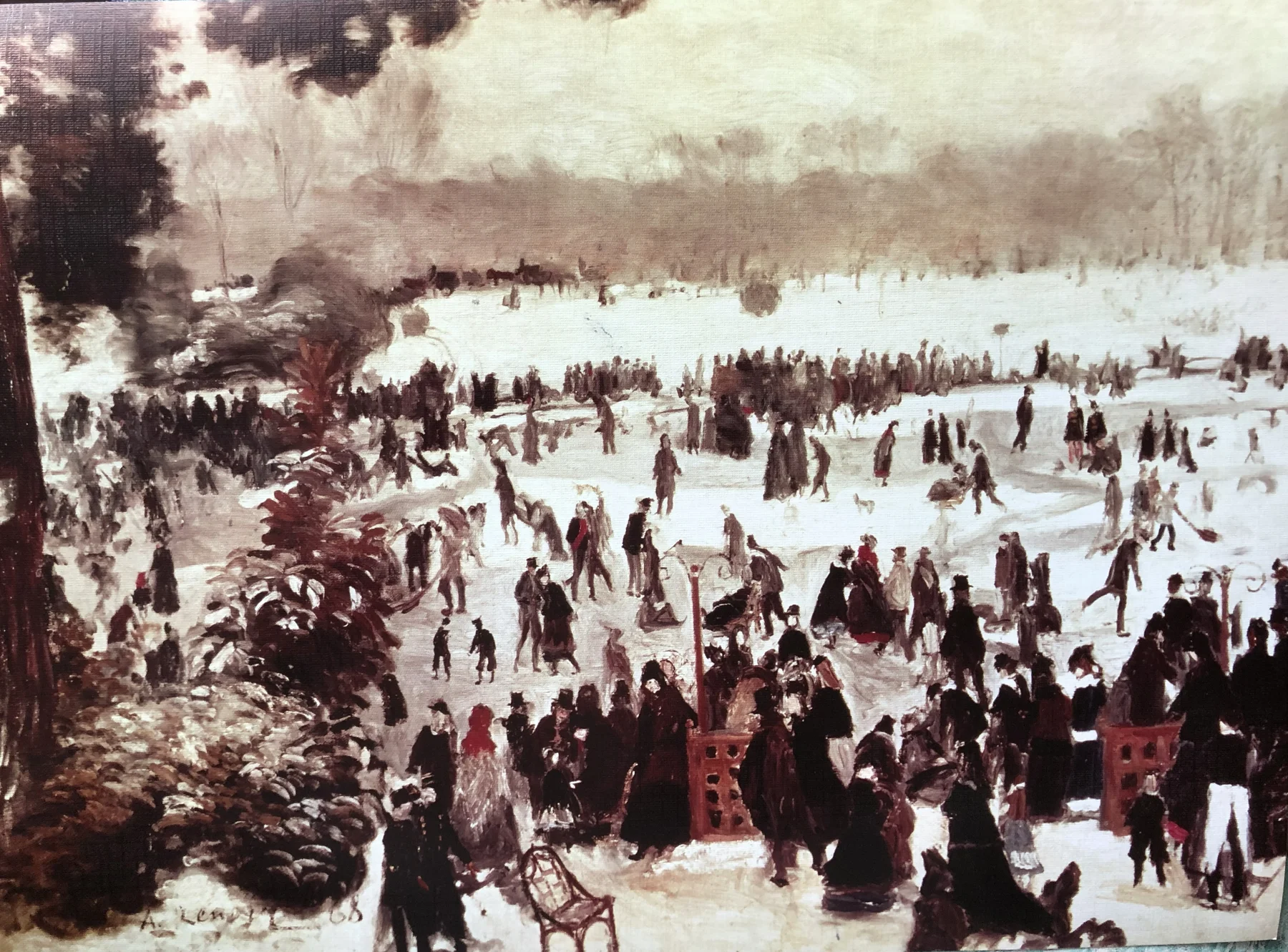
SKATERS IN THE BOIS DE BOULOGNE
Pierre-Auguste Renoir
- Artist
- Pierre-Auguste Renoir (1841–1919)
- Date
- 1868
- Dimensions
- 72 x 90 cm
- Medium
- Oil on canvas
- Location
- Phillips Collection, Washington D.C., USA
Set in the harsh Parisian winter of 1868, Skaters in the Bois de Boulogne masterfully evokes the light and mood of the season and the joy of life. The painting by one of the founders of Impressionism bears all the characteristics of the new style, which is why it seems strange that the picture predates the movement’s official “birthday” in 1869. That summer Renoir and Monet travelled to the riverside resort of La Grenouillère in the suburbs of Paris, where they painted a series of six dappled pictures of the river. These are regarded as the first Impressionist works. The paintings, which made a great impact in their time, are still considered important milestones in art history, but they cannot claim priority, since the Impressionist revolution was already well under way in 1869, as Skaters in the Bois de Boulogne testifies.
The Bois de Boulogne
The Impressionists — Monet, Bazille, Pissarro, Sisley and Renoir — met in Paris in the early 1860s. In and around this city they worked feverishly to capture the life of the bustling promenades and the picturesque, rural mood of the outer districts. The setting of Renoir’s winter scene is the Bois de Boulogne, a large wooded park west of central Paris. It was founded by Napoleon III in 1852 to rival London’s Hyde Park. People flocked to the opening of the Bois de Boulogne, which covers an area more than twice the size of New York’s Central Park, and Napoleon’s park soon took over from the Champs-Élysées as the main attraction. The rich travelled here by carriage, others came by public transport or on foot, but everyone sought refreshment here, escaping the bustle of the big city, an opportunity to relax and enjoy life’s simple pleasures.
Depicting People
Although the Impressionists placed the emphasis primarily on landscape painting, Renoir also showed great interest in depicting people. Fortunately the Paris of the 1860s offered many opportunities for this, as the urban middle class increasingly delighted in leisure activities and outdoor pursuits. One of the first to record the new lifestyle was an artist whom the Impressionists all looked up to: Édouard Manet. In his picture Music in the Tuileries Gardens (1862), top-hatted gentlemen and elegantly dressed ladies converse and pass the time under the shady trees of one of the most beautiful public parks in Paris.
Following in Manet’s footsteps, Renoir and the Impressionists became the main visual biographers of the age: in their paintings they presented the lively café life of Paris and portrayed theatre audiences, dancers, boaters and swimmers.
A Winter Wonderland
Of the Impressionists, Renoir was perhaps closest in spirit to Manet: Skaters in the Bois de Boulogne shows many similarities with his older colleague’s painting of the Tuileries Gardens. In Renoir’s winter wonderland men, women, children and happily barking dogs gather around the park’s two lakes. While some simply look on and chat, many venture onto the ice to enjoy the pleasures winter offers. Like Manet’s picture, Renoir sacrifices detail for the liveliness of the overall effect. Vivid colours flash — here a red scarf, there a yellow sledge — leading the eye from one interesting figure to another. The artist depicts the snow-covered trees with his familiar light brushstrokes and lively patches of light; the sky plays in blue and pink, mixed with a little yellow where thin rays of sun try to break through the shroud of clouds. Similarly, the snow is not pure white, since Renoir maintained that “white does not exist in nature”.
Snowy Subjects
Although Renoir is best known for his summer landscapes in which the sun backlights his figures, the picture of the Bois de Boulogne is not exceptional in his oeuvre. In the same year he painted the atmospheric Landscape, Snow Effect, which is even closer to Impressionist ideals. In 1870, a year after the genre-founding trip to La Grenouillère, he made Snowy Landscape, a fine example of his distinctive style, with its purple-tinted snow and trees dappled with sunlight. Snowy landscapes like this were a popular subject for all the Impressionists, who were as preoccupied with the play of light on snow as with its reflection on the surface of water, and snow also brought something new. Alfred Sisley, perhaps the group’s most prolific artist, made picturesque pictures of the snow-covered suburbs of Paris, and Pissarro also painted similarly atmospheric scenes in London in the early 1870s. What distinguishes these pictures from Renoir’s Skaters in the Bois de Boulogne is the more emphatic role given to the depiction of the landscape compared with the human figures. Like many of Renoir’s other paintings, Skaters in the Bois de Boulogne conveys a special relationship between setting and people, which is what makes the picture so spectacular.
- Renoir: La Grenouillère, 1869
- The Bois de Boulogne at the time the painting was made
- Manet: Music in the Tuileries Gardens, 1862
- Renoir: Landscape, Snow Effect, c. 1868