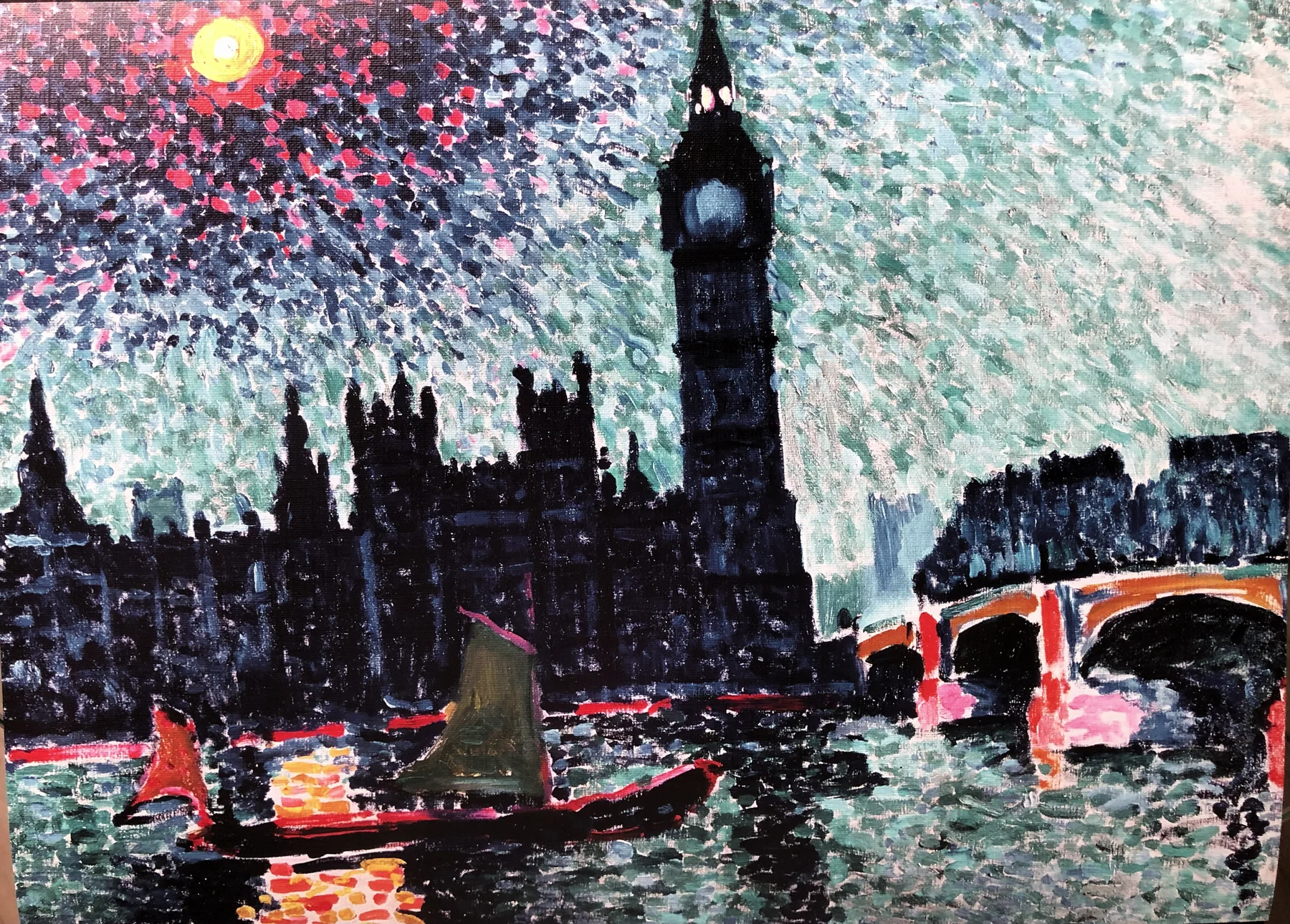
THE HOUSES OF PARLIAMENT, LONDON
André Derain
- Artist
- André Derain (1880–1954)
- Date
- 1906
- Dimensions
- 79.1 x 86 cm
- Medium
- Oil on canvas
- Location
- Museum of Modern Art, Troyes, France
André Derain was one of the most radical and controversial French painters of the early 20th century. A tireless innovator who experimented with different styles throughout his career, he is regarded as one of the very first exponents of a short-lived but extremely influential art movement, Fauvism. Developed together with Henri Matisse and Maurice de Vlaminck, the movement’s style is characterised by expressive brushstrokes, simplified composition and above all the use of pure, dynamic colours.
Wild Beasts
The name “Fauvism” comes from the French word Fauves, meaning “wild beasts”. The term was first used by a critic named Louis Vauxcelles in response to an exhibition by a group of painters at the Salon d’Automne in Paris in 1905, which announced the birth of a new, distinctive art movement, Fauvism. The critic’s wrath was directed mainly at works such as Matisse’s The Green Stripe (1905), in which the artist depicted his wife with a repugnant green nose, and Derain’s Collioure (1905), an unconventional Mediterranean landscape he painted in Matisse’s company that same summer. Derain’s painting, made of vibrant patches of paint applied expressively, is a riot of colour and the defining work of his Fauvist period (1905–1908), but its simplicity and strong colours also raised doubts.
First Recognition
Since the appearance of Impressionism nearly four decades earlier, no group of artists had shocked the critics as much as the Fauves. Many judges considered their paintings crude and unfinished, yet some appreciated the new approach, notably the avant-garde Paris art dealer Ambroise Vollard, who had on many occasions represented Van Gogh, Renoir and Picasso. Vollard first took to Derain’s works at the 1905 exhibition of the Salon des Indépendants, which had broken away from the traditional Paris Salon, and then also visited the notorious Salon d’Automne. While some reacted to the event by sticking labels on it, Vollard expressed his opinion in an entirely different way — a few days later he bought Derain’s entire studio. This gave the artist unprecedented financial independence, as well as wide publicity among an increasingly receptive public.
A Visit to London
The following year Derain painted The Houses of Parliament, London, one of 30 London townscapes he made on Vollard’s commission during his two visits to the English capital in 1906 and 1907. Vollard knew of the enormous success of Claude Monet’s Impressionist London pictures at the 1904 Paris exhibition and wanted Derain to compete with him. In many ways he set Derain a challenge: he gave him the opportunity to rival the works of the great French master and to create a new spirit with his inimitable style.
A Dazzling Painting
When Derain arrived in London, he was at first disappointed by what he saw: “Everything here is dead… you can’t hear anything.” The same cannot be said, however, of the paintings he made here, which reflect explosive energy and vitality. The Houses of Parliament, London is in fact a first work of Fauvism, a dazzling mosaic of vivid colour contrasts. Derain depicts the distinctive clock tower and the surrounding buildings in silhouette, in green and turquoise tones that are reflected in the sky and on the vibrant surface of the water. From on high the sun, ringed in red, pours forth its rays, bathing Westminster Bridge in orange and pink light. Although Derain observed the scene from the riverbank, his strangely swirling horizon gives the impression that he painted the picture bobbing up and down on the water, creating an Impressionist sense of spontaneity. In reality, however, the contrast with Impressionism could not be greater. While Impressionist artists such as Monet remained faithful to nature and captured fleeting, authentic “impressions” of light effects, the Fauves rejected naturalism completely, treating colour far more arbitrarily and emotionally and, in Derain’s words, creating “deliberate disharmony”. As a result, Monet’s poetic, smog-shrouded London seems filtered through a golden veil, while Derain’s real city sparkles like a firework display.
An Experimental Painter
While Monet painted from relatively few viewpoints, from the windows of St Thomas’ Hospital or his room at the Savoy Hotel, Derain roamed further. Walking along the riverbank, he captured the landmarks he saw, such as London Bridge, St Paul’s Cathedral and stretches of the Thames, and only a few times ventured into the city to paint bustling Regent Street or visit the British Museum or the National Gallery. Of the 30 paintings made during Derain’s two visits, 29 survive. They offer a special insight into the artist’s experimental methods. Although these pictures exemplify the vivid, expressive colours of the Fauves, many other influences can be discovered in them. In The Houses of Parliament, London, for example, Van Gogh’s swirling, mosaic-like motifs are striking, while in other paintings Seurat’s pointillist style, Signac’s broken brushstrokes and Cézanne’s brilliant colour range can be detected. Derain clearly drew much from the works of contemporary artists, but he never imitated. An innovator to the core, he filtered what he had learned through his vivid imagination and created something new and extraordinary that was entirely his own.
Masterpiece Connection
Known as the “painter of light”, J. M. W. Turner (1775–1851) was perhaps the greatest British landscape painter who ever lived. In his picture The Burning of the Houses of Lords and Commons (1834) he presents his own otherworldly vision of the Parliament building across the Thames, without depicting details, concentrating only on the terrifying power of nature. Some of Derain’s later works undoubtedly reflect Turner’s influence, but even in his earlier Fauvist period he acknowledged Turner’s influence on his artistic creed. In 1906 he said of it: “Turner authorises us to create forms that go beyond traditional realism.”
- Ambroise Vollard
- Regent Street, 1907