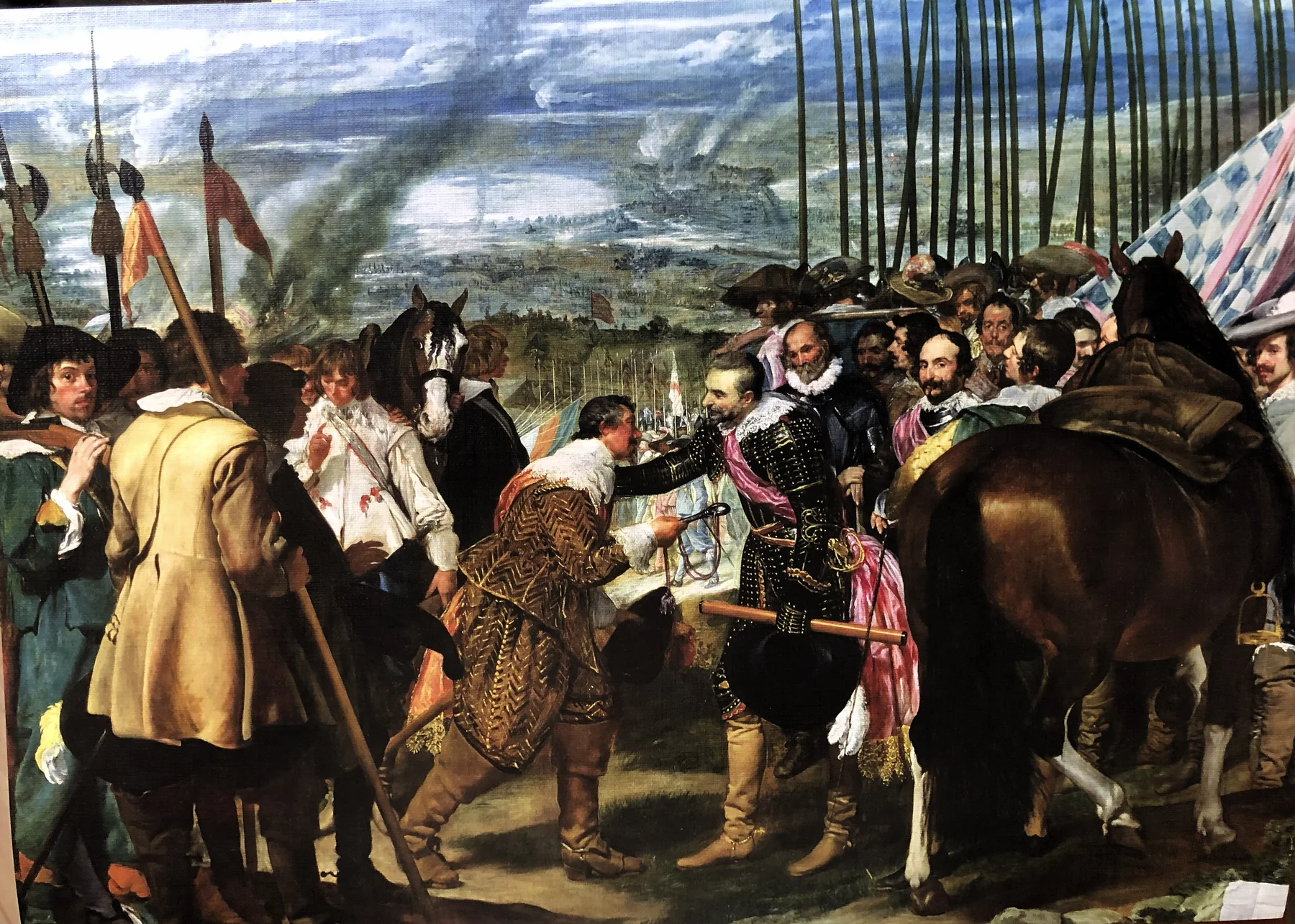
THE SURRENDER OF BREDA
Velázquez (Diego Rodríguez de Silva y Velázquez)
- Artist
- Diego Rodríguez de Silva y Velázquez (1599–1660)
- Date
- Between 1634 and 1635
- Dimensions
- 307 x 367 cm
- Medium
- Oil on canvas
- Location
- Museo del Prado, Madrid, Spain
Today regarded as one of the greatest Spanish painters, Velázquez was a celebrated portrait painter in his lifetime, but he also created superb full-length and history pictures. The Surrender of Breda, recording the victory of Spanish troops over the Dutch, is regrettably Velázquez’s only surviving work on a historical subject.
Key Historical Events
Velázquez painted The Surrender of Breda some ten years after the historical event, to decorate the Hall of Realms of the newly built royal palace of Buen Retiro on the outskirts of Madrid. King Philip IV’s ambitious chief minister, Olivares, intended to decorate the Hall of Realms with royal portraits and history paintings presenting the victories won by the royal armies since 1621. Velázquez, painter to His Majesty and the Count-Duke (Olivares), and seven other artists, including Juan Bautista Maino and Francisco Zurbarán, were commissioned to depict important historical events of the past in life-size, landscape-format pictures.
Although Duke Olivares himself chose the subjects, Velázquez was commissioned to make only one history picture for the grand undertaking. His The Surrender of Breda depicted an event well known to the Spanish public of the time, in which the Spanish general Ambrogio Spinola receives the keys of the defeated city of Breda, the chief fortress near Antwerp, from Justin of Nassau, the defeated Dutch governor. In the war launched to thwart Dutch aspirations for independence, the Spanish forced Justin of Nassau to capitulate in early June 1625 after a long siege.
From Palace to Prado
The Surrender of Breda was probably finished in the spring of 1635 for the ceremonial opening of the reception room of the new royal palace. Velázquez probably played a significant part in the decoration of the Hall of Realms, since records show that in June 1635 he received 2,500 ducats for this painting and other pictures exhibited in the palace. The Surrender of Breda, together with most of the history paintings of the Hall of Realms, can now be seen in the Prado Museum in Madrid.
Recording History
The Surrender of Breda reflects the artist’s unparalleled confidence in handling large figures, although it was only his second work on a historical subject. Velázquez’s picture glows with light, illuminating everything from the back of the figure on the left leaning on his lance to the broad field of the distant battlefield. He creates atmosphere for his scene and lends it a solemnity befitting the occasion; he records the historical moment as if he had been there.
A Captivating Depiction
The Surrender of Breda places the emphasis on the surrender marking the end of the fighting and the beginning of peace negotiations between the Spanish and the Dutch. None of the contemporary historical accounts mentions that the defeated Justin of Nassau handed over the keys of the city to Spinola, as seen in the picture’s main motif: Velázquez may have taken the idea of this symbolic representation of surrender from a play by the Spanish playwright Calderón.
Despite the fact that two enemy armies meet on the battlefield, Velázquez depicts the scene with incredible emotion and humanity. We witness a moving event: with a friendly and consoling gesture the Spanish general reaches out and touches the shoulder of the weary, stooping Dutch governor. The diagonal line of the arm emphasises the direct eye contact between the two generals, and the Spanish dignitaries standing behind Spinola also watch the scene with sympathy. On the side of the victors not the slightest sign of gloating or arrogance can be seen, only the expression of humility and nobility in recognition of the heroic resistance shown by the defeated general and his troops.
Just a Moment
X-rays of the painting have revealed some changes to the picture, which are still visible today. Velázquez, for example, tried depicting the horse from several angles before finally choosing the rear view, showing the animal’s rump, tail and huge, bulging belly. The viewpoint is unusual but fits perfectly into the scene, as he depicts the horse’s raised right hoof in motion, at the moment of shifting position. With this setting Velázquez emphasises the documentary character of the picture, capturing the moment, just as with the young Dutchman in white, who seems to be asking for a second of silence with his raised right hand.
- Velázquez: Equestrian Portrait of the Count-Duke of Olivares
- Interior of the Prado
- Velázquez: The Marquis Ambrogio Spinola