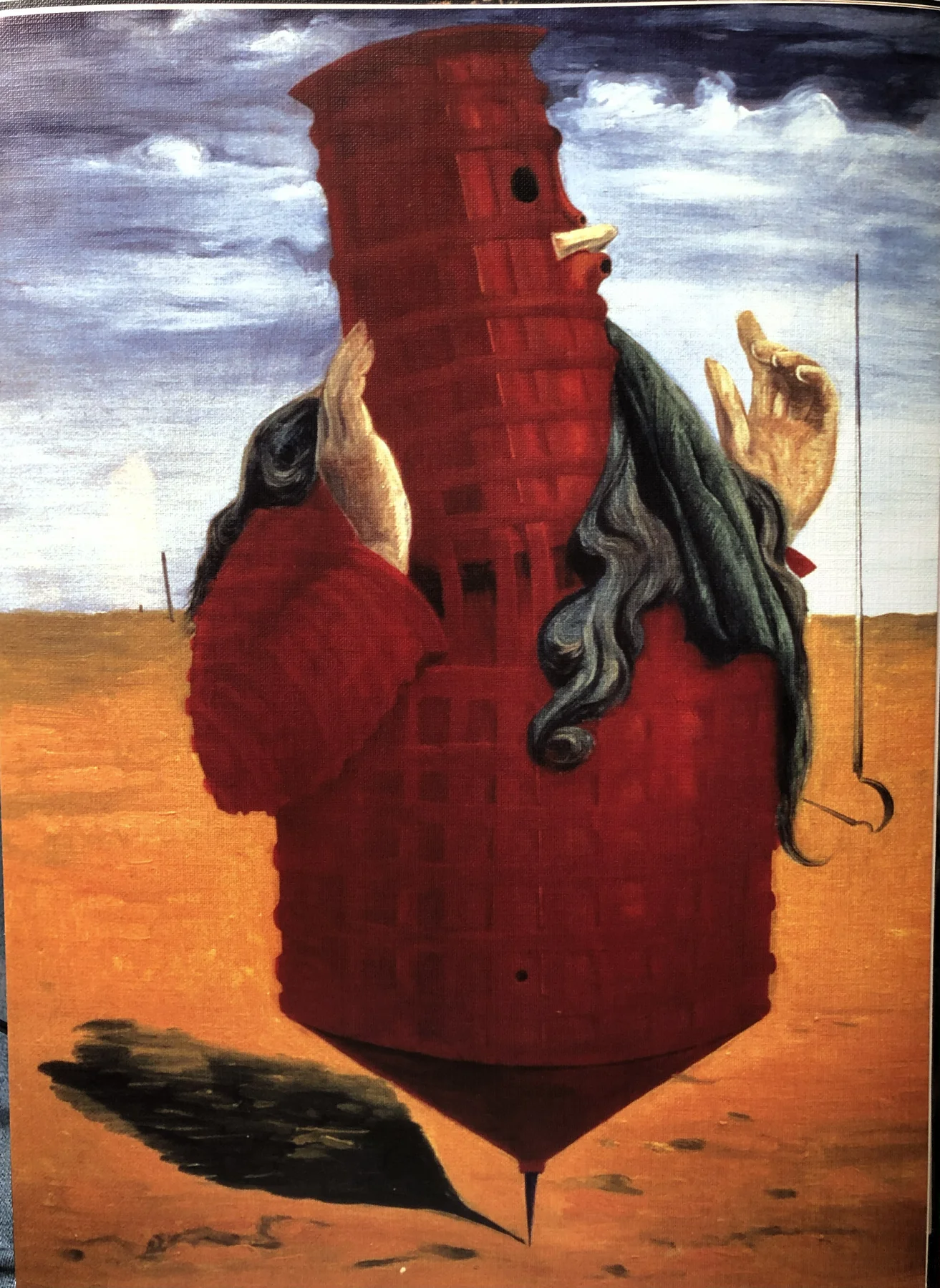
UBU IMPERATOR
Max Ernst
- Artist
- Max Ernst (1891–1976)
- Date
- 1923
- Dimensions
- 100 x 81 cm
- Medium
- Oil on canvas
- Location
- Musée National d'Art Moderne, Centre Pompidou, Paris, France
The German-French painter Max Ernst was one of the most inventive artists of his time, constantly experimenting with new graphic techniques and challenging people’s perception of reality. After his success with collage technique, in the early 1920s he switched to oil painting and came up with series of realistically executed but endlessly startling pictures, which are regarded as the earliest Surrealist works. His work Ubu Imperator was inspired by a childhood nightmare and by the grotesque anti-hero of a satirical play popular at the time.
From Dada…
Ernst was deeply shaken by the First World War and gave vent to his oppressive feelings through Dada. The Dada movement, which emerged in several cities at once around 1916, rebelled against the cultural values of a society that had led the world into the horrors of a senseless war. Aiming to shock the public, Dada artists often held their exhibitions in outrageous venues, such as public toilets.
In 1919 Ernst made strange collages from antique engravings. At the request of the French writer André Breton, in 1921 he sent 56 collages to Paris for his first solo exhibition. Although he could not attend the event in person (as a former German soldier he was not granted an exit permit), his works were received with acclaim by the Paris Dada group. In 1922 Ernst joined them in Paris and also took a job in a factory to support himself.
Meanwhile Ernst created works that already led into the realm of the subconscious, and he began to apply collage technique in his paintings too. In his work Oedipus Rex (1921) — in which huge fingers pierced by sharp objects hold a giant nut — for example, he painted the different pictorial elements realistically, but like his collages he juxtaposed them in such a way that the picture is very hard to interpret. The same applies to his painting Celebes (1921), the image of a monster created from an African grain-storage vessel.
…to Surrealism
In 1922, however, Breton broke with Dada, feeling that the movement had exhausted its possibilities. Seeking new paths and partly inspired by Sigmund Freud’s theories, he and his circle of friends spent their evenings in trance and word-association séances. Through the “automatism” of these activities they wanted to free the subconscious from the shackles of logical thought and bring a new form of reality to the surface. In this way they took the first steps towards Surrealism, which formally became a movement with Breton’s first Manifesto in 1924.
A Great Spinning Top
Ernst’s realistic style can also be seen in Ubu Imperator, but here painterly freedom is beginning to come to the fore over the collage effect. A monumental figure resembling a spinning top stands with a startled expression in a deserted landscape. Its blood-red armour — for which an old clay mould of a bronze cannon or a steam locomotive may have served as a model — is covered with green hair or some kind of fabric, and the object to its right may be a scythe or a whip, or perhaps a needle and thread. The distant column emerging on the horizon emphasises the depth of the picture.
The Nightmare
Ernst did not like his paintings to be “over-explained to the extreme”, but certain pictorial elements of Ubu Imperator can be traced back to a childhood nightmare, which he later mentioned in his memoirs. In this vision a “glossy black man” draws various figures with a thick crayon on the surface of an imitation mahogany panel. These creatures fill little Max with “fear and dread”. The man collects them in a vase “and then stirs the contents of the vase with his crayon, faster and faster. The rapidly spinning vase turns into a spinning top, and the crayon into a whip. Only now do I realise that this strange painter is my father… With satanic fury he spins the top so that the hideous toy jumps into my bed, with all the horror my father could conjure with his dreadful crayon on the imitation mahogany panel.”
Which Ubu?
The painting’s title alludes to the monstrous anti-hero of Alfred Jarry’s scandalous play Ubu Roi. Jarry (1873–1907) created his title character while still at school, modelled on an obese mathematics teacher; later, in his short adult life, he developed the manuscript into a satire mocking the greed of the bourgeoisie. After the audience greeted the play’s premiere in 1896 with loud disapproval, however, Jarry was forced to present his work in puppet theatres, and it could return to the stage only in 1907. The Surrealists were naturally inspired by Jarry. In the title of his painting Ernst promoted the king to emperor.
- Opening of Max Ernst’s 1921 exhibition
- A worker drying the clay moulds of a cannon
- Alfred Jarry