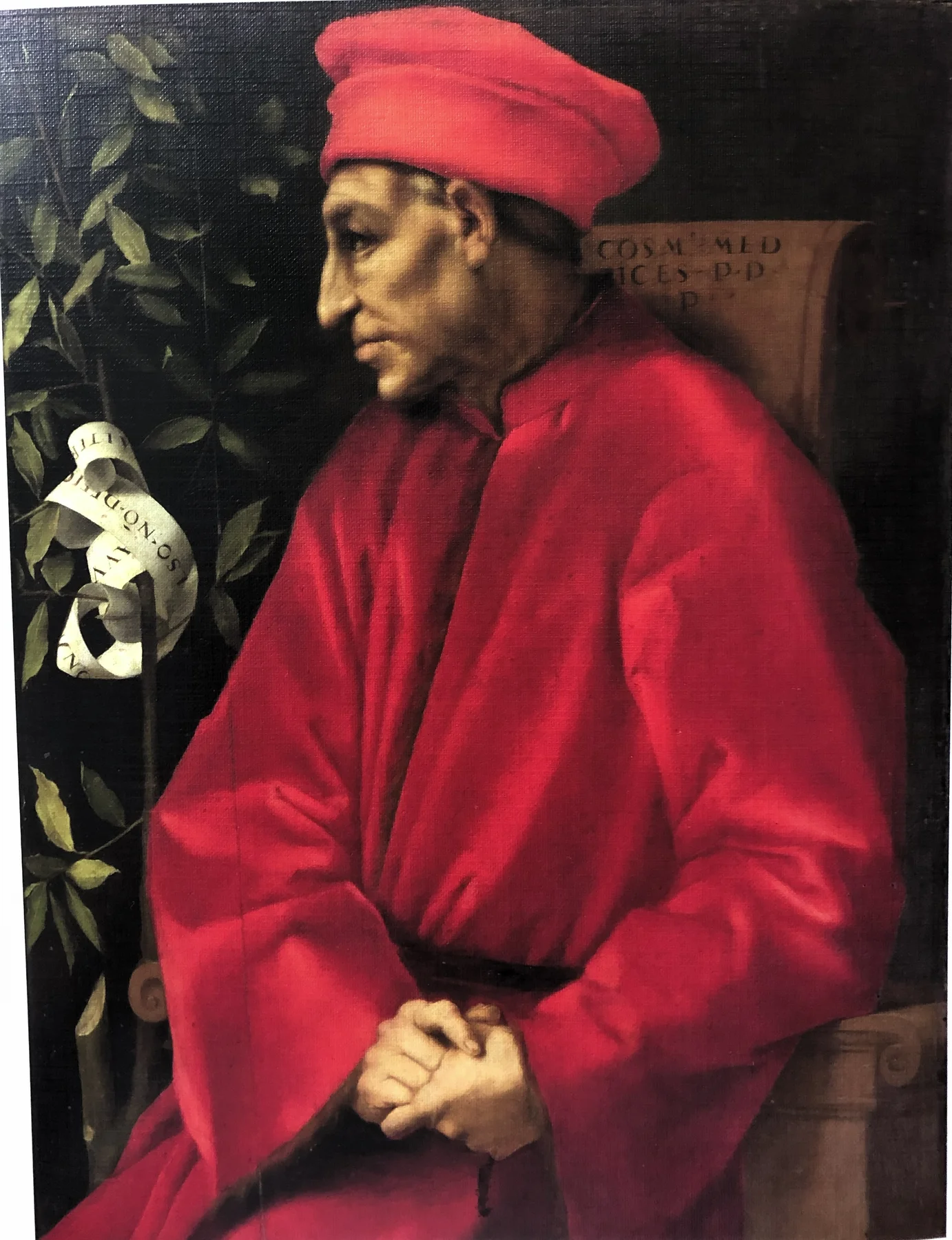
PORTRAIT OF COSIMO DE’ MEDICI
Pontormo (Jacopo Carucci)
- Artist
- Pontormo (Jacopo Carucci) (1494–1557)
- Date
- c. 1519
- Dimensions
- 86 x 65 cm
- Medium
- Tempera on panel
- Location
- Galleria degli Uffizi, Florence, Italy
Jacopo Carucci, better known as Pontormo, the name he took from his birthplace, was a Florentine painter who, thanks to his original talent and distinctive style, won the favour of the greatest patron family of the late Renaissance, the Medici. Pontormo trained under Leonardo da Vinci — Michelangelo praised him as a rising star — and soon became one of the most respected and sought-after painters in the city. As a mark of esteem, he was chosen to create a painting glorifying the continuity of the Medici bloodline, the Portrait of Cosimo de’ Medici.
A Posthumous Portrait
Pontormo always painted from life, so the Portrait of Cosimo de’ Medici, made more than half a century after the nobleman’s death in 1464, is unusual in his oeuvre. The painting was in fact not intended as a simple portrait, and the presence of the Medici patriarch in the picture is actually almost entirely symbolic. The painting was commissioned around 1519 by Goro Gheri, the influential secretary of the then head of the Medici clan, Lorenzo II, Duke of Florence. In May of that year Lorenzo II passed away, breaking the main branch of the Medici line. A few weeks later, however, a boy was born to another Medici descendant, who thus filled the void and practically brought the family name back from the brink of extinction. After Lorenzo’s death the governing of Florence fell to Gheri, who, as a loyal Medici servant, commissioned a picture to mark the birth of the new heir.
Moving Symbolism
It is believed that the Portrait of Cosimo de’ Medici was intended as a gift for Lorenzo II’s uncle, Pope Leo X, who was seriously worried about the continuity of the family tree. Pontormo’s picture is both a celebration and a reminder of this key moment in family history. The portrait depicts Cosimo de’ Medici in a calm posture, in a luxurious red robe. Perhaps he is looking into the future, which by then seems secure. Beside him we see the emblem of the Medici family, a broken laurel branch, the Broncone, with a new, symbolic shoot. On the ribbon wound around the shoot is a line from Virgil’s epic, the Aeneid: “When one dies, another takes its place.” The first designs of the Broncone are associated with Cosimo’s grandson, Lorenzo il Magnifico, and Pontormo evokes it here to symbolise the link between the first head of the family and its future leader.
An Original Style
Interestingly, Pontormo’s painting is a three-quarter portrait. This form was first popularised by Leonardo da Vinci with his Mona Lisa (c. 1503–1506), and it became increasingly popular during the 16th century. Nevertheless this was Pontormo’s only concession to the trends of the time. Despite the irresistible influence of Renaissance greats such as Da Vinci, Raphael and Michelangelo, Pontormo went his own way and was able to develop a distinctive, unique style. In the last period of the Renaissance, which culminated in Raphael’s death in 1520 and the Sack of Rome in 1527, Pontormo emerged as one of the leading exponents of a new painting style, Mannerism. Deriving from the Italian word “maniera”, meaning style, Mannerism was a highly dramatic, deliberately artificial movement that created continuity between the Renaissance and the Baroque.
Imitating Nature
During the Renaissance artists were taught to observe nature; they studied disciplines such as optics, geometry and anatomy, thereby rising among the learned professions. Pontormo, however, departed from this line, sacrificing the idealised realism of the Renaissance for a more emphatic emotional approach characterised by vivid colours, distorted forms, expressive lines and unusual perspectives. Pontormo created above all religious works, and his distinctive style is most powerfully shown in works such as the dazzlingly coloured Deposition (1525–1528), whose grief-stricken figures almost float in the air. He was nevertheless also an excellent portrait painter, and one of the finest examples of his style is Monsignor della Casa (c. 1541), in which he unnaturally elongated the sitter’s body, emphasising his elegance and intellect.
A Psychological Portrait
Although the Portrait of Cosimo de’ Medici bears less of the artist’s usual distorting manner and distinctive formal language, it is a portrait of psychological depth that reveals Pontormo’s emotional sensitivity and passion. The painting was probably well received, since it was not Pontormo’s last Medici portrait. During the 1530s and 1540s he painted portraits of Alessandro de’ Medici and the late Lorenzo II, and also made two portraits of Maria Salviati, the mother on whose child’s shoulders the family’s future rested.
- Deposition
- Pontormo: Portrait of Maria Salviati