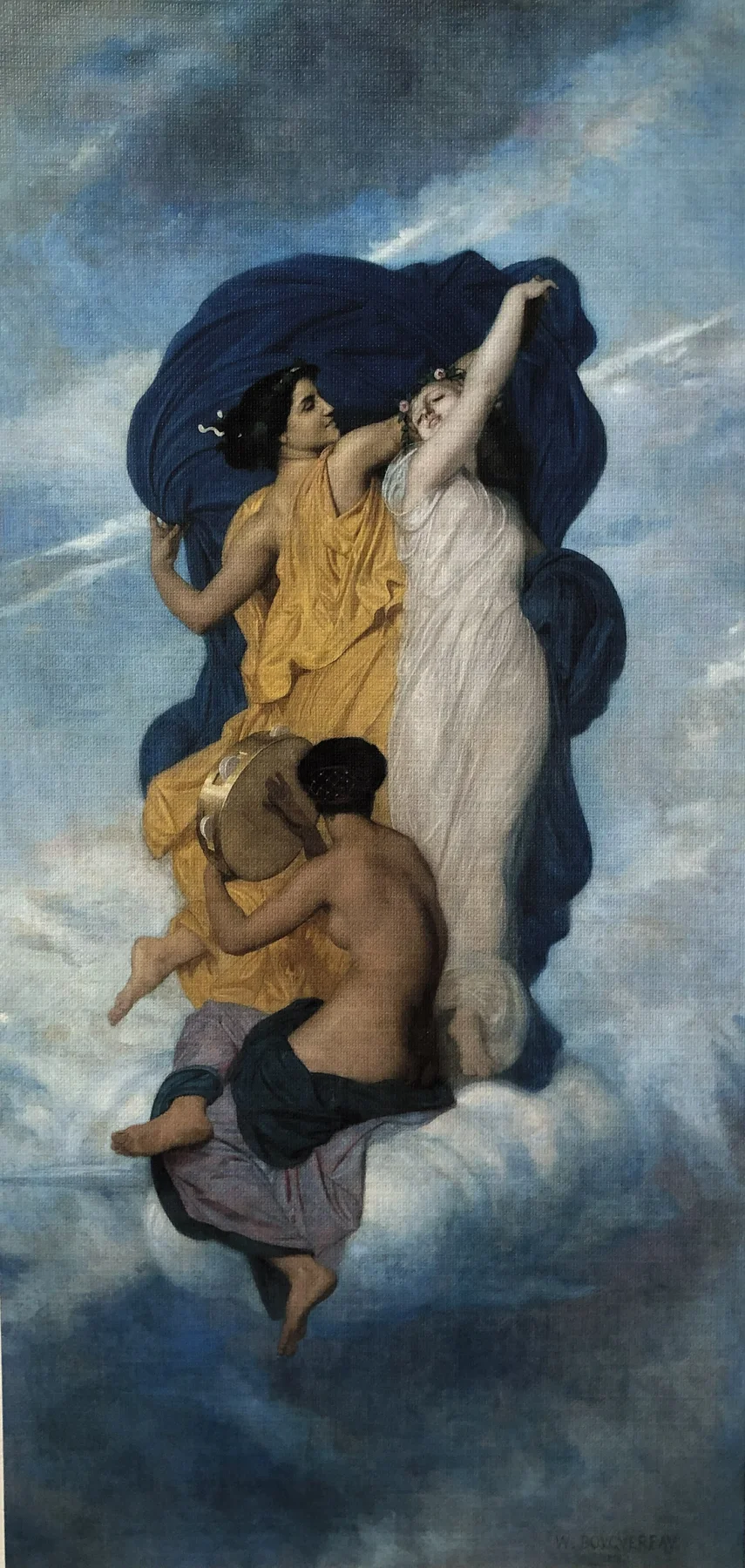
THE DANCE
William-Adolphe Bouguereau
- Artist
- William-Adolphe Bouguereau (1825–1905)
- Date
- c. 1856
- Dimensions
- 367 x 180 cm
- Medium
- Oil and wax on canvas
- Location
- Musée d'Orsay, Paris, France
Few 19th-century artists received as much adulation and as much ridicule at once as William Bouguereau, who over an artistic career of 50 years became one of the richest and most influential painters in France. Technically brilliant, Bouguereau was a champion of the ideals of the ultra-conservative academic style through allegories drawn from the ancient world. Not surprisingly, he and the Impressionists despised each other.
A Prize-Winning Student
As a graduate of the prestigious École des Beaux-Arts in Paris, Bouguereau committed himself to the academic art supported by the Institut de France. The movement derived its style from antiquity and the Renaissance, characterised by emphatic lines, clean contours and anatomical precision. But instead of painting the surrounding world as it really was, the academic painters strove for a kind of idealised depiction which, they believed, revealed pure and eternal truth.
The École’s highest professional prize was the Prix de Rome: the lucky winner each year received a four-year scholarship at the Villa Medici, the seat of the French Academy in Rome, an experience that almost guaranteed a lucrative career, with commissions from state and church institutions and, not least, private patrons.
In 1850 Paul Baudry won the prize, but since Bouguereau also managed to meet the requirements, both painters could travel to Italy. When Bouguereau returned to France in 1854, he immediately threw himself into paid work. The Dance was commissioned for a lady named Madame Moulin, who wanted to decorate the garden pavilion of her luxury residence in La Rochelle with four large decorative panels. (The other three pictures were titled The Hunt, Fishing and The Bath.) The huge picture, more than three and a half metres long, is filled with life-size figures.
Memories of Pompeii and the Influence of Raphael
The Dance, one of Bouguereau’s earliest works, was made at a time when his Italian experiences were still fresh in the artist’s memory. The style of the work leads back to the world of the remarkably lively, genre-like frescoes he could have seen in the villas of Pompeii and Herculaneum. Several of these charming scenes of everyday life depict graceful female figures in floating dresses. Critics of his time also mentioned the influence of Raphael, whose Galatea of 1512 Bouguereau copied during his stay in Rome.
Although the picture is made in a realistic style, the scene presents an allegory, the personification of Dance or, in a somewhat broader sense, the cycle of life. (Bouguereau was obsessed with allegory; he once said that he would never paint a war, only “War”.) Allegorical depiction had the advantage that the artist could portray naked female bodies on canvas (which of course greatly helped the picture sell), precisely because it was not interpreted as “real” and so could not scandalise the public, as did, for example, the everyday nudity of Manet’s Luncheon on the Grass (1863), which horrified Parisians.
The Dance was exhibited with other works at the Salon of 1857, where Bouguereau received a first-class medal.
Member of the Salon Jury
“There is only one kind of painting,” Bouguereau once said. “It is the one that offers the eye perfection and is flawlessly beautiful in execution, like the works of Veronese and Titian.” The coarse brushwork and vulgar style of the rising Impressionists clearly did not suit his taste.
Bouguereau was a member of the notorious jury of the 1863 Salon, which rejected some three thousand pictures, including Luncheon on the Grass. The scale of the mass rejection caused such public outrage that the government agreed to the creation of a new annual exhibition. This was the Salon des Refusés, which in the 1870s was a lifeline for the Impressionists.
Mocked but Invincible
The Impressionists, not surprisingly, liked to make fun of Bouguereau (and vice versa). On one occasion Renoir ordered new glasses, and when he put them on and saw crystal clear with them, he tore them off his eyes with the exclamation: “Good heavens! Now I see like Bouguereau!” Degas and his friends coined a new term — “Bouguereauté” — to describe neat, sterile pictures.
But perhaps Bouguereau had the last word: unlike Monet and Renoir, who spent long years in poverty, he had a high income from the start, and this did not change later either.
- Trinità dei Monti and the Villa Medici, Rome, 1808
- Fresco from a villa in Pompeii
- Raphael: The Triumph of Galatea