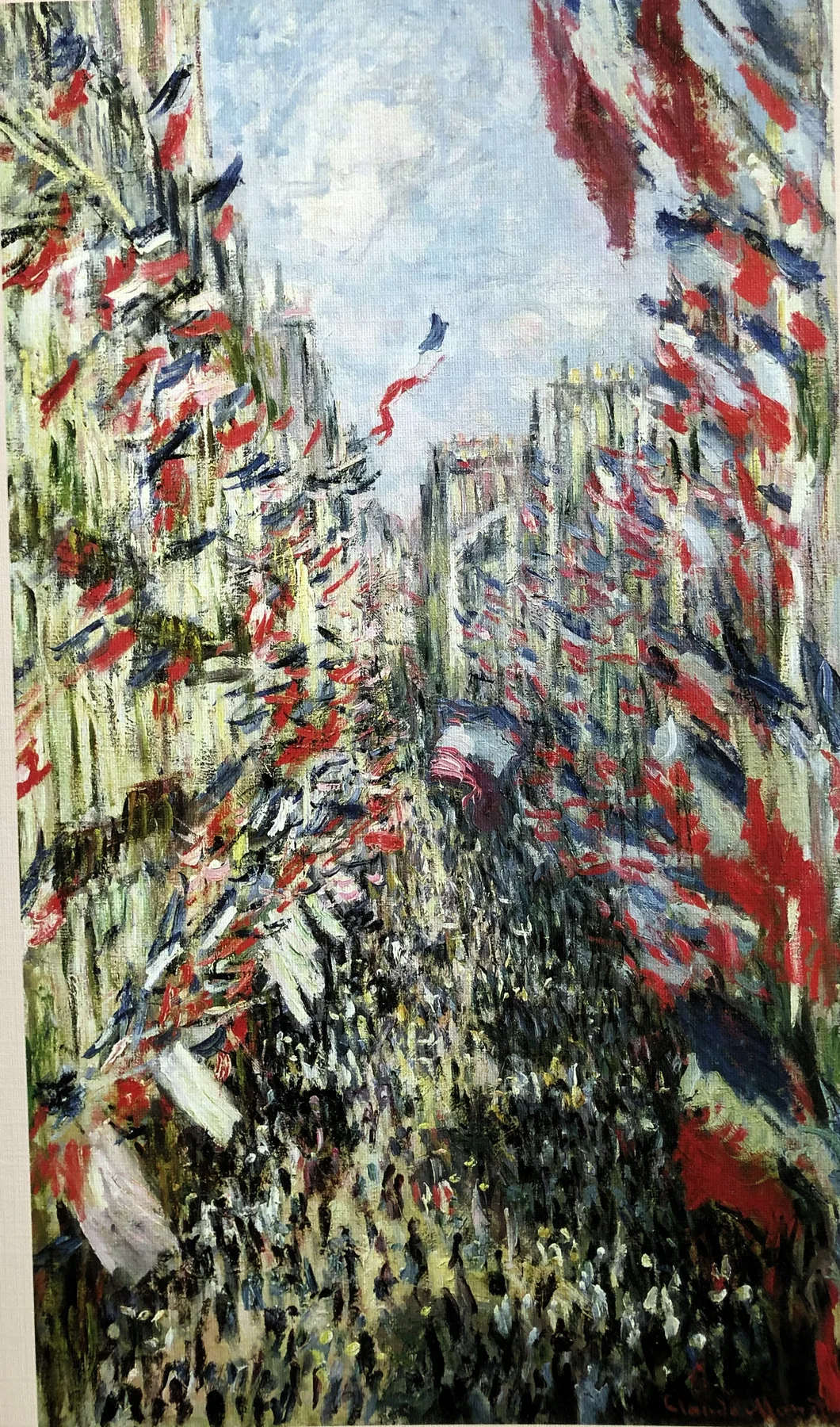
THE RUE MONTORGUEIL, PARIS, CELEBRATION OF 30 JUNE 1878
Claude Monet
- Artist
- Claude Monet (1840–1926)
- Date
- 1878
- Dimensions
- 81 x 50 cm
- Medium
- Oil on canvas
- Location
- Musée d'Orsay, Paris, France
1878 was a difficult year for the Monet family. They had recently moved out of their rented house in Argenteuil and spent this year in Paris. The terminally ill Camille was caring for their newborn son, while Claude was so short of money that he had to beg his friends for a little charity. None of their troubles, however, can be seen in this dynamic bird’s-eye view of a Paris street, where under a forest of swirling flags a cheerful crowd celebrates the 1878 World’s Fair, which symbolised France’s recovery from the shock of defeat eight years earlier. Spurred by the drama of the occasion, Monet took up his palette and in the course of a single day sketched two scenes that not even a photographer could have captured better.
Paris Reborn
To appreciate the events of June 1878, we must recall how low Paris had sunk at the beginning of the decade. France’s humiliating defeat by the Prussians in 1870 led in 1871 to the bloody uprising of the Commune, when discontented masses and the National Guard attacked government troops and established the independent Paris workers’ council. The army later retook Paris street by street and applied brutal reprisals to anyone on whom the faintest shadow of suspicion of being a Communard fell. (Renoir escaped execution by a hair’s breadth.) In all, thirty thousand people lost their lives in the violence.
After extensive reconstruction work, in 1878 the government held the World’s Fair as a symbol of the rebirth of the French Republic. Lasting from 1 May to 10 November, the event was a dazzling display of international industry, architecture and art over some 27 hectares of the capital.
A Hymn to the Republic
The people of Paris decorated the streets, and the sight was particularly impressive in the city centre. The scene in the picture is dominated by flags: the Republic’s beloved tricolours flutter in the wind, contrasting with the static vertical lines of the buildings. “I liked flags,” Monet later recalled. “On 30 June, the first national holiday, I walked down the Rue Montorgueil with my equipment. The beflagged street was teeming with people. I noticed a balcony, went up the stairs and asked permission to paint from there.” Monet’s composition takes in a huge space. The nearest buildings fill the full depth of the canvas, turning the street into a canyon. This feeling is heightened by the unusually elongated canvas. The painter’s brushstrokes become increasingly fine as they approach the vanishing point; he depicts the furthest flags only as patches, so the distant background is blurred, out of focus.
That day Monet painted a second, very similar scene titled The Rue Saint-Denis, 30 June. Although this is also an upright composition, it is less elongated and emphasises the bend of the street more. In these two triumphant “flag pictures” Monet achieved an expressive fusion of line and colour.
In a Single Afternoon
The much-caricatured Monet was showered with new criticism when he showed his painting at the fourth Impressionist exhibition in 1879. “Monsieur Monet is represented by thirty landscapes, presumably made in a single day,” the critic Albert Wolff wrote mockingly in Le Figaro, where he unanimously dismissed the Impressionists’ works as “schoolboy scribbles”.
To be fair, even the artist’s friends felt the flag pictures were hasty. Over the following years Monet developed his hand, eye and memory to perfection in order to preserve fleeting effects of light and colour on canvases that he began on location and finished in the studio through long, incredibly meticulous work, while managing to recapture all the freshness of the moment.
Similar Masterpieces
Flags appear in the pictures of many Post-Impressionist painters, especially the Fauves. Among them we can mention Raoul Dufy’s painting 14 July in Le Havre (1905) and Albert Marquet’s work of the same title from 1906. Dufy, attracted by the graphic magic of flags, repeated the subject in the whirl of tricolours in The Fanfare, 14 July 1951, and in the red-and-blue uniforms of the military musicians.
- The Paris World’s Fair in 1878
- The Rue Saint-Denis on 30 June 1878