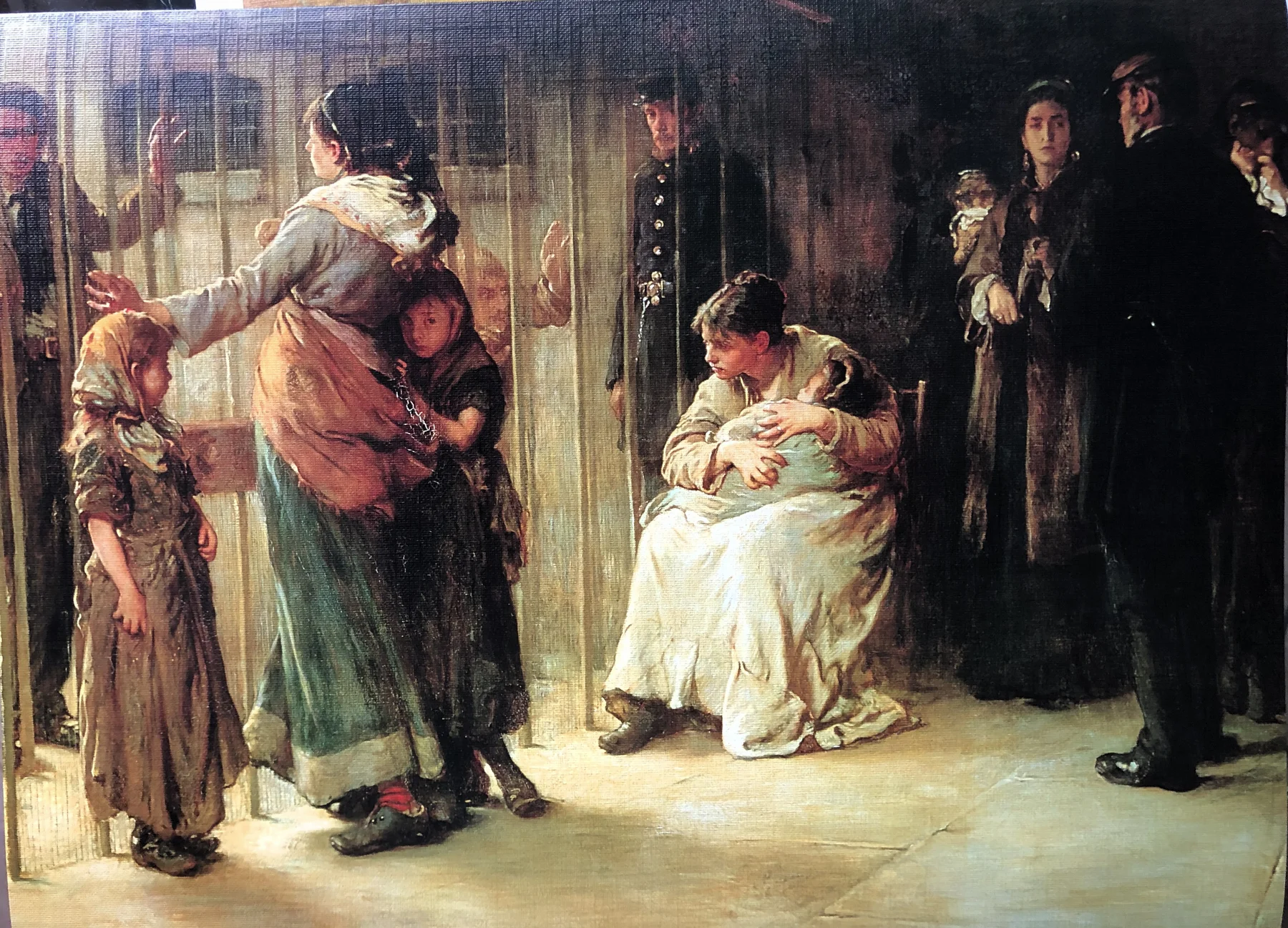
NEWGATE: COMMITTED FOR TRIAL
Frank Holl
- Artist
- Frank Holl (1845–1888)
- Date
- 1878
- Dimensions
- 152.3 x 210.7 cm
- Medium
- Oil on canvas
- Location
- Royal Holloway and Bedford New College, Egham, Surrey, United Kingdom
The well-to-do classes of Victorian England generally ignored the poor, whose lot was grinding toil from cradle to grave. A few braver painters, however, ventured into workhouses and prisons to portray society’s outcasts and set their heart-rending likenesses before the eyes of the rich. Frank Holl was one of them; with his psychologically authentic depictions of families broken up by crime and the deep misery that goes with it, he launched a deliberate and calculated attack on the conscience of the middle class.
Graphic Realism
At the time he painted Newgate: Committed for Trial, Holl was working as an illustrator for the weekly magazine The Graphic, run by William Luson Thomas, known for his reformist thinking. Thomas commissioned works from a select group of artists committed to the genre of social realism, who depicted life in its raw reality in order to bring the fate of the disadvantaged before the public.
It was on one such commission that Holl came to London’s Newgate prison, where a woman was visiting her husband behind bars. This scene prompted the artist to develop the sketch he had made in the prison into a large oil painting. (This was common practice for other Graphic illustrators too, such as Luke Fildes and Hubert von Herkomer.) Holl chose as the setting for his picture the area called the “cage”, where prisoners and visitors were separated by a double row of bars.
Newgate
When Holl visited Newgate in the 1870s, he could see the prison buildings of an institution that had existed since 1188 in their final form. Conditions had once been terrible: prisoners slept on straw in overcrowded cells, children were born and grew up “inside”, never even hearing of freedom. The warders confiscated the prisoners’ money, so those imprisoned for debt faced the grim shadow of life imprisonment, having no means of repayment.
Thanks to the influence of the social reformer Elizabeth Fry (who appears on the five-pound note), the cells were renovated in the 1850s, and the Bankruptcy Act of 1869 abolished the debtors’ prison, so in Holl’s time the inmates of Newgate were either serving life sentences or awaiting trial. From 1868 the formerly public hangings were carried out within the prison walls, behind closed doors, so Newgate lost some of its frightening “attraction”. After seven centuries the old institution’s time was slowly running out, and in 1902 its buildings were finally demolished. Holl’s attention here, however, was directed not so much at the inmates as at their wives.
The Weaker Sex
The situations of the painting’s three main female figures differ somewhat. On the right of the picture, the well-dressed woman entering hesitantly between two women sobbing quietly seems unable to believe that her husband (who is not in the picture) has been locked up with common criminals. The mother in the middle of the composition sits completely broken, listlessly clutching her child — her wedding ring glinting cynically — while her husband crouches snarling at the bars. The scene suggests that the man belongs to the worst kind of criminal, a wife-beater, from whom the woman is temporarily safe.
The Telling Face…
In depicting the man’s bestial expression Holl reflects the then popular pseudo-scientific theory of phrenology — the study of human character from the physical features of the face — as well as the firm Victorian conviction that working men lacked the human quality that would make them good fathers.
No Way Out
According to the rules of phrenology, the man on the left looks less like a hardened criminal. He is awaiting trial after being arrested for embezzlement at work. At that time women received only minimal education, so his wife has little chance of finding work.
And this is where the picture’s impact is greatest. Since the Victorian man was honour-bound to provide for his wife and children, this frank presentation of the disgraced husband and the helpless wife must have deeply disturbed Holl’s clientele. The effect is made complete as one of the frightened-looking girls turns straight towards us, as if begging for help.
Agony of the Soul
Holl painted the picture in the prison to get an authentic impression of the place. The pale, unfriendly lighting is indeed infinitely convincing. He deliberately chose a low viewpoint to increase the psychological impact on the viewer and to express — in his own words — “the pathos and agony of the soul”. He arranged the figures of the picture in a complex network of expressions, postures and symmetries. On the one hand we see the world behind the bars, almost a mirror image of the “free” world, a kind of inverted reality; on the other, outside along the bars, representatives of the different ages of womanhood line up, from the child (in the foreground) through the mother to the old woman (the older woman sobbing in the half-shadow).
Artistic Connection
One of the most powerful depictions of Victorian misery is Luke Fildes’ picture Applicants for Admission to a Casual Ward (1874), in which a long line of the destitute waits at the door of the shelter. When Fildes showed his work at the Royal Academy, it prompted one critic to remark (which could equally apply to Holl’s picture): “Few people turn away from the picture without studying at length this sad manifestation of the lowest depths of London life, and many do not fail to ask: what can I do to make things better?”
- Interior of Newgate prison, 1870
- William Luson Thomas
- Elizabeth Fry
- Newgate prison, 1888