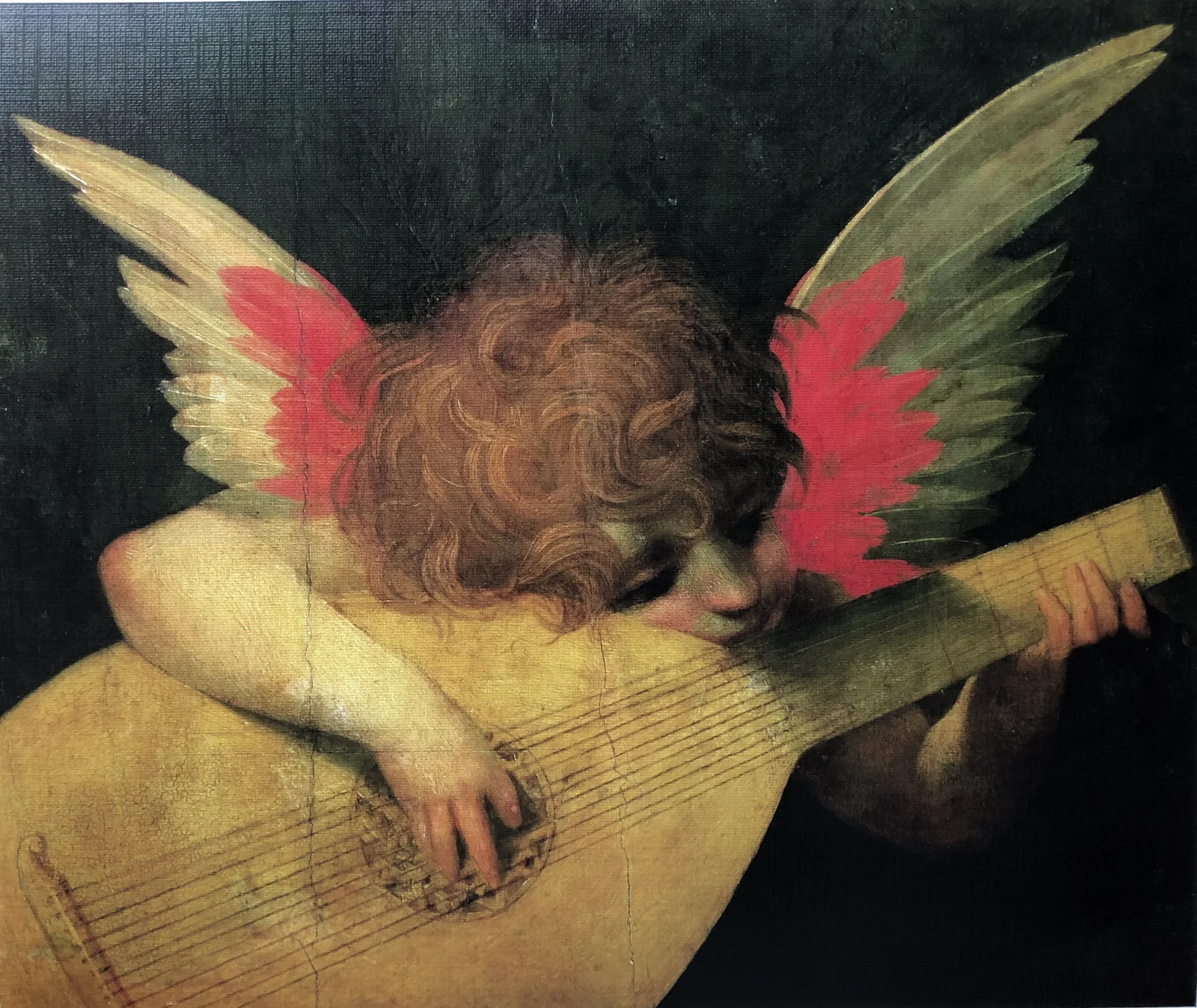
MUSICIAN ANGEL
Rosso Fiorentino
- Artist
- Rosso Fiorentino (1494–1540)
- Date
- c. 1522
- Dimensions
- 47 x 39 cm
- Medium
- Tempera on panel
- Location
- Galleria degli Uffizi, Florence, Italy
The Florentine painter Rosso Fiorentino, working in the last decades of the Renaissance, had an enormous influence on the development of European art. Bold, provocative and highly individual in style, Rosso belonged to the small group of 16th-century Italian Mannerists whose paintings formed a bridge between the restrained classicism of the Renaissance and the more theatrical, emotional Baroque period that followed.
The Red Florentine
Born Giovanni Battista di Jacopo de Guasparre, Rosso Fiorentino got his well-known artist’s name, meaning “the red Florentine”, from his flaming red hair. Also referred to as “Il Rosso” (“the Red”), the artist’s fiery temperament lived up to his name: his stubborn nature, sharp tongue and the arrogance he exuded won him few friends. Despite the shortcomings of his personality, Rosso Fiorentino’s talent as a painter was widely recognised by his fellow artists and — even more importantly — by the Medici family, the greatest patrons of the arts of the time and former owners of Musician Angel.
The Mannerist Style
Rosso Fiorentino trained under Raphael’s contemporary, the Florentine master Andrea del Sarto, one of the finest draughtsmen and colourists of the late Renaissance. The young artist was a very obstinate pupil and soon developed his own Mannerist style, characterised by vivid colours, sharp lighting, indeterminate perspectives and lanky, elongated figures. The term Mannerism comes from the Italian word maniera, meaning “style”, and perfectly conveys the stylised visual world and mood of Rosso Fiorentino’s art. Although his works retain the refinement and splendour of Renaissance painting, they carry a greater emotional charge, radiating both elegance, as in The Marriage of the Virgin (1523), and violence, as in Moses Defending the Daughters of Jethro (1523).
A Charming Portrait
Musician Angel may not be Rosso Fiorentino’s most famous or most characteristic painting, but it is certainly the most tender in mood and in many respects the most mysterious. In this small picture, unusual in an age of huge frescoes and soaring altarpieces, a cherub plays his lute. In the Renaissance cherubs enjoyed great popularity, especially in religious works, and were often depicted as playful or mischievous figures. Interestingly, the tousle-haired figure in Rosso Fiorentino’s picture is not like that. The artist painted the angel in an almost solemn mood of concentration, lost in the music he is playing for himself or for an audience outside the picture. It is a charming portrait, yet also unusual: artists did not usually devote so much space and attention to a single cherub. They more often depicted them as supporting figures in more animated scenes, as Rosso Fiorentino did in one of his pictures, Madonna and Child with Saints (c. 1518), in which he shows two little reading cherubs at the bottom of the painting. For this reason and because of the picture’s small size, it has been thought that Musician Angel may in fact be only a detail of an originally larger work. It is possible that such a painting existed and was later damaged, or was deliberately cut down after it was finished. The cherub’s serious expression carries only a slight, elusive hint of the scene to which it may once have belonged.
Traditional Paint
Like many Italian artists of the first half of the 16th century, Rosso Fiorentino worked increasingly with oil paint, then relatively new, but he made Musician Angel in tempera on panel. Tempera, whose use goes back to the ancient Egyptians, is a type of paint the artist makes himself by mixing powdered pigment with a binder such as egg yolk. The resulting paint is durable, dries quickly, is extremely stable and was favoured for centuries. With the appearance of oil paint, first popularised by the Flemish master Jan van Eyck, however, the use of this more traditional and labour-intensive paint gradually fell out of practice.
Wealthy Patrons
Musician Angel was made in the early 1520s; the picture was commissioned or bought by the Medici family, an influential dynasty of politicians and bankers with many ties to the papacy and later to the French royal power. The Medici were Rosso’s most important patrons, and their luxurious Florentine palaces held many of the artist’s paintings, such as the Madonna Enthroned with Ten Saints (1522), the youthful portrait of Catherine de’ Medici, which can still be seen in the Pitti Palace. In 1605 Musician Angel moved to the city’s other great art gallery, the Uffizi Palace, newly built by the Medici family. Highly prized by its owners, the work was given a place of honour alongside other Renaissance masterpieces in the famous octagonal room, the Tribuna. Despite the turbulent events of the 1730s that ended the Medici era, the painting remained in the possession of the Uffizi.
- The Marriage of the Virgin
- Moses Defending the Daughters of Jethro
- Jan van Eyck
- Madonna Enthroned with Ten Saints