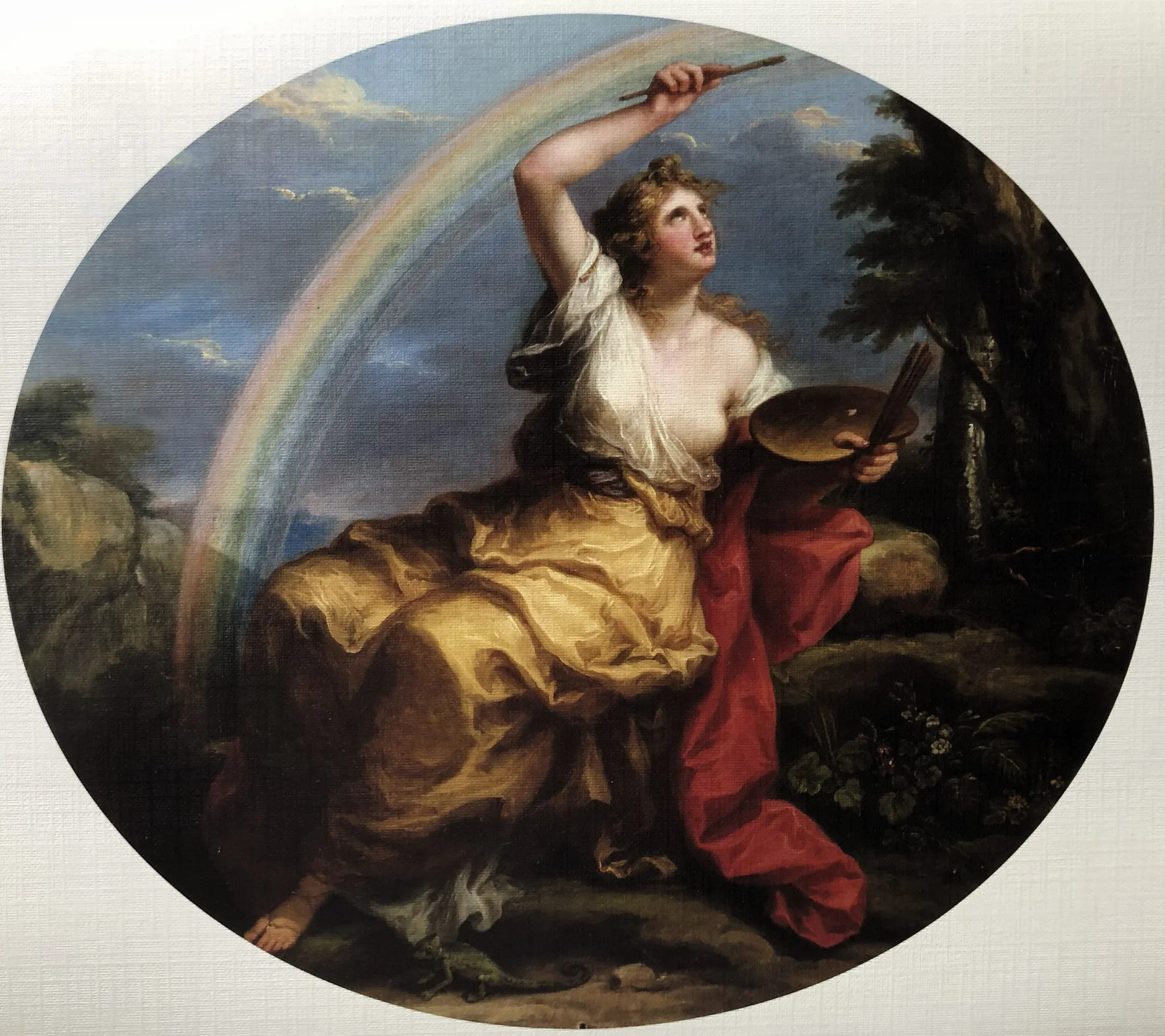
COLOUR
Angelica Kauffman
- Artist
- Angelica Kauffman (1741–1807)
- Date
- c. 1780
- Dimensions
- 132 x 151 cm
- Medium
- Oil on canvas
- Location
- Burlington House, Royal Academy of Arts, London, United Kingdom
One of the most outstanding artists of the second half of the 18th century, Angelica Kauffman showed remarkable talent for painting and music even as a little girl, and was later supported and admired by such a figure as the famous portrait painter of the time, Sir Joshua Reynolds. Swiss-born Kauffman lived in England from 1766 to 1781 and won an exceptional artistic reputation; her patrons included the ruling families of Great Britain, Russia, Poland and Austria. Known for her Neoclassical style, besides her many portraits Kauffman also painted scenes on historical, literary and mythological subjects. Her allegorical work Colour was made around 1780 as part of a larger series presenting the four modes of expression of painting.
The Bigger Picture
Towards the end of her fifteen-year stay in England Kauffman painted a series of large canvases on the subject of painting, titled The Elements of Art, for the Royal Academy of Arts in London. She designed the four oval pictures for the ceiling of the council chamber of Somerset House, the elegant Neoclassical building newly erected between the Thames and the Strand, which housed the Royal Academy from 1781. Together the canvases present the four traditional components of painting and accordingly bear the following titles: Invention, Composition, Design and Colour. In the early 19th century the Royal Academy moved into the National Gallery building in London, and in 1868 it moved its headquarters to Burlington House on Piccadilly. Colour and the other three works of the series now decorate the ceiling of the entrance hall of Burlington House.
Classical Values
Enjoying the support of her friend Sir Joshua Reynolds, Kauffman was a highly respected artist, especially valued for her history pictures and portraits. Working in the Neoclassical style, Kauffman adhered to the artistic principles set out by Reynolds in his Discourses. Returning to the classical values of ancient Greece and Rome, she sought to teach the viewer through her paintings.
The Art of Painting
Like the allegorical figures in the other works of The Elements of Art series, the young woman symbolising “Colour” is a self-portrait of Kauffman. The settings and poses vary according to the nature of the subject; for example, the female figure of “Invention”, depicted with a winged head, looks upwards in search of inspiration. In the 18th century artists and critics debated a great deal whether colour or drawing was most important in a painting. The dignified “Design”, shown in a moment of deep concentration, sits among ancient columns making a careful sketch of a sculptural torso. By contrast, Kauffman’s figure embodying “Colour” seems much more natural and relaxed.
The Freedom of Colour
Completely absorbed in her task, “Composition” watches a chessboard and ponders her next move. Her posture and clothing are similar to those of the figure of “Colour”, but the artist depicts the latter free of all constraints, in the open air. Her left breast is bare, and with her right arm, playing in various shades, she is perhaps taking colours from the rainbow onto her palette, or with a casual gesture painting a coloured arc on the blue of the sky.
Artistic Connection
Angelica Kauffman was a close friend of the brilliant English portrait painter Sir Joshua Reynolds (1723–1792, pictured), the first president of the Royal Academy from 1768 to 1792. Kauffman’s style of portraiture bore the stamp of Reynolds’ influence; he admired the young Swiss painter and referred to her in his diary entries as “Miss Angelica” and “Miss Angel”. Reynolds painted Kauffman in 1766 (Portrait of Angelica), and the following year she returned the favour with her work Portrait of Sir Joshua Reynolds. At 26 Kauffman was ensnared by a marriage swindler posing as a Swedish count, and only with Reynolds’ help was she able to have the marriage annulled, but the unfortunate affair was nevertheless humiliating for Kauffman.
- M. I. Dicksee: Angelica Kauffman Visiting Mr Reynolds’ Studio (left) and Sir Joshua Reynolds
- Invention, Composition, Design, the three further elements