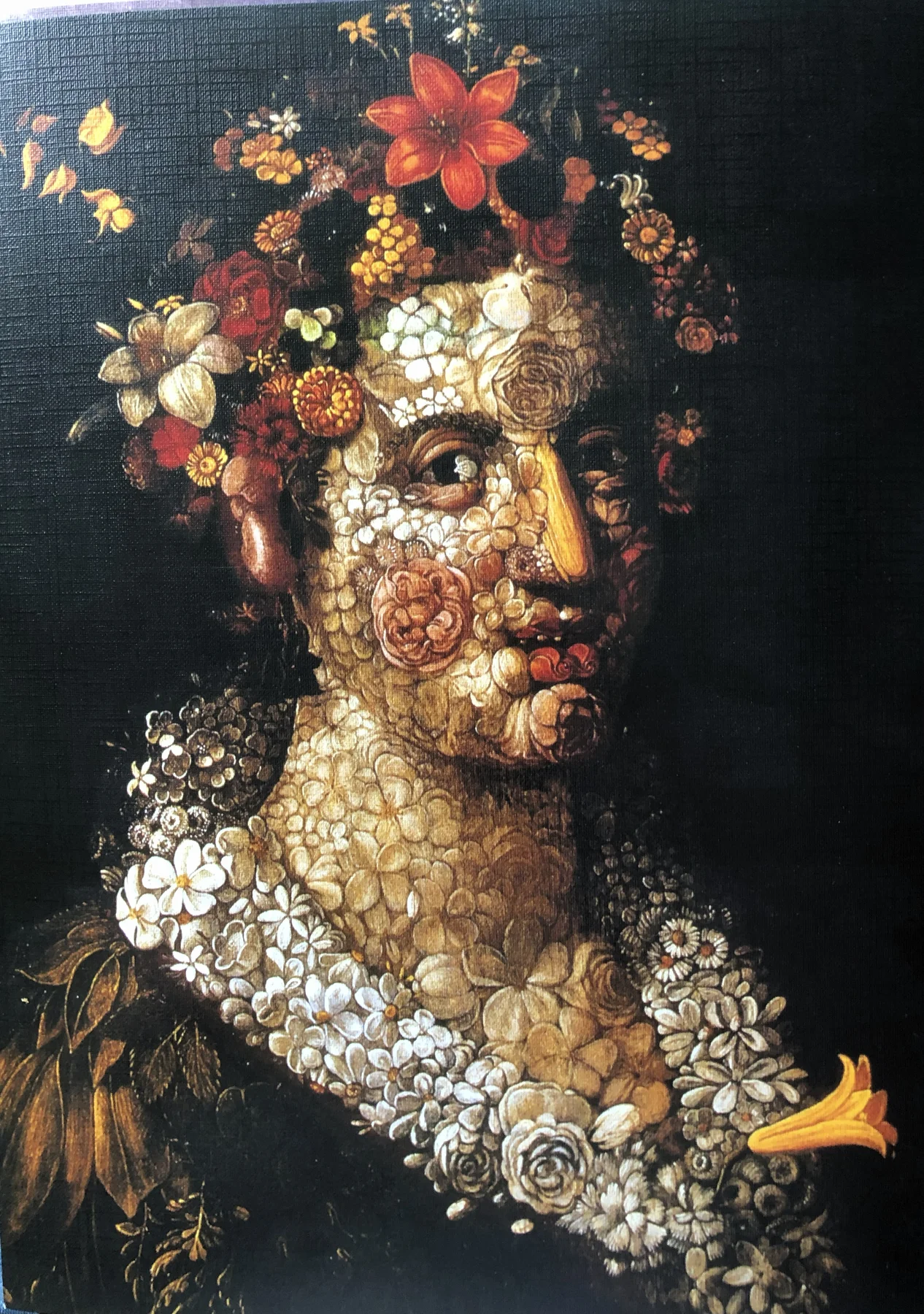
FLORA
Giuseppe Arcimboldo
- Artist
- Giuseppe Arcimboldo (1527–1593)
- Date
- c. 1591
- Dimensions
- 73 x 56 cm
- Medium
- Oil on panel
- Location
- Private collection
Giuseppe Arcimboldo was court and portrait painter to the Holy Roman Emperors Maximilian II (1527–76) and Rudolf II (1552–1612), and in this no one could match him. Presumably no one at the court in Vienna or Prague resembled the portraitist’s strange likenesses, which he composed of meat, fish, vegetables or — as in this case — flowers and herbs. Instead of resembling people, the portraits served rather as symbols and allegories, reflecting the culture and ideas of High Renaissance Europe. This magnificent portrait is one of three pictures painted in the later part of the artist’s life and depicts the Roman goddess Flora, who symbolises fertility, abundance and the beauty of nature.
Flower Girl
Arcimboldo painted the first version of Flora in 1588, and the second two years later. The third — see overleaf — is an almost exact copy of the first. (The portraits were extremely popular, and the artist was often asked to make a second copy.) In 1587 the artist left Rudolf’s court and by then had returned to his native Milan, but he continued to paint and send new pictures to Prague. In this period of his life he drew his subjects mainly from ancient mythology: Vertumnus (1591), for example, also depicts a Roman deity.
Flora, goddess of flowers, is evidently one of Arcimboldo’s least complex paintings; her flowers and leaves easily transform into eyelids, neck and nose, recalling the elegant style of a Roman mosaic or fresco. All three paintings are more or less similar in that Flora wears a garland of flowers in her hair and a dress decorated with leaves, with a white ruff at her neck. On the second picture Arcimboldo painted tiny insects and a lizard, and this painting contains another important difference, described below.
The Cult of Flora
Artists have long depicted the association between femininity and nature, which dates from Roman times or even earlier, with Flora, goddess of flowers, a symbol of fertility and sexuality. According to the Roman poet Ovid, Flora was originally a nymph. Favonius, god of the west wind, then married her; he gave her power over flowers and enabled her to sow seeds and colour flowers. (Flora and Favonius — their Greek counterparts Chloris and Zephyrus — also appear in Botticelli’s paintings Primavera (Spring), 1477–78, and The Birth of Venus, 1485.) According to the Romans, Flora became angry if she was ignored, so every year they held the Floralia, a six-day spring festival at which scantily clad courtesans performed erotic dances in her honour.
This recalls another Roman tradition that classified women as wives (in the sense of housewife and mother) or prostitutes (that is, in terms of the flesh). For centuries artists sought to blur these distinctions, and Flora’s sexuality expressed both fertility and sensual pleasure. This duality can be seen in Titian’s Flora (1515, Uffizi, Florence), where the goddess holds flowers in her right hand while her left draws attention to her half-bared breast. Interestingly, in Arcimboldo’s second version of Flora (1591) the goddess reveals one breast, as if she too acknowledged her sensual nature. The second version lacks the yellow lily at her neck, a symbol of fertility.
A Learned Naturalist
In 16th-century Europe there was growing interest in the natural sciences, and Maximilian II was utterly fascinated by them, inviting the finest botanists and zoologists to his court. Arcimboldo created his strange composite portraits mainly to dazzle and entertain this select company of scholars.
In the portrait of Flora Arcimboldo painted the real flowers with meticulous care. A more or less similar painting, Spring (1563), is a portrait made of plants, composed of drawings of 80 identifiable native herbs and flowers from Western Europe to South-East Asia.
The artist found the plants collected by the ruler’s botanists mostly on his doorstep. Maximilian constantly developed his beloved palace gardens, which included a herb garden created by the famous Flemish herbalist Carolus Clusius. In this way Arcimboldo could paint the plants from nature. He also compiled a natural-history dossier to which he could refer in making his pictures, such as Flora. Besides his flower studies, Arcimboldo also made watercolours of the animals of the imperial menagerie, including screw-horned and red hartebeest, an elephant, a cheetah, an elk, a goat and many exotic birds.
Meanwhile he won fame as a nature painter and, as a result, many clients, including the Grand Duke of Tuscany and the eminent Bolognese naturalist Ulisse Aldrovandi. The artist, however, sometimes let people down, as when Aldrovandi commissioned him to paint a rare Persian lily. A doctor brought a valuable specimen to Arcimboldo, but the artist left Prague for a wedding, and the lily wilted before he could paint it.
- Maximilian II and his family, a painting by Arcimboldo
- Titian: Flora
- Botticelli: Primavera, detail: Flora
- Spring, a painting by Arcimboldo
- Ulisse Aldrovandi