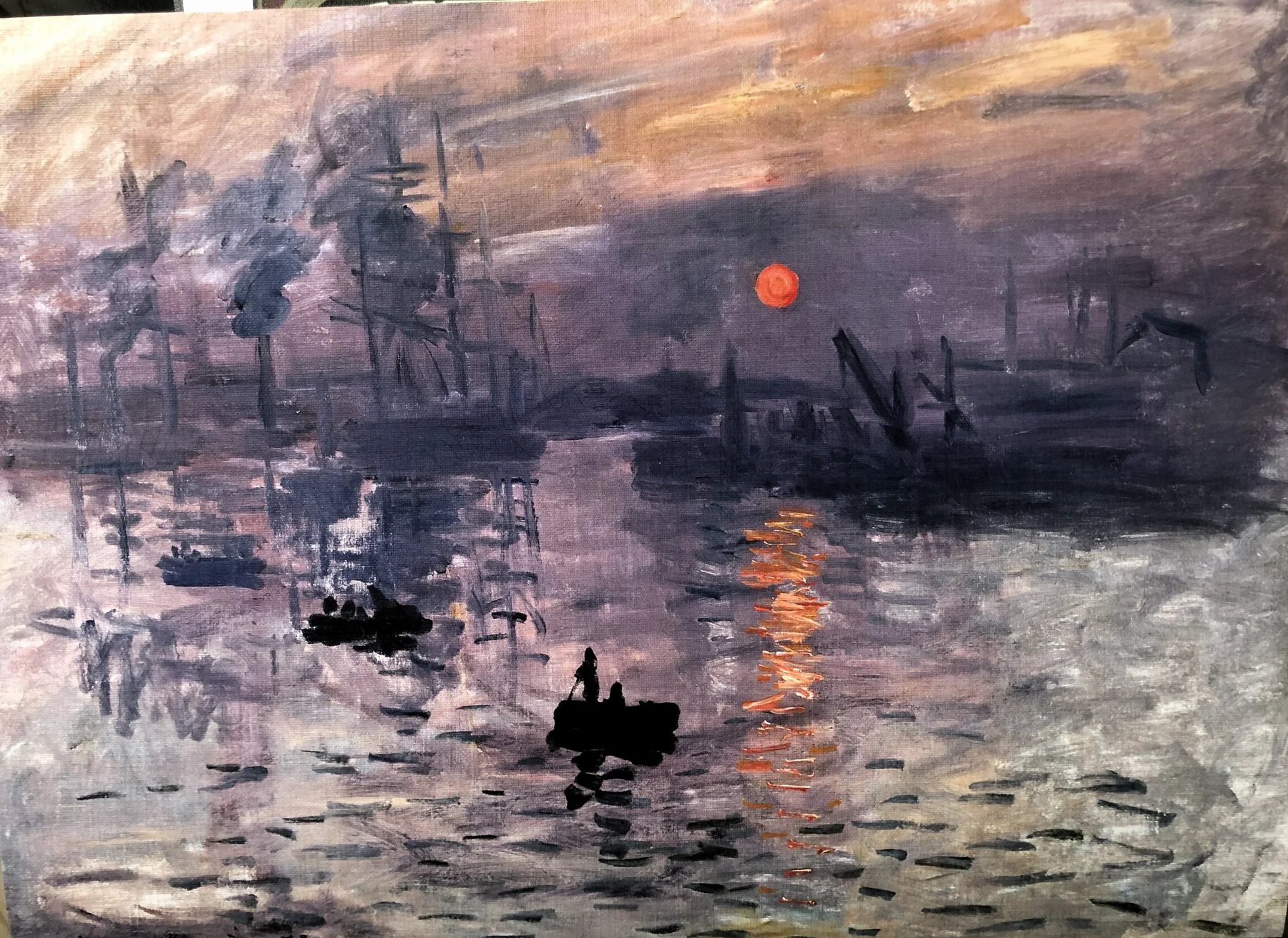
IMPRESSION, SUNRISE
Claude Monet
- Artist
- Claude Monet (1840–1926)
- Date
- 1872
- Dimensions
- 48 x 63 cm
- Medium
- Oil on canvas
- Location
- Musée Marmottan Monet, Paris, France
Monet’s Impression, Sunrise has a captivating story — it gave its name to the famous art movement, Impressionism. The naming happened almost by chance, as the French art critic Louis Leroy used the title of Monet’s painting to describe an exhibition of independent painters in Paris in 1874. The “exhibition of the Impressionists” showed works by Monet, Degas, Renoir, Cézanne, Morisot, Sisley and Pissarro. This now respected circle then consisted of painters who were mocked for their revolutionary new technique. By using the epithet “Impressionist”, Louis Leroy was in fact expressing his disdain for the painters and their pictures; he bluntly stated that for some painters an impression means that even the simplest wallpaper patterns look more finished than their paintings. The term introduced by the critic stuck to the painters, but gradually lost its negative overtone — and “Impressionism” was soon born.
Depicting Light at Dawn
Claude Monet moved in 1872 to the small town of Argenteuil on the Seine, where he painted many studies of sailing boats, such as The Harbour at Argenteuil (1872). The artist worked on the riverbank or in his floating studio, a small boat equipped with painting supplies, so that he could paint comfortably directly in nature. His river scenes from the early 1870s try to capture the fleeting effects of sunlight on the surface of the water. The setting of Impression, Sunrise is the French coast at Le Havre; in this picture too Monet sought to capture the special effects of light and colour of the passing moment. Shortly before painting this masterpiece he had returned from a trip to London with his friend and fellow Impressionist Camille Pissarro, where he was deeply impressed by Turner’s The Fighting Temeraire, which he saw in the National Gallery. Turner’s tug and orange-shrouded sky also appear in Impression, Sunrise.
Monet wanted to paint the “blanket of light” that covers the landscape at a given moment. At dawn the sun rose over the harbour, and he presented this corner of the awakening world. Through the unique handling of light in scenes like this, the painter gave life and energy to seascapes that would otherwise seem empty and lifeless.
Lights Enclosed in Mist
Perhaps somewhat strangely, Impression, Sunrise does not faithfully reflect Monet’s Impressionist style. The artist usually painted with lighter colours, applying with short, broken brushstrokes the vivid lines and patches of light of pure colour that created the general atmosphere of the whole scene. In Impression, Sunrise he instead used thin layers of paint in a narrowed colour range. Monet’s painting is more schematic than most of his works; it was this seemingly hasty, unfinished-looking technique that enraged the critics when the picture was first shown.
Monet uses mainly blurred bluish-greys to evoke the misty dawn at Le Havre. In the foreground he depicts the ripples of the sea with horizontal dark strokes of dark blue and greenish black. The rising sun and its reflection contrast with the cold greyish blues. The sharply defined orange-red disc of the sun glows warmly, while Monet painted its vertically shimmering reflection on the water quite differently. The broken brushstrokes applied in orange oil paint are visibly thicker and seem even more vibrant with the white highlight. With this seemingly careless, hurried brushwork Monet captures the fleeting moment of the atmospheric seascape and the sunrise.
Monet’s Vision
Monet adored the sea and spent long hours observing the changing light reflected on the water. Impression, Sunrise does not offer a wide panorama but rather concentrates inward, on the harbour and the shore. Instead of a dramatic presentation of the sea’s power, it depicts a calm harbour scene.
Thanks to Monet’s compositional skill, our eye can wander freely over the picture to observe the painting’s fine details and tones. We can place ourselves completely in the work and see the scene through Monet’s eyes. As we look for the picture’s focal point, we glimpse the orange patch of the sun and its vertical reflection on the water, which falls beside the boat in the foreground. In the boat the outlines of two figures — one seated, one standing — can be made out. Monet repeats the boat motif twice more along a diagonal running towards the left edge of the picture, but their images gradually fade as they disappear into the distance. With the diagonal structure Monet creates the illusion of depth in his painting.
It is worth noting that Monet applied the same diagonal composition to great effect in his picture Poppy Field at Argenteuil (Coquelicots) the following year. In this later painting he projects the two figures of the foreground into the background too, creating a sense of depth on the flat surface of the canvas.
Public Humiliation
Completed in 1872, Impression, Sunrise was first shown at the scandalous exhibition of the independents held in Paris from 15 April to 25 May 1874. It was the first joint exhibition of the Anonymous Society of Painters, Sculptors and Engravers, at which Monet was represented by 12 paintings alongside works by Degas, Renoir and Cézanne. Under the crossfire of the critics’ attacks, however, buyers were found for very few works. Impression, Sunrise, a national treasure, can be seen under glass in the Musée Marmottan Monet in Paris.
- Turner: The Fighting Temeraire
- Monet: The Harbour at Argenteuil (1872)