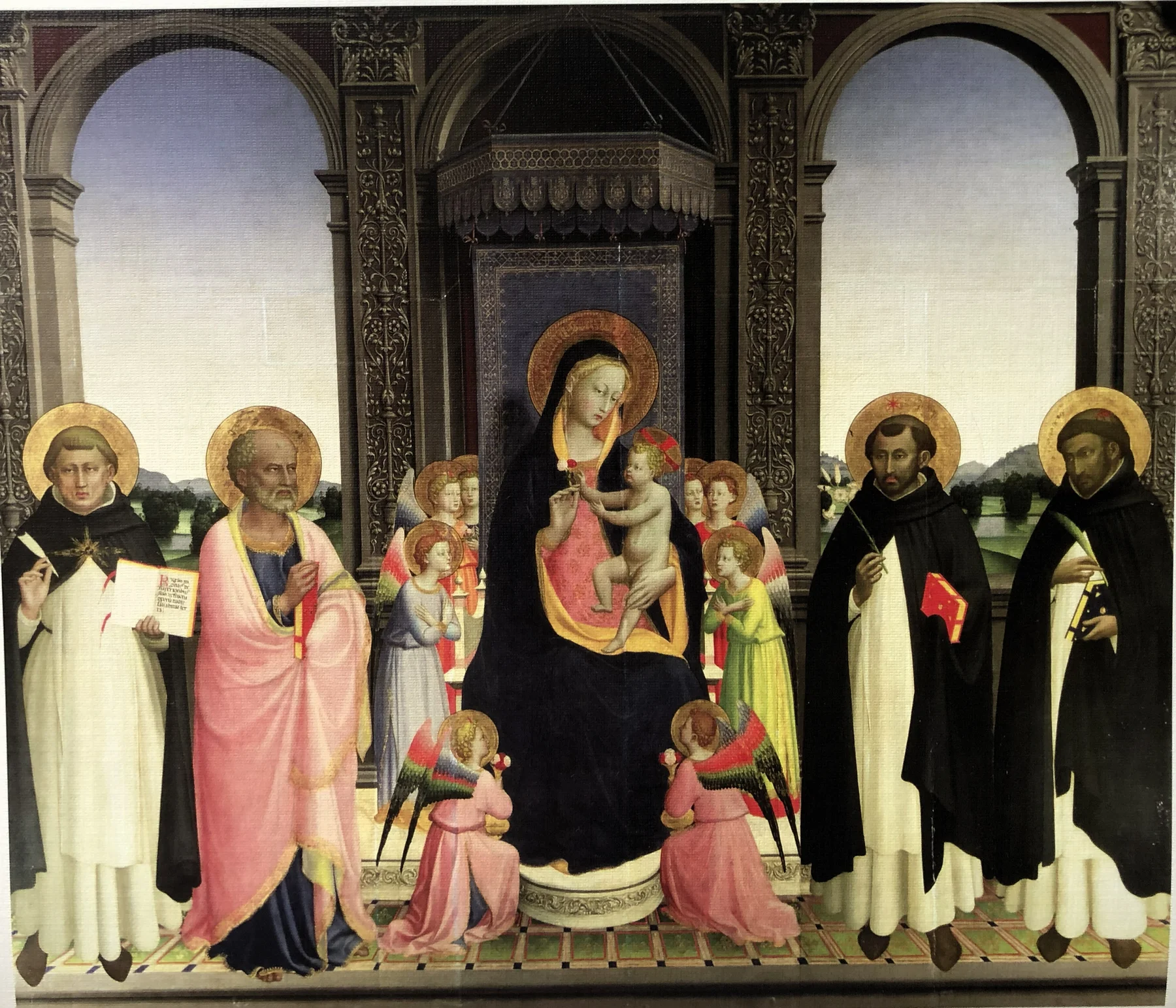
MADONNA AND CHILD ENTHRONED WITH SAINTS THOMAS AQUINAS, BARNABAS, DOMINIC AND PETER MARTYR
Fra Angelico (Giovanni da Fiesole)
- Artist
- Fra Angelico (c. 1400–1455)
- Date
- c. 1425
- Dimensions
- 212 x 237 cm
- Medium
- Tempera on panel
- Location
- San Domenico, Fiesole, Italy
At first sight this picture showing the Madonna and Child in the company of angels and saints seems a traditional depiction, pervaded by the deep spirituality and devotion of a painter of saintly life. The painting, however, is of far greater significance, since the art of its creator, Fra Angelico, formed a bridge between Cimabue and Giotto, who embodied the earlier Gothic style, and the early Renaissance that culminated in the genius of Michelangelo and Leonardo da Vinci.
The Glory of the Order
Although the sources are contradictory, it is generally believed that Fra Angelico, originally named Guido di Piero, was born around 1400 and entered the Dominican order between 1417 and 1421. The first records referring to him as the friar Fra Giovanni da Fiesole (Brother John of Fiesole) date from 1423. Fra Angelico was a wonderfully talented artist who painted religious pictures, including three altarpieces for the monastery of San Domenico. The Madonna and Child Enthroned with Angels was an early work on the well-known religious subject, painted specifically as an altarpiece for the high altar of the monastery church. The Dominican community put Fra Angelico’s outstanding artistic abilities at the service of its missionary work and the glorification of God.
Reworking a Masterpiece
In 1501 the Italian painter Lorenzo di Credi (1459–1537), representing the Florentine school, painted over the originally gold background behind the Madonna and Child and the other figures, replacing it with architectural elements and a landscape visible between open arches. The original frame of Fra Angelico’s painting was later removed, as were parts of the panel together with the other saints depicted on them.
Masterly Technique
Fra Angelico’s masterly style is best shown in this painting through his use of tempera (a mixture of pigment and binder, egg yolk or gum arabic). Before applying each layer of paint Fra Angelico made faint preparatory drawings for the successive layers, but none of this meticulous preparation is visible on the surface of the painting. The contrast of the white tunics and black cloaks of the three saints gives the picture mass and depth. Let us try to imagine Fra Angelico’s picture without the distracting effect of the early-16th-century architectural elements, with the original Gothic-style gold background echoing the haloes adorning the figures.
Fra Angelico had an excellent feel for colour but was also well acquainted with the latest achievements in depicting linear perspective. The figurative foreground of the picture is partly defined by the low-set floor. The lines of the finely painted ornate mosaic tiles run towards the side panels and draw our eye towards the picture’s focus, the centre of the picture, near the Madonna’s hand as it almost touches the infant Jesus.
The Illusion of Space
Fra Angelico’s altarpiece follows tradition in its subject as well as in its execution: as was customary for religious triptychs, the central panel (with the Madonna and Child) is flanked by two wing panels depicting saints. His innovation lies in the way he skilfully creates space and depth around the Madonna and the infant Jesus. The two kneeling angels holding a vase of flowers play a part in shaping the space in front of the throne, while the six angels arranged in a circle beside and behind the throne create a sense of depth.
The saints (including the founder of the Dominican order, St Dominic, in a black cloak holding a red book) occupy both sides of the central panel and emphasise the solemnity of the moment. The brightly coloured wings of the kneeling angels point towards the Madonna and the two angels standing above them with their arms crossed before their bodies as a sign of humility towards the Virgin Mary. Every motif reinforces the purity and harmony of the central, monumental figures of the Madonna in a blue cloak and Christ. Although the Virgin looks out of the picture towards the viewer, she seems transfigured; her expression and the whole painting radiate a meditative mood in keeping with Fra Angelico’s religiosity. With her left arm she gently holds the infant Jesus, who seems to float in her lap.
- Fra Angelico: Crucifixion, detail with the Madonna and attendant, in the chapter house
- Fra Angelico: Madonna and Child, the central element of the triptych