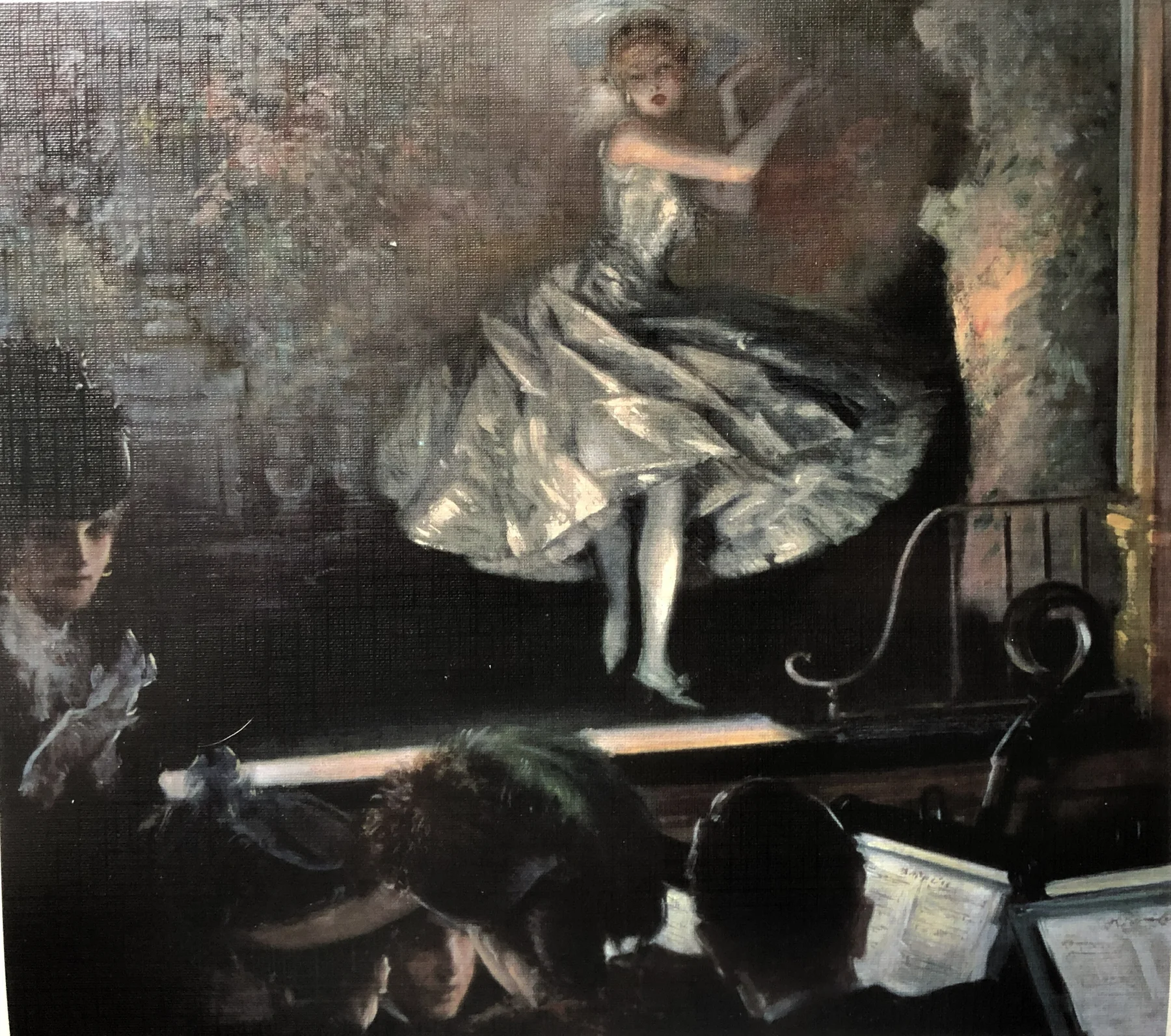
DANCER IN WHITE BEFORE THE FOOTLIGHTS
Everett Shinn
- Artist
- Everett Shinn (1876–1953)
- Date
- 1910 (reworked in 1952)
- Dimensions
- 88.90 x 99.06 cm
- Medium
- Oil on canvas
- Location
- Butler Institute of American Art, Youngstown, Ohio, United States
Dancer in White before the Footlights stands out in Everett Shinn’s varied oeuvre. This masterpiece is Shinn’s largest, characteristic theatre picture and is regarded as his principal work. The well-formed figures are not as sketchy as many of his illustrations; attention is directed to a few key figures rather than the crowd of New York’s lower and upper classes he loved so much. The picture creates a sense of intimacy and spontaneity; it was made from the orchestra pit, so it seems as if we too were part of the scene. The sense of drama Shinn developed as a newspaper illustrator is fully displayed here, as the artificial light accentuates the heavy make-up, draws sharp lines and shatters the glittering illusion. Dancers inspired many artists, including Degas and Toulouse-Lautrec. Their beautiful style, grace and sense of movement fill the picture with strong drama. In Dancer in White before the Footlights we see the dancer, the musicians and the audience, who look back at the crowd rather than at the dancer — all in a narrow space, as if we were looking at a snapshot.
The Excitement of Nightlife
Shinn was fascinated by city life, the intoxicating excitement, the overflowing vitality and the cheap popular entertainment characteristic of the booming American cities, above all the streets of New York. What the painter loved most was the theatre, so much so that he even built one himself. Many of his works celebrate theatrical spectacle, and this masterpiece is the greatest of them. Shinn was undoubtedly influenced by Edgar Degas’ paintings showing the dramatic side of theatre life, which he could have seen during his trip to Europe in 1900.
Minor Corrections
Shinn held on to the painting almost until the end of his life, not selling it for a long time. In 1952, the year before his death, he changed a few small parts of the picture. Infrared photographs show that the dancer’s right arm was originally outstretched, parallel to the stage. On the left of the painting the lady wore a wide-brimmed hat that left her forehead uncovered. These corrections can be seen when studying the picture closely. After the reworking Shinn sold Dancer in White before the Footlights to the art dealer Victor Spark, who sold it to the Butler Institute of American Art in 1957.
The Ashcan School
American cities changed rapidly at the turn of the 20th century. Skyscrapers, cars, trams, electricity and film all changed the structure of the city. Millions of people sought a new life in the United States in just a few decades, and the mixing of new cultures and languages created an intoxicating atmosphere — this was the great American melting pot. The group of artists known as the Ashcan School, including Shinn, George Sloan and George Luks, shared views on capturing the vitality and reality of the city, but they also had a social consciousness; they sought to show the dark side of life too, which gave them their name. The group fought against the artificial academic style and the injustices they saw around them. Shinn was sometimes criticised for being less serious than his companions, since he preferred painting cheerful theatre scenes to crime and slum housing.
Painter of Dancers
Edgar Degas (1834–1917) is often called the “painter of dancers”. He had many pictures on other subjects too, but his paintings of dancers captured at ballet performances or in cabarets are the most popular. Shinn was enormously influenced by Edgar Degas, who more than once depicted the activities and lives of dancers behind the scenes. Like Degas, Shinn was more interested in the human side hidden behind the event. The dancer is only part of the scene.
- Typical vaudeville theatres in New York in the 1920s
- The Ashcan group
- The Star of the Dance, a pastel by Edgar Degas