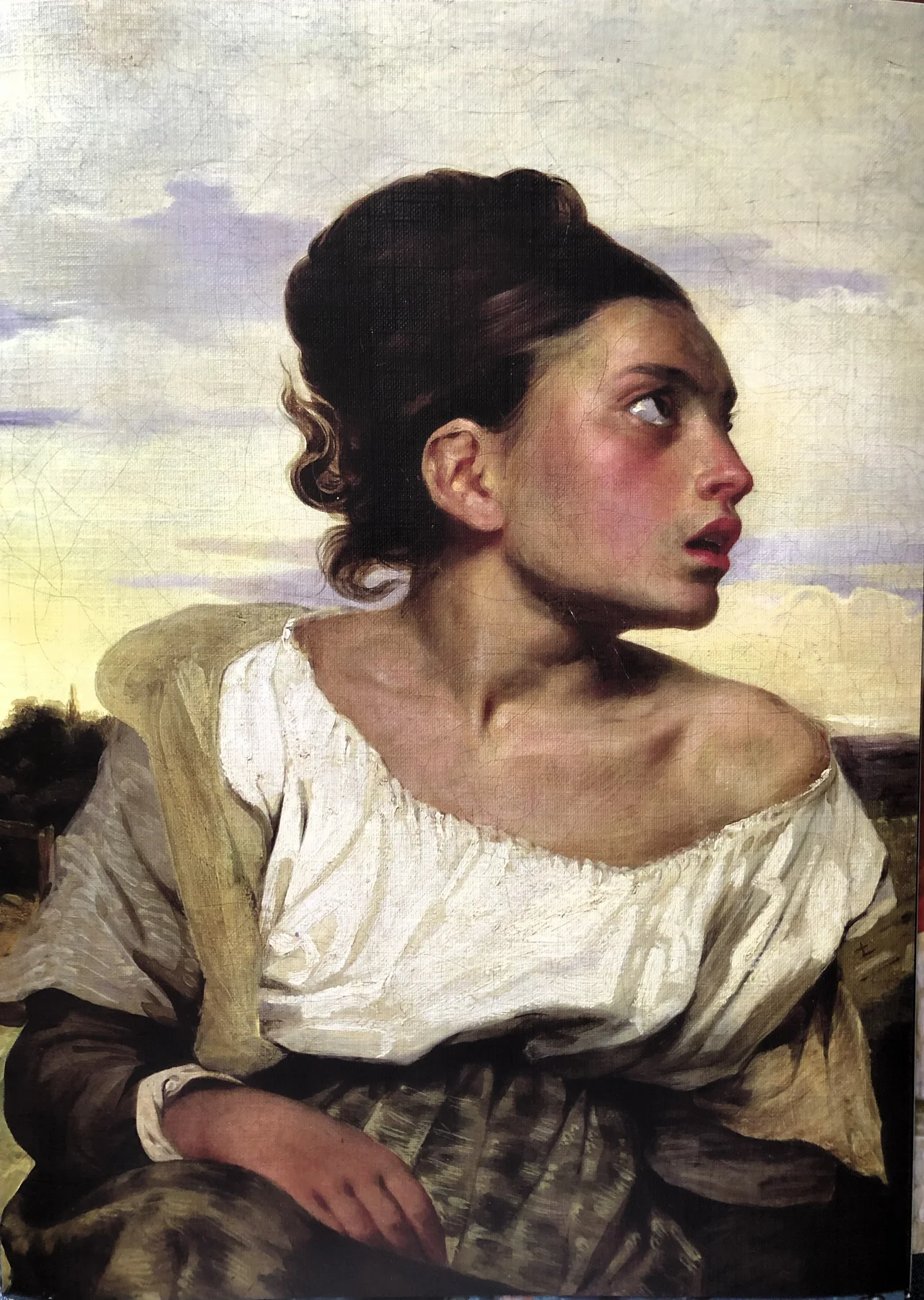
ORPHAN GIRL AT THE CEMETERY
Eugène Delacroix
- Artist
- Eugène Delacroix (1798–1863)
- Date
- c. 1824
- Dimensions
- 65 x 55 cm
- Medium
- Oil on canvas
- Location
- Musée du Louvre, Paris, France
Eugène Delacroix’s powerful paintings are characterised by drama, vitality and passion. With his swirling colours and spontaneous style, the greatest French Romantic painter brought natural emotion into his works. Delacroix painted Orphan Girl at the Cemetery at the beginning of his career; it was probably a study for his later large-scale painting showing the devastation of war, The Massacre at Chios. The painting perfectly illustrates the artist’s talent for depicting the effects of historical events on everyday life. The painting has been part of the Louvre’s permanent collection of 35,000 works since 1906, when the painter, collector and art historian Étienne Moreau-Nélaton bequeathed to the museum the picture he had inherited from his grandfather.
Paintings Full of Passion
“I do not like painting governed by reason,” Delacroix wrote in his Journal, and indeed his impulsive, energetic style seems to be guided more by the heart than the mind, although his classical training can be found in his careful compositions and the fine finish of his works. In most of his paintings he presents scenes of intense emotional charge; images of extreme ecstasy or (more often) of terror and destruction, from shipwrecks and sacked cities to bloody massacres.
Every detail of Orphan Girl at the Cemetery radiates hopelessness and despair. The girl in the painting is a survivor of the Ottoman attack of 1822 on the Greek island of Chios, where thousands were massacred and thousands more taken into slavery. Delacroix was horrified by the bloodshed and felt it his duty to paint it. As always, his intention was not a historically faithful depiction of the event. He wanted the viewer to live through and feel the emotional consequences of what had happened. The Massacre at Chios became the painter’s second-largest exhibited work.
A Portrait of Despair
Delacroix was a master of conveying emotion. Tears of sadness gather in the orphan girl’s dark, ringed eyes, but the intensity of her gaze also expresses fear and anxiety. Her half-open mouth, her hand resting limply in her lap and her dress slipping from her shoulder suggest hopelessness.
Delacroix painted the girl with clear outlines, so that she stands out against the landscape and sky of the background, painted with looser brushwork, emphasising the sense of loneliness.
Master of Colour
In another journal entry Delacroix wrote that in painting “colour gives the semblance of life”. He loved brilliant white highlights — as can be seen on the girl’s blouse and the striking whites of her eyes. In the late 1800s these features of his painting were crucial for the Impressionist and Post-Impressionist painters, including Manet, Signac, Seurat, Van Gogh — and later Matisse and Picasso — all of whom acknowledged that they owed him a great deal for this.
Innovations in the Background
Delacroix’s emotional style of landscape painting — in which every detail of the picture counts — was greatly influenced by the English landscape painters of the time, including John Constable. The first of two art exhibitions financed by the French government was held at the Louvre in Paris in 1824. Many British pictures were shown — so many that they were mocked as “British Salons!” It was here that Delacroix first saw John Constable’s The Hay Wain (1821), and he was so captivated by its vibrant colours and broken brushwork that he is said to have repainted certain details of The Massacre at Chios to achieve a similar effect.
Artistic Connection
In the second half of the 1800s Delacroix had an enormous influence on the style of the Impressionist painters. For them he was the inspiration. Édouard Manet copied his first masterpiece, The Barque of Dante (pictured), twice, paying tribute to his expressive use of colour. Vincent van Gogh asked for engravings of Delacroix paintings as inspiration in the asylum at Saint-Rémy, and Paul Cézanne made at least 27 copies of his pictures and owned ten of his paintings. He once said of Delacroix: “He has the most beautiful palette in France… we all paint in his shadow.”