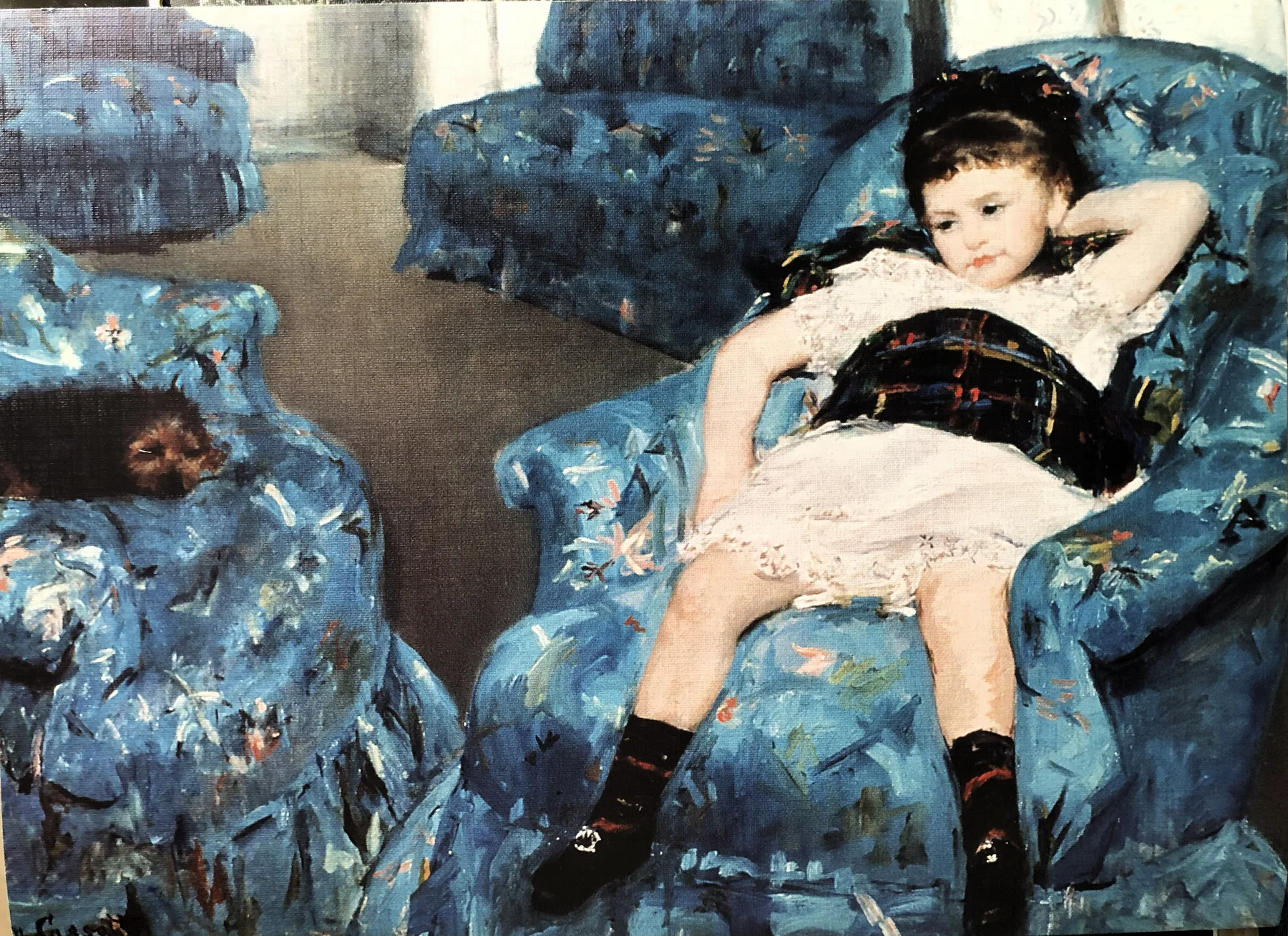
LITTLE GIRL IN A BLUE ARMCHAIR
Mary Cassatt
- Artist
- Mary Cassatt (1844–1926)
- Date
- 1878
- Dimensions
- 89.5 x 129.8 cm
- Medium
- Oil on canvas
- Location
- National Gallery of Art, Washington D. C., United States
Mary Cassatt was special among the Impressionist painters of the late 19th century — for she was a woman and an American. A truly independent spirit, she led an unusual life compared with the women of her time; thanks to her successful artistic career she was able to support herself. Her works, in an individual style, characteristically glorify women’s domestic activities and maternal self-sacrifice. Little Girl in a Blue Armchair is a famous work, but it differs from many of Cassatt’s more characteristic, moving studies of women and children. The picture seems more modern and apparently deals with the question of loneliness, as a little girl sits alone in a room that is empty apart from a few similarly blue armchairs and a sleeping dog.
Natural and Sincere
Mary Cassatt settled in Paris with her mother and sister in 1877 and was inspired by her domestic surroundings. She painted many intimate portraits of close relatives going about their daily activities. The sitters’ poses are always natural; she depicts the women in relaxed positions, as if unaware of the artist’s presence. They are often absorbed in their work, such as knitting, sewing or, as in Reading Le Figaro, reading a newspaper. This painting shows the artist’s mother and was made in the same year as Little Girl in a Blue Armchair, faithfully reflecting Cassatt’s ability to observe objectively yet create an intimate portrait. There is no trace of the more voyeuristic gaze of a male artist; in Cassatt’s portraits of women we feel that the painter has just caught sight of the sitters.
Little Girl in a Blue Armchair was made in 1878, and the model is the little daughter of friends of the French artist Edgar Degas. Mary Cassatt said: “I love painting children. They are so natural and sincere.” Seeing this picture, the viewer too feels that Mary Cassatt wants to express the artlessness of the child’s personality and paints her as naturally as possible.
A Gift to Washington
Little Girl in a Blue Armchair was probably shown at the Fourth Impressionist Exhibition in 1879 — titled Portrait of a Little Girl — when many of Cassatt’s works were put on public display. Little Girl in a Blue Armchair was bought from the artist by the Paris art dealer Ambroise Vollard. In 1963 it was bought by the collectors Mr and Mrs Mellon, who twenty years later gave it to the National Gallery of Art in Washington D. C., where it can still be seen today.
A Study in Blue
By 1878, when Little Girl in a Blue Armchair was made, Cassatt had already developed her firm, free brushwork, clearly visible on the patterned blue armchair and the girl’s lacy dress. This more Impressionist style unfolded even further in Cassatt’s works of the 1880s, until the 1890s, when she turned to more compact forms and stronger contours. The blue armchairs, with their strong colour, seek to dominate the portrait, while in the patterns the rough, energetic brushstrokes of colour almost bring the fabric to life.
The light highlights the forms and objects in the foreground, and it almost seems to radiate from the girl’s dress. The tartan fabric around the child’s waist is given a darker background colour, but the artist painted the yellow, blue, green and especially bright red check lines with thick, bold brushstrokes. Cassatt’s little dog, dozing in the armchair beside the child, was made with a few quick brushstrokes and became a charming, well-observed study of a beloved dog.
Composition
The influence of Degas can be detected in Little Girl in a Blue Armchair. In this composition Cassatt experiments with a kind of asymmetry characteristic of Degas; she deliberately did not place the subject in the centre. The interesting blue-patterned furniture, which seems awkwardly arranged in relation to each other, completely fills the picture. The furniture in the background occupies the empty space, while the girl and the dog sit side by side in separate armchairs, leaning towards the viewer. The angle of the girl’s armchair pushes the subject particularly forward to draw our attention.
The view in the painting cannot be called conventional, as the girl’s unusual posture also expresses. Her left arm bends strangely as it supports the back of her neck, and the bend of her legs also seems awkward. The mysterious expression in the girl’s dark eyes becomes understandable as she sprawls in her blue armchair, fixing her gaze on some invisible object. The prettily dressed child was surely brought to the artist’s home by her parents for a portrait and is obviously bored with posing. Mary Cassatt perfectly understands the child’s feelings and objectively presents the girl’s defiance and relaxed behaviour. The artist’s manner of depiction is far from sentimental, merely a true, empathetic painting of a little girl’s involuntary movements. Although the viewer looks at the child in the picture, the painting’s proportions and perspective manage to change our ideas, suggesting that this is in fact the child’s point of view.
- Cassatt’s painting, Reading Le Figaro, 1878
- Interior of the National Gallery of Art
- Edgar Degas, who influenced Cassatt