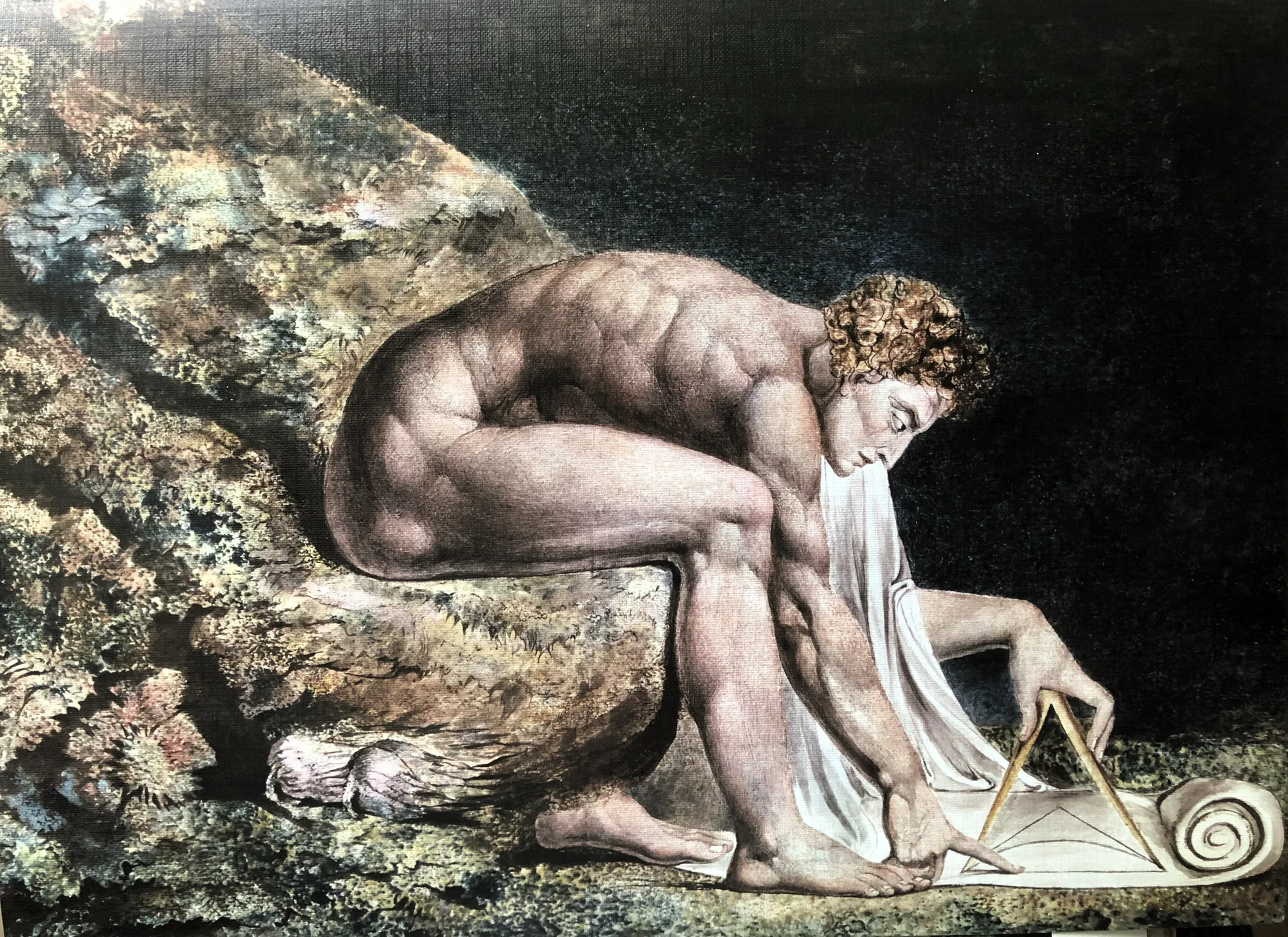
NEWTON
William Blake
- Artist
- William Blake (1757–1827)
- Date
- c. 1795–1805
- Dimensions
- 46 x 60 cm
- Medium
- Colour print, pen, ink and watercolour
- Location
- Tate Britain, London, England
William Blake was a deeply religious artist who made highly personal, powerful, symbolic, visionary works at the turn of the 18th century, when other British artists were mostly painting landscapes and portraits. Blake’s highly individual view of the world and the universe is shown in his pictures, such as Newton, which depicts the great scientist and philosopher Sir Isaac Newton as a sculptural figure bending over his compasses. Many considered Blake an eccentric. The symbolic meaning behind the work also reveals his debatable, unfavourable opinion of the great thinker.
A Trained Engraver
Newton was just one of a series of 12 paintings made around 1800 for the civil servant Thomas Butts, who was his constant patron for many years. A trained engraver, William Blake made many prints for books, such as Cervantes’ Don Quixote.
It seems that Blake conceived the series as six pairs of opposites, and the true meaning of the print Newton becomes clearer if we view it together with its opposite, Nebuchadnezzar. This picture resembles Newton in style, but in it we see a wild-eyed, long-haired, muscular man who has evidently been trapped in a cave and whose animal strength is waning. In the Old Testament Book of Daniel, Nebuchadnezzar built Babylon and placed himself above God — God’s punishment was that he went mad. If Blake’s Nebuchadnezzar depicts the loss of reason, then Newton presents reason incarnate. While Newton — the supreme rationalist — is generally considered a genius, Blake painted a more negative picture of him. He acknowledged the scientist’s intellect, but in his view Newton had a very limited, one-sided vision. Blake regarded himself as having “fourfold vision”, by which he meant a truly many-sided individual, that is, the four basic aspects of man: body, reason, emotion and imagination. Blake believed that Newton tried to explain the workings of the physical world but left God out of his calculations, an error the artist could not forgive.
The Dispute over the Date
Newton is one of two known prints from the same plate, which Blake finished with pen, ink and watercolour. There is still some dispute about the date the print was made. Although the monogram on the picture reads “1795 WB inv. (made by)”, it seems more likely that this print was drawn or finished later, since this version is more characteristic of the linear style of Blake’s following ten years. Several of Blake’s works, including Newton and Nebuchadnezzar, are in Tate Britain.
Blake the Visionary
William Blake was an otherworldly, mystical artist who claimed to have visions. He rejected drawing from nature, and his powerful works are products of his incredible imagination. Blake believed that as an artist he had received intuition from God to create these exceptional works. Blake’s exact technique for making these 12 famous large colour prints, including Newton, is still debated. His contemporary Frederick Tatham described Blake’s printmaking method thus: “[Blake]… took a common thick millboard and sketched his design thickly in some dense ink or paint. Then he applied oil paint, mixed in such a proportion that it spread well. He then painted sketchily and quickly so that none of the paint had time to dry. Then he took a print of this on paper, which he further coloured with watercolour, and when he wanted to make a new print he repainted the outlines on the millboard.”
Blake’s View of Science
Newton depicts the famous scientist bending forward, measuring with a pair of compasses. Looking at the picture, we see a man of extraordinary intelligence and perseverance struggling with a mathematical problem. Blake, however, encourages us to recognise the symbolism of his view of Newton too. According to Blake’s visual language, the figure’s downward-bending, hunched, naked body betrays a posture of despair; his head is lower than the arc of his curving back.
The tunnel vision of the hunched figure is emphasised by the way his gaze follows the line of one leg of the compasses. There are many other straight lines too that convey a lack of flexibility, such as the almost unnaturally regular triangle formed by Newton’s limbs on the seat carved into the rock. The compasses are a symbol of materialism, although the artist also used them in his colour print The Ancient of Days (1794), in which God wields them in a scene presenting the creation. In Newton Blake tries to express futility, as the hunched figure tries to measure the immeasurable. William Blake wanted to emphasise the scientist’s lack of imagination and emotion, qualities the artist considered equally important but which had vanished from the scientist in his purposeful pursuit of explanation.
- Tate Britain
- The Ancient of Days, 1794