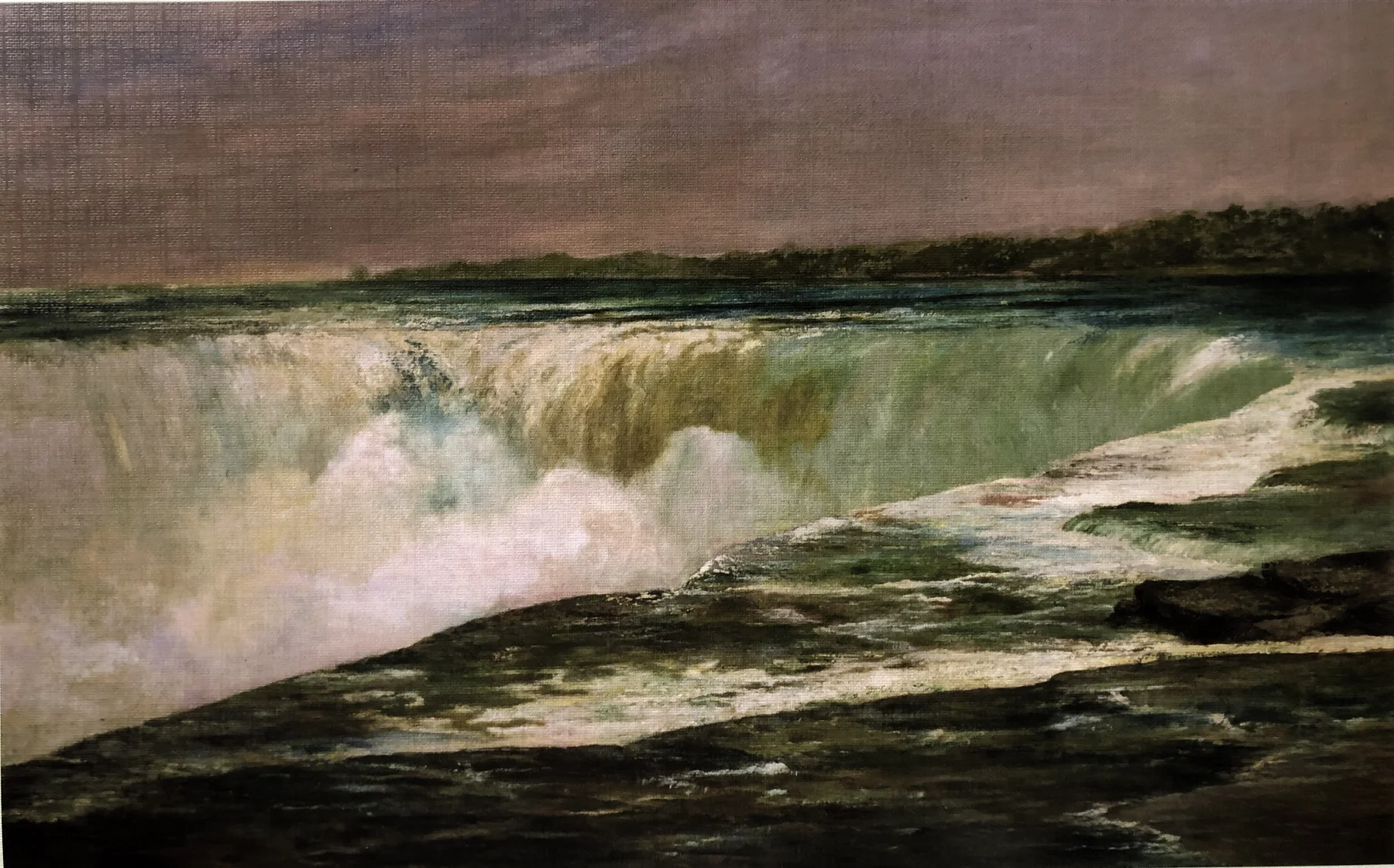
NIAGARA FALLS
William Morris Hunt
- Artist
- William Morris Hunt (1824–1879)
- Date
- 1878
- Dimensions
- 158 x 252 cm
- Medium
- Oil on canvas
- Location
- Williams College Museum of Art (WCMA), Williamstown, Massachusetts, USA
The American landscape and portrait painter William Morris Hunt was an influential figure in artistic life who helped introduce the American public to the works of famous French painters such as Millet, Courbet, Daubigny and Rousseau. As Boston’s most important artist in the mid-19th century, he reinterpreted the style of the French artists and painted Niagara Falls, which shows the awesome power of one of North America’s natural wonders.
The Magic of the Falls
In 1878 William Morris Hunt spent his vacation with his sister in Niagara, near the famous falls. He intended the holiday as a rest, but he was so spellbound by Niagara Falls that he had his painting equipment sent from his Boston home. He stayed at the falls for about a month, capturing this monumental force of nature from different viewpoints and with varied techniques, in charcoal, pastel and oil. During his stay in Niagara the artist was asked to make paintings for the legislative chamber of the Albany State Capitol. He proposed Niagara Falls as one of the two large pictures, but it was rejected.
A Huge Canvas
Although William Morris Hunt was known in Boston primarily as a portrait painter, his studies of Niagara Falls gave him the opportunity to taste the delightful world of landscape painting. Inspired by the breathtaking surroundings, Hunt wanted to convey the proportions of the huge falls, so he began painting two huge canvases, each 1.5 x 2.5 metres, his largest easel works.
Art Studies
As a student at Harvard University William Morris Hunt showed his talent at a very young age. He decided to become a sculptor and went to Paris to study further, but there, inspired by the academic painter Thomas Couture’s picture The Falconer (1845), he found his true vocation, painting. Hunt became a pupil of the painter and teacher Couture, and in the 1850s he accompanied Jean-François Millet on his rural painting trips around Barbizon.
Lively Brushwork
Greatly influenced by the Barbizon School, Hunt returned home to America in 1855. Free from the constraints of a style tied to ancient and other historical subjects, the French painters brought a fresh approach to painting, which had a great influence on Hunt, and he painted Niagara Falls in a freer style. Couture painted directly on the canvas, without preliminary pencil sketches. This fascinated Hunt, who enthusiastically presented the dramatic landscape in Niagara Falls, conveying the natural effects created by the swirling mass of water with energetic brushstrokes applied in layers.
The Same Viewpoint
Hunt made several different studies of the largest cataract of Niagara Falls, on the Canadian side, but for this painting he chose a spectacular viewpoint on top of the rock called Table Rock. Interestingly, his fellow American artist Frederic Edwin Church painted his picture Niagara from almost the same spot in 1857. Church’s huge canvas was received with great acclaim by critics and public alike at its first showing. Hunt must have admired Church’s magnificent work, but it is a little strange that he tried to create such a similar picture.
Different Modes of Depiction
Church’s enchanting Niagara abounds in fine details, from the cloudy sky through the dark, steep bank of the falls to the arc of the rainbow. Hunt’s depiction is perhaps more direct; he draws the viewer into the beautiful world of the 800-metre-wide Canadian cataract roaring in white foam. A long diagonal starting from the lower left quarter of the picture almost cuts the picture in two. Because of the perspective, the horseshoe-shaped edge of the precipice narrows into a huge white arrow, as the far bank of the falls follows the line of the plane of the horizon. The misty, humid surroundings of the falls are filled with enormous energy and light. The painting vividly depicts the sublime drama of the unbridled power of nature.
A Family Donation
Niagara Falls was at first owned by Hunt’s main patron, John Murray Forbes, together with several other Niagara pictures by the artist. The painting remained in the family’s possession until 1961, when it was donated to the collection of the Williams College Museum of Art in Williamstown, Massachusetts, where it can still be seen today.
Artistic Connection
During his years in Paris, in 1852, William Morris Hunt met the influential French painter Jean-François Millet (pictured). Millet painted his landscapes in a fresh, naturalistic style; his figures are peasants doing hard work, depicted in everyday situations. Millet and several other like-minded artists made regular trips to the small village of Barbizon on the edge of the Forest of Fontainebleau. Hunt formed a close friendship with Millet, and the two artists travelled together to paint in Barbizon in the early 1850s. Hunt returned home to America in 1855 with several Barbizon paintings and played a major part in winning recognition for the French school in Boston’s social circles.
- The Albany State Capitol building
- Harvard University in the 19th century
- Thomas Couture
- Frederic Church: Niagara