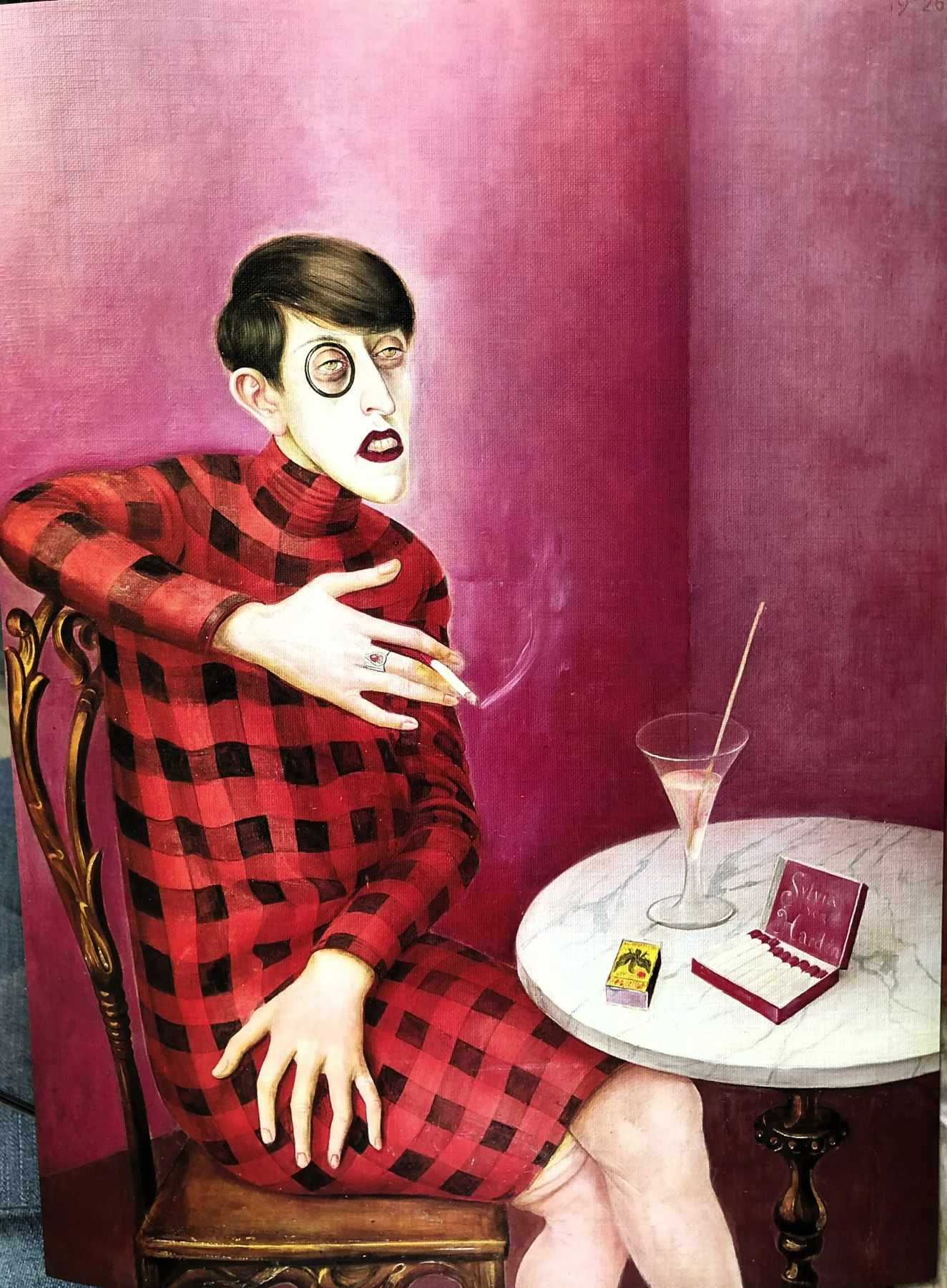
PORTRAIT OF THE JOURNALIST SYLVIA VON HARDEN
Otto Dix
- Artist
- Otto Dix (1891–1969)
- Date
- 1926
- Dimensions
- 121 x 89 cm
- Medium
- Oil on canvas
- Location
- Musée National d'Art Moderne, Centre Georges Pompidou, Paris, France
Otto Dix was one of the exponents of the 20th-century art movement called the “New Objectivity” (Neue Sachlichkeit), and his paintings are diagnoses of contemporary German society. His pictures of war and the big city show the darker and harsher side of life, going beyond the limits of objective realism and distorting reality to such an extent that the “inner essence” comes to light. One of his most famous paintings, the iconic Portrait of the Journalist Sylvia von Harden, is identified with the affectation and decadence of 1920s Berlin.
Café Culture
Otto Dix moved to cosmopolitan Berlin in 1925 and spent nearly two years in the city. With many of his friends — including the art dealer and editor Alfred Flechtheim and the actor Heinrich George — he frequented the Romanisches Café, then a fashionable meeting place for intellectuals, artists and various bohemian figures. In one year Dix made many artistically mature portraits, including the likenesses of the Art Dealer Alfred Flechtheim and the Poet Ivar von Lücken (both 1926).
Dix also approached another café regular, Sylvia Lehr, who had adopted the aristocratic-sounding name Sylvia von Harden. The freelance journalist, poet and author of romantic love stories agreed to sit for the painter — and so the superb Portrait of the Journalist Sylvia von Harden was born. With this picture, and other paintings made in the same period, such as the famous Portrait of the Dancer Anita Berber (1925), Otto Dix symbolised the tawdry glitter and decadence of Berlin during the Weimar Republic.
Perfecting the Technique
In making his portraits Otto Dix wanted to emphasise the importance of drawing over painting. By 1925 the artist had fully mastered the technique of the old masters, the combined use of drawing, tempera underpainting and thin layers of oil paint. “In my painting method I established the form from the beginning: it lay beneath the layers of paint down to the last detail, and I could bring it to the surface as I wished.”
Dix usually made a precise drawing of his chosen sitter and then transferred it to canvas or panel. Then, still in the sitter’s presence, he applied the first layer of tempera; this was followed by further transparent layers of paint, but for these he no longer needed the model. “I have learned that while the model is present I always notice a few little things here and there, and gradually everything only gets worse and more and more complicated…”
Cold Reds
Dix held that in a painting colour is inseparable from form, and that a particular shade — clearly red in Sylvia von Harden’s case — can be associated with the sitter’s personality. Wearing a rather shapeless red-and-black checked dress, the journalist sits in the corner of a pink-walled room, holding a red-filtered Russian cigarette (her name is on the packet), with a glass of spritzer on the table. According to black-and-white photographs of the time, von Harden, with her boyish 1920s haircut and prominent cheekbones, was an attractive, stylish representative of the sophisticated Berlin lifestyle.
A Merciless Vision
Dix, however, presents his sitter with the merciless eye of a caricaturist, emphasising her weaknesses and affectations. Placing great emphasis on the face as well as the hands and body language, Dix depicts a pale, evil-eyed, triangular face, on which the monocle emphasises the cold, lifeless eyes. The long, elongated aquiline nose curves towards the blood-red lips, predatory yellowish teeth and jutting chin. Von Harden’s large bony hands reveal much about her character. In her right hand she holds a smouldering cigarette, she places her left restlessly on her thigh like some spider, and with both arms she forms a barrier in front of her body.
- Heinrich George
- Interior of the Romanisches Café in Berlin
- Alfred Flechtheim, 1928