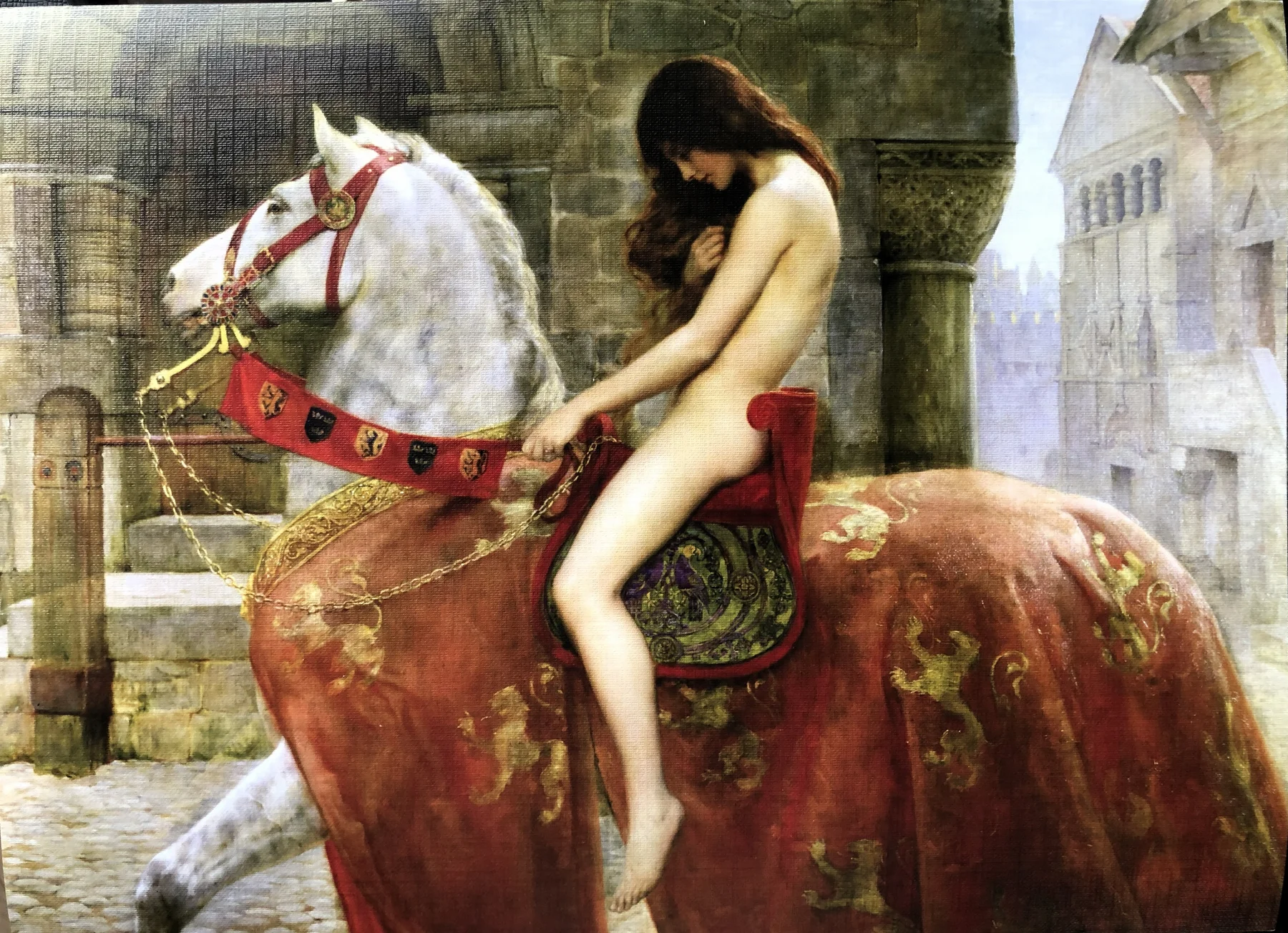
LADY GODIVA
John Maler Collier
- Artist
- John Maler Collier (1850–1934)
- Date
- c. 1898
- Dimensions
- 142.2 x 183 cm
- Medium
- Oil on canvas
- Location
- Coventry Art Gallery & Museum, Coventry, England
The mysterious figure of Lady Godiva has long been a popular subject among painters. The mythical story of its heroine and the irresistible appeal of the mystery surrounding her make this picture one of the most remarkable nudes in art history. The Victorian painter John Maler Collier was one of those captivated by the legendary woman, and of all these pictures his is perhaps the most famous depiction.
A Mystical Figure
According to legend, Lady Godiva was an aristocratic woman of the mid-11th century who rode naked through the town of Coventry to protest against the high taxes imposed by her husband, the Earl of Mercia, which were oppressing the people. To protect her virtue, people were told in advance to stay at home and draw the shutters while she passed through the streets. As a result of her daring act the earl is said to have abolished the taxes, and Lady Godiva became a heroine, although her figure is shrouded in obscurity and mystery.
Artistic Influences
A romantic subject like this found fertile ground in an artist such as John Collier, who at the start of his career became a follower of the Pre-Raphaelite style. Educated at Eton, Collier grew up in a family with influential political and social connections. His father was a judge of the Privy Council and moved in high circles, so he was able to introduce his son to the painter Lawrence Alma-Tadema (1829–1912) and to one of the founders of the Pre-Raphaelite Brotherhood, John Everett Millais (1829–1896). Millais followed the young Collier’s artistic development closely, guided and encouraged him, and undoubtedly had a great influence on his works.
Beauty and Mood
Collier’s wonderfully painted Godiva bears all the stylistic features of the Pre-Raphaelites: the precise brushstrokes and care extending to every tiny detail, to which we can also add Godiva’s gleaming skin and flaming red hair. In addition Collier perfectly conveys the mood of the scene. His streets are eerily deserted, and his viewpoint suggests exactly the image that would have met the townspeople’s eyes had they opened their windows as Lady Godiva rode past them.
Women Radiating Strength
During his career Collier painted many nudes of historical, often mythological female figures. In many of them a disturbing wildness can be discovered: from the warlike Clytemnestra in a bloodstained dress (1882) to Lilith (1887), sensual but ominous with a snake coiled around her body, the biblical demon who according to legend was Adam’s first wife. These female figures of Collier’s radiating violence differ sharply from the humble figure of Lady Godiva, endowed with traditional beauty, whose perseverance and strength the artist depicted much more subtly. Although she bows her head deeply, there is an inimitable grace in her bearing. The ornate, brightly coloured cloth of her horse emphasises her nakedness even more, but also her courage and dignity. Collier depicted the Lady’s calm determination, which simmers quietly rather than erupting, yet is a force to be reckoned with.
Contemporary Criticism
Some contemporary critics attacked Collier’s Pre-Raphaelite obsession with precision and tiny details. In their view he “reduced painting to the level of accurate representation” and thereby deprived his works of real emotion. Collier did not defend himself against the charges; in his writings he firmly championed accuracy and thoroughness over artistic sensibility. This evident simplification, however, worked to his advantage in many respects. Despite his receptiveness to mythical subjects, Collier is probably better known for his portraits.
A Talented Portrait Painter
Long before painting Lady Godiva Collier had already proved his talent for portraiture. Relying partly on the connections that had brought him together with Millais, Collier soon became the chosen portrait painter of high society. During his career he portrayed many famous personalities, including Charles Darwin, the future King George V and Lord Kitchener. At his death in 1934 his fortune amounted to some £2–3 million, most of which he had earned from his portraits.
Moral Dilemmas
Around the turn of the century Collier began to set out his ethical views in his so-called “problem pictures”. These paintings depicting the moral dilemmas of everyday life clearly illustrate Collier’s ability to encourage the viewer to examine the emotions and motives of his characters. He applied this technique to great effect in Lady Godiva too. As she rides alone on horseback through the streets of the town, the question arises in us: what event in her life led her here?
Artistic Connection
At the beginning of his artistic career Collier was strongly influenced by the Pre-Raphaelite painter John Everett Millais. The style of his later portraits is said to be very reminiscent of Millais’ works of this kind. The similarity is indeed interesting between Millais’ portrait of Lord Alfred Tennyson (left-hand picture) made in 1881 and Collier’s likeness of Charles Darwin (right-hand picture) from the same year.
- John Everett Millais
- In the exhibition room of the Coventry Art Gallery
- Lilith
- Clytemnestra