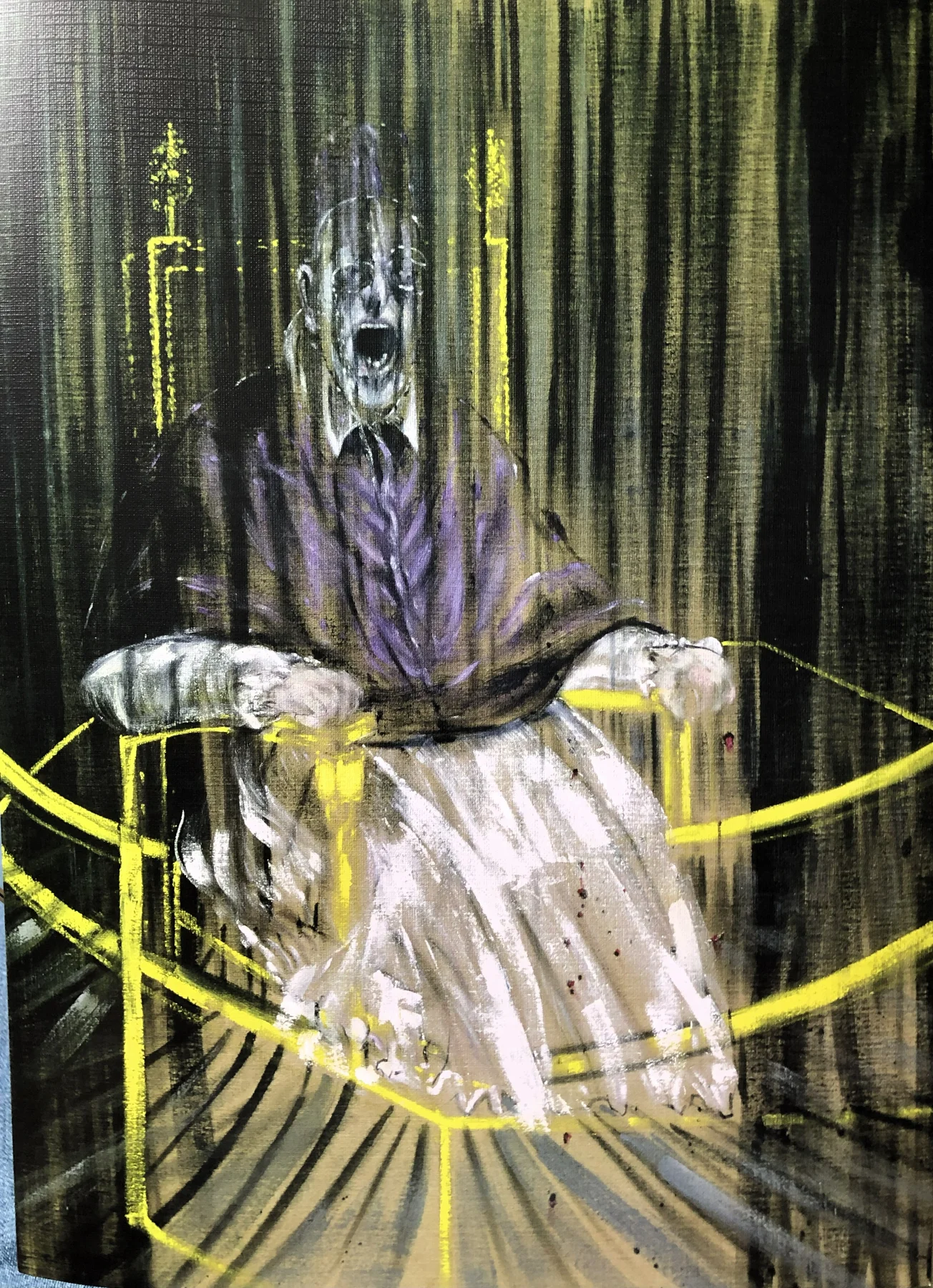
STUDY AFTER VELÁZQUEZ’S PORTRAIT OF POPE INNOCENT X
Francis Bacon
- Artist
- Francis Bacon (1909–1992)
- Date
- 1953
- Dimensions
- 153 x 118 cm
- Medium
- Oil on canvas
- Location
- Des Moines Art Center, Des Moines, Iowa, United States
Regarded as one of the finest artists of the 20th century, the British painter Francis Bacon had an entirely unique vision. His expressive, often violent, modern pictures of distorted people and animals still shake and shock the viewer today. With its haunting image of the screaming pope, full of energy and tension, Study after Velázquez’s Portrait of Pope Innocent X is one of Bacon’s best-known works.
A Splendid Obsession
Francis Bacon considered Velázquez’s Portrait of Pope Innocent X (1650) one of the greatest pictures of all time and confessed that he had been “hypnotised by this painting” for two or three years. It became an obsession for the artist, who worked to create his own version of the masterpiece. From his first work, Head VI, painted in 1949, over the course of 13 years Bacon created nearly 50 different studies of the pope inspired by Velázquez. The relatively small Head VI depicts the pope’s shoulders as the upper part of his head blurs and his mouth screams out of his closed, transparent cubic cage. The connection with the Velázquez picture is even more evident in Bacon’s later pope pictures, including three studies painted in 1951 for the 1951 Hanover Gallery exhibition.
Complex Inspiration
Bacon painted Study after Velázquez’s Portrait of Pope Innocent X in 1953. Almost 20 years later he described what had inspired his special painting. Since the thought of Velázquez’s picture would not leave him in peace, he watched the scene in Sergei Eisenstein’s 1925 film Battleship Potemkin in which a nurse — with a bloody eye and broken spectacles — screams during the memorable series of executions on the Odessa Steps. The catalyst for combining these two pictorial elements was a medical handbook Bacon had bought in Paris, containing colour illustrative photographs of various diseases of the mouth. The artist saw the red mouths as the same colour as the pope’s cape in the original Velázquez painting.
The Scream
Of all Bacon’s portraits of popes, Study after Velázquez’s Portrait of Pope Innocent X is the closest to the original in composition. Painted 300 years after Velázquez’s papal portrait, the modern version clearly reflects Bacon’s very different conception of reality. Bacon greatly esteems the Spanish artist Velázquez, but rebels against the traditional social and ecclesiastical authority of the picture’s subject, the pope.
Vertical Stripes
Francis Bacon’s obsession with Velázquez’s papal portrait was at first caused by its “magnificent colour”. Yet in Study after Velázquez’s Portrait of Pope Innocent X he did not try to repeat the same colour on the pope’s cape. Instead he chose a purple shade and used its complementary, yellow, for the pope’s cage-like, transparent throne structure. The long, dark vertical stripes and strokes of paint running across the whole picture create the impression of a curtain or window blind, at once hiding and revealing the pope. Bacon explored this effect even more evidently in an earlier study of the pope, which he then destroyed in 1951.
The terrifying image of the pope’s screaming head — with its lace-trimmed white garment spattered with drops of blood — expresses a deep fear and anxiety about human existence. It recalls Edvard Munch’s Expressionist work painted in 1893, The Scream. Bacon’s pope sits on his throne, but imprisoned. The artist separated the figure from the viewer by means of slanting yellow lines, placing the picture behind railings or on a kind of platform. Bacon described the tubular frame as “an attempt to lift the image out of its natural surroundings”. The yellow lines also create the impression that the throne is turning into a rocking chair.
Masterpiece Connection
Francis Bacon confessed that he had little time for contemporary art, and his favourite painter was Diego Velázquez (1599–1661, pictured). Although Bacon was obsessively interested in Velázquez’s Portrait of Pope Innocent X, it may seem strange that the artist never saw the original work. He did not even visit the Galleria Doria Pamphilj, home of the Velázquez painting, when he spent three weeks in Rome in 1954. Perhaps he wanted to avoid disappointment, or was afraid to see the original. In any case, comparing his own works with that of the great Spanish master, Bacon felt that with his painting attempts he had “falsified” the image of the pope, and later regretted them, saying: “I think they are very silly.”
- Velázquez: Portrait of Pope Innocent X
- The nurse with broken spectacles from the film Battleship Potemkin