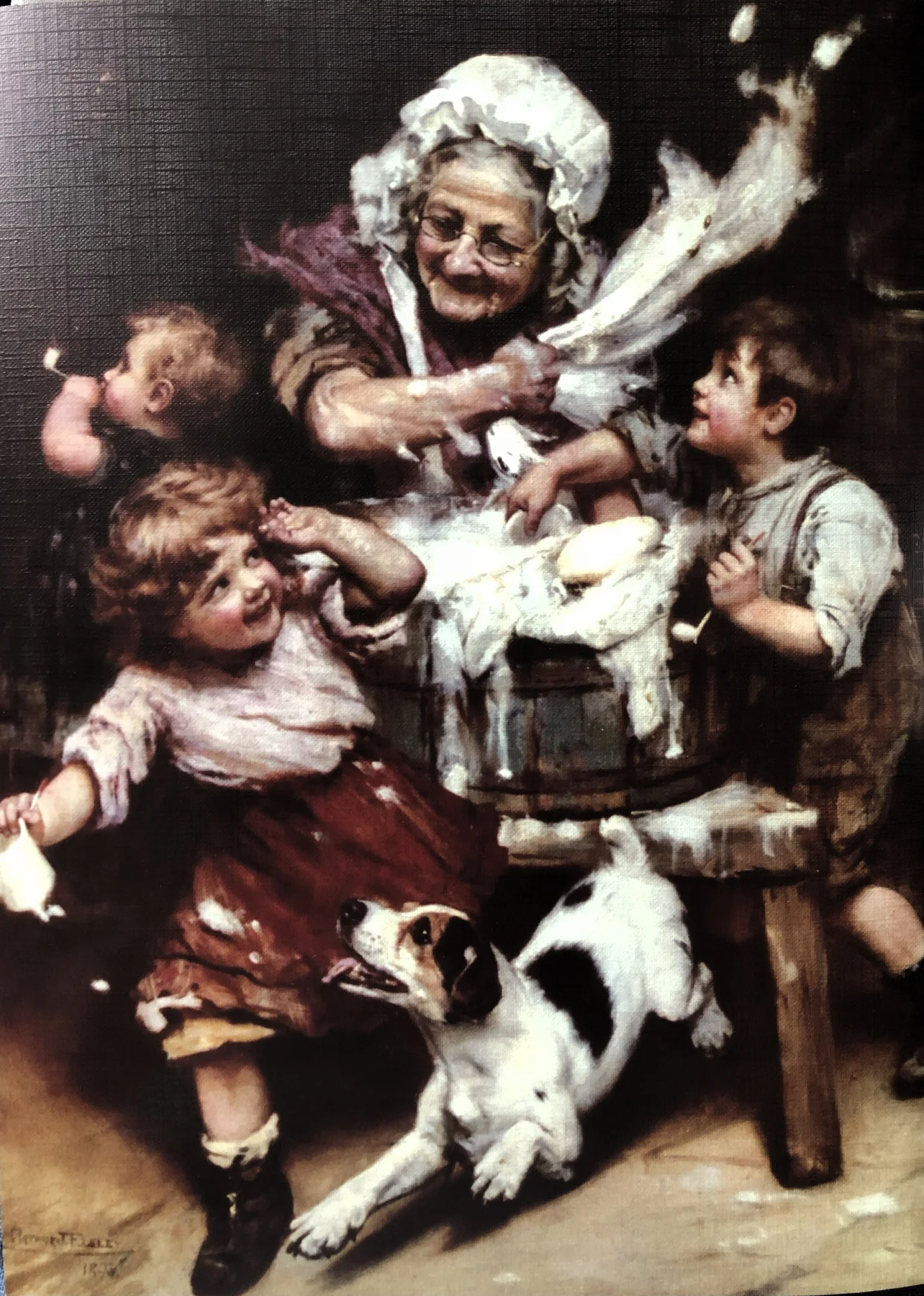
SIEGE (THE WASH TUB)
Arthur John Elsley
- Artist
- Arthur John Elsley (1860–1952)
- Date
- 1893
- Dimensions
- 92.5 x 66.5 cm
- Medium
- Oil on canvas
- Location
- Lady Lever Art Gallery, Wirral, United Kingdom
In Arthur John Elsley’s picture, which depicts a captured, cheerful moment of Victorian family life, soap suds fly, mischievous children run about and a lively Jack Russell terrier barks merrily in the cheerful chaos. It was once said of Elsley that he “knows all the ingredients of children’s paradisal happiness”, and his special feel for depicting light-hearted family togetherness made him one of the most popular English artists of the late 19th and early 20th centuries.
Sunlight Soap
Elsley painted Siege in 1893, when he had already established his reputation as England’s finest painter of children and animals. One of the main reasons for his popularity and success was that he managed to reach a very wide audience; his paintings were often reproduced as prints and calendars, or used to advertise consumer goods. Siege was one such work; it was bought by the soap manufacturer William Hesketh Lever to use as part of his company’s advertising campaign to promote Sunlight Soap.
Lever began buying pictures by excellent English painters for advertising purposes in the late 1880s, but he was not the only one. Lever’s main rival, A.&F. Pears, started this trend in 1887, when its shrewd director, Thomas Barrett, bought John Everett Millais’ well-known, sentimental picture Bubbles (1885–86) to use in a Pears soap campaign. The initiative was a very risky venture, but it paid off handsomely, winning enormous public support and bringing general recognition to the soap brand and to Millais himself.
In response Lever wanted to imitate the by then well-established formula. In 1889 he bought another English artist, William Frith’s picture The New Frock, and made it the painting of the first Sunlight Soap advertisement, with the caption: “So clean”. Interestingly, although the advertising brought general recognition to both artists, neither Millais nor Frith was happy with the way their paintings were altered and — in their view — ruined. Since they had sold the copyright of their pictures, however, there was nothing they could legally do.
Striking a Chord
Elsley had always admired Millais, whose paintings influenced some of his works. When Lever bought Siege, Elsley was overjoyed to follow in his old idol’s footsteps. Sales did indeed continue afterwards and provided the artist with a good living. The painting, also known by the rather apt title The Wash Tub, was ideal for Lever’s Sunlight Soap campaign. Not only was the subject itself fitting, but Elsley’s scene depicting cheerful ordinary people in their modest home was also in perfect harmony with Lever’s long-term vision of “bringing back the close family bond that once existed”. The painting also struck a chord with the public. As part of the Sunlight Soap promotion people eagerly collected soap wrappers, which they then exchanged for a high-quality reproduction of the painting.
A Talented Painter
Despite his cheerful, often light-hearted subjects, Elsley took his work extremely seriously. He studied at the Royal Academy until 1882, and at the height of his career, between 1878 and 1927, he exhibited 52 paintings at the Academy’s annual exhibitions. Elsley began painting his pictures of cheerful family life focusing on children and animals when he moved into the studio of his fellow English painter Frederick Morgan in 1889. But long before that he had been a talented animal painter, and, as in Siege, the protagonists of his paintings were usually domestic animals. His earliest known work depicting an animal, of a Cairn terrier, was made in 1871, when the artist was only eleven. After that Elsley made many excellent drawings of chimpanzees, giraffes and wolves during a visit to London Zoo in 1874. He was such an expert in animal painting that he even painted animals for his studio partner, Frederick Morgan. One of the two artists’ most famous joint works, Trumps, depicts a little girl playing with two puppies. The painting was made at the start of their collaboration, around 1889, and both artists signed it.
A Fitting Home
Morgan’s works were very similar in subject to Elsley’s pictures, and his paintings too featured in advertising campaigns in the late 1800s and early 1900s. The most famous example is the comical He’s Coming (c. 1890), which depicts two small children about to bath an evidently enthusiastic puppy. The painting featured in a Pears soap advertising campaign first in the 1890s and again in 1915. A year later, in 1916, A.&F. Pears was taken over by its larger rival, Lever Brothers, so William Lever united this unique collection of fine-art advertising. Nearly 75 years later, in 1983, the company now known as Unilever donated Siege and He’s Coming to the Lady Lever Art Gallery in Merseyside. This was a fine gesture. The gallery was founded in 1922 by Lever’s wife in a model village, picturesque Port Sunlight, named after Lever’s soap brand. The village was built according to Lever’s vision to create a family-centred community for his factory and workers.
- William Hesketh Lever
- Thomas Barrett
- The New Frock and William Frith
- He’s Coming, advertisement