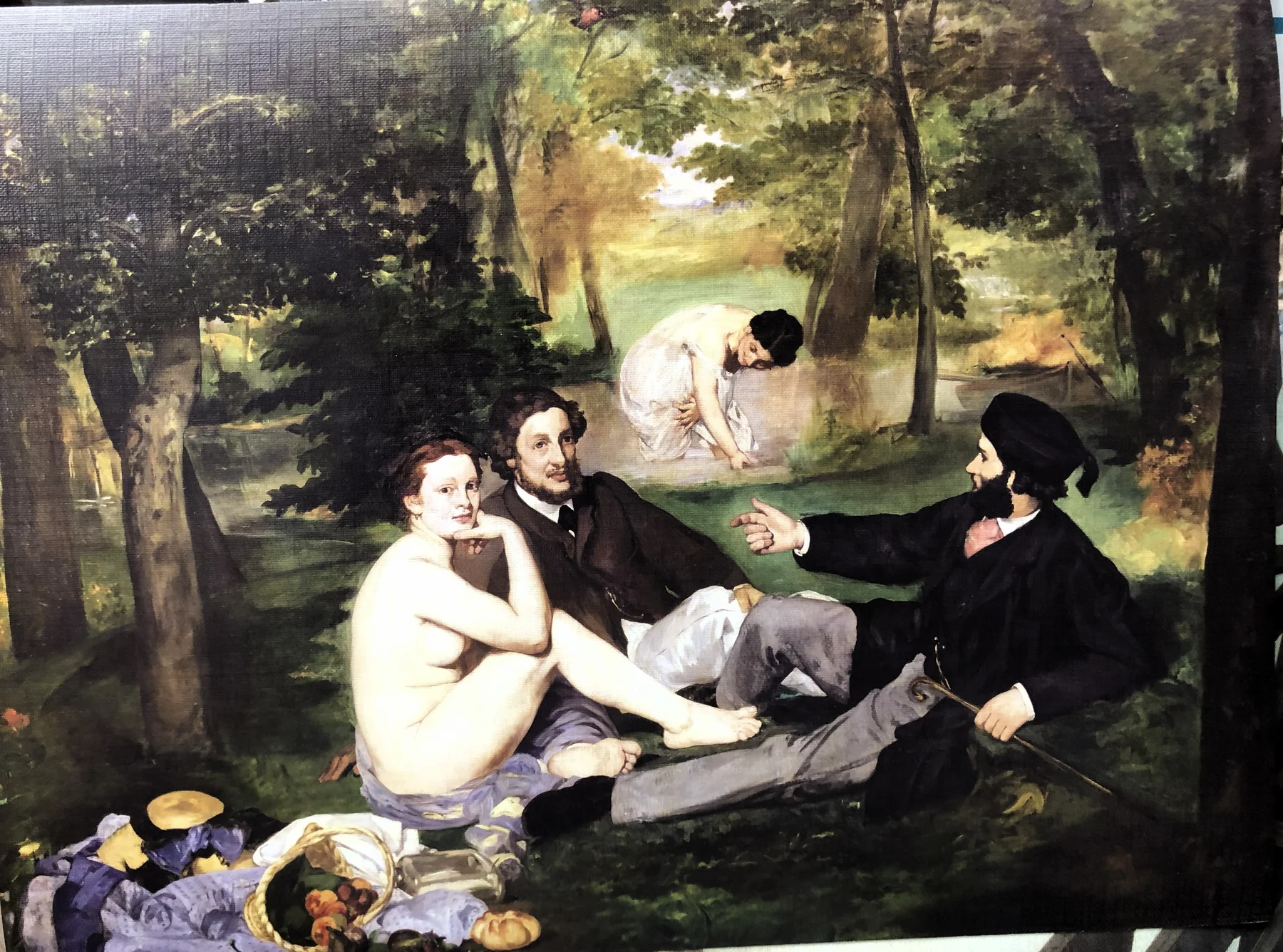
LUNCHEON ON THE GRASS
Édouard Manet
- Artist
- Édouard Manet (1832–1883)
- Date
- 1863
- Dimensions
- 208 x 264 cm
- Medium
- Oil on canvas
- Location
- Musée d'Orsay, Paris, France
When Édouard Manet exhibited Luncheon on the Grass, one of the most famous and influential works of French painting, a scandal broke out at once. The enigmatic painting, which disregarded both elite art and traditional culture, inspired many young Impressionist painters of its time. Because of the bold novelty of his work and artistic conception, many regarded Manet as the founder of modern art. Although it was rejected from the official Salon exhibition of 1863, Luncheon on the Grass caused a great outcry when it was shown under the title The Bath (Le Bain) at the Salon des Refusés (created to exhibit paintings similarly rejected by the jury). As the main attraction of the event, the picture became at once a scandal and an object of ridicule among the public.
Nudity and Scandal
Although the influence of the old masters can clearly be felt in Manet’s paintings, they shocked the public and baffled the critics with their modernity. The picture shows a naked woman sitting casually in a forest clearing, picnicking in the company of two young men dressed in Parisian fashion. The scene raises a moral question: why are two gentlemen sitting beside an unclothed woman? Nudity was considered acceptable only if it was sufficiently distant in time or space from the viewers’ own world, but this lady’s shameless direct gaze seemed vulgar and almost threatening.
With figures arranged after a composition by Raphael and by evoking the bucolic mood of Giorgione’s (or, according to several sources, Titian’s) Pastoral Concert, Manet tried to revive the lofty ideals of Renaissance art. But whereas the 16th-century painting is an entirely imaginary scene from the past, in Manet’s picture the clothes are obviously contemporary. This bold mixture of the classical and the modern — the bohemian lifestyle of the time set in the framework of classical art — led to the harsh criticism of the picture.
Manet caused even greater outrage with his picture Olympia, shown two years later. The reclining nude was modelled on Titian’s Venus of Urbino, but her provocative sexuality was considered a breach of propriety. One critic wrote of the picture: “Art sunk so low does not even deserve reproach.”
A Revolutionary Technique
Manet’s style and working methods were found as scandalous as the subjects of his paintings. Both pictures were made with a bold, new technique: on the large canvas, with its riot of colours, sharp, direct lighting creates vivid contrasts of light and shadow. Manet dispensed with unnecessary details and with the subtle shades and transitional tones used to model forms. To quote one critic, “the shadows are indicated by more or less large black patches”, and another said of the picture: “Even a woman who is not in the least beautiful has bones, muscles, skin and some kind of colour. This one has nothing.”
Another aspect of Luncheon on the Grass also baffled the critics. Compared with the figures sitting in front of the sketchily painted forest background, the person in the distance seems unnaturally large. Manet seems deliberately to have ignored the laws of perspective and the rules of composition. The painting testifies that Manet consciously opposed convention and launched a new, freer direction in contrast to traditional subjects and their presentation.
An Avant-Garde Leader
With his two scandalous paintings Manet unintentionally found himself in the role of leader of avant-garde art and father of Impressionism. He was a respected member of the circle of young Impressionists associated with the names of Monet, Renoir, Sisley and Cézanne. Although they surrounded him with admiration, Manet deliberately kept his distance from the group and did not take part in the Impressionist exhibitions. He did, however, adopt their open-air painting technique, and under their influence his works became lighter and freer in the 1870s; the young Claude Monet in particular made a deep impression on him.
Manet was an extremely versatile artist. He treated many different subjects in his paintings and also excelled in etching and lithography. He did not bind himself to any dogma and did not like to make theories about his works. His friend, the famous writer Émile Zola, wrote of him: “When he began a painting, he could never say what it would become.” Although his pictures radiate freshness and spontaneity, Manet often repainted them or even cut them into small pieces. Some objected that he could only paint what was in front of him. His paintings, however, are far from a simple copying of nature; they show that he was more interested in the process of painting than in the subject of his pictures. His brilliant painterly abilities are well illustrated by his last great work, A Bar at the Folies-Bergère (1882).
Artistic Connection
This enigmatic picture inspired painters such as Claude Monet, Paul Cézanne and especially Pablo Picasso, who treated the work in a series of 27 paintings, six prints and 140 drawings. Monet painted his own version of Luncheon on the Grass (picture) on an even larger canvas than the original, in which his friends formed the members of the picnicking group, but he left out the nude and arranged his figures in more natural poses.
- Manet: Olympia, 1863
- Émile Zola