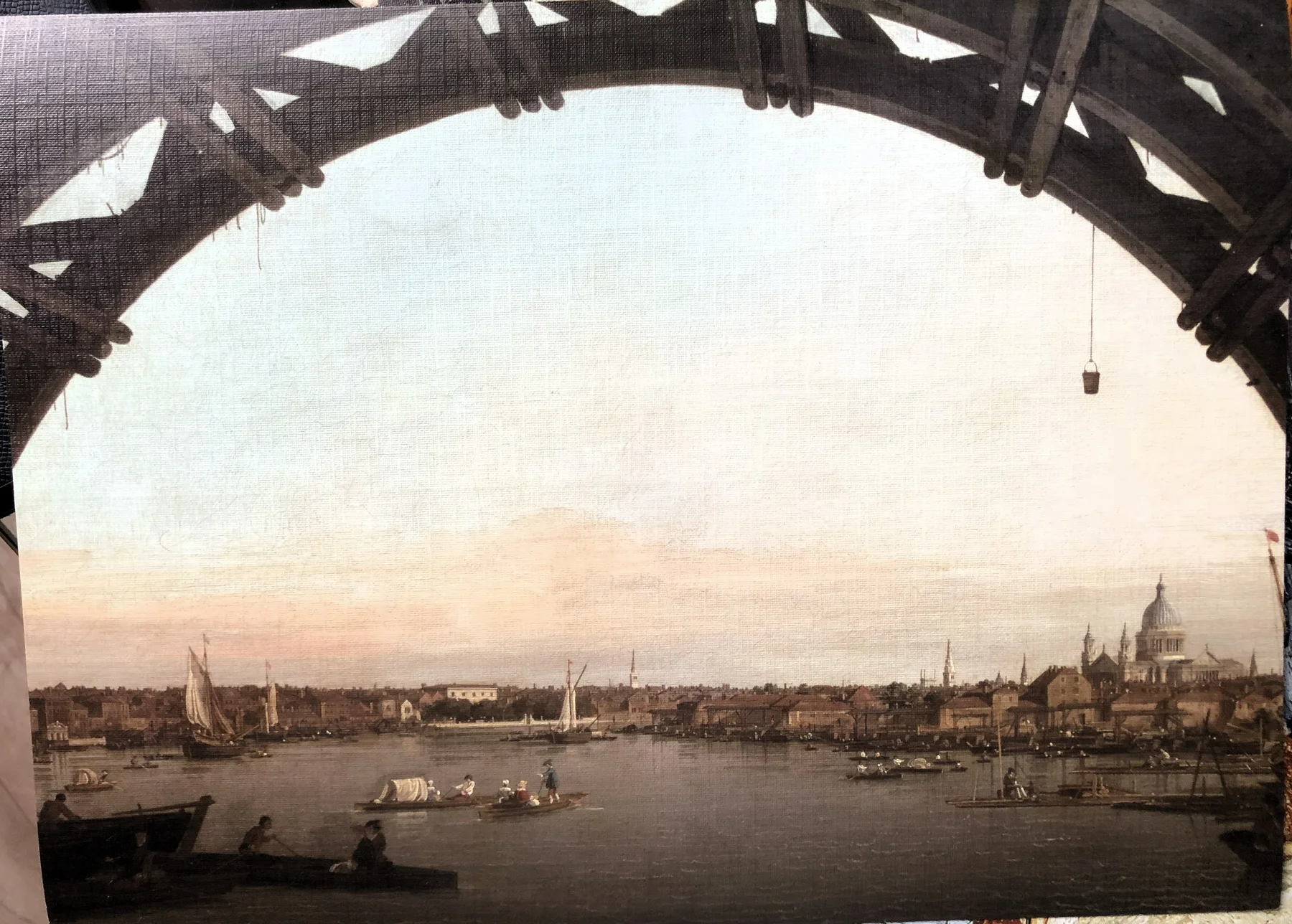
LONDON SEEN THROUGH AN ARCH OF WESTMINSTER BRIDGE
Canaletto
- Artist
- Canaletto (Giovanni Antonio Canal) (1697–1768)
- Date
- 1746–47
- Dimensions
- 59.7 x 97.5 cm
- Medium
- Oil on canvas
- Location
- Collection of the Duke of Northumberland, England
The great 18th-century Italian painter Canaletto won fame with his vedute — views. At a time when crowds of English tourists came to the continent to visit the sights of France and Italy, especially Florence, Rome and Venice, on a grand cultural tour, Canaletto successfully sold his pictures as souvenirs of Venice. He owed his fame not only to his paintings presenting picturesque Venice and its wonderful architecture but also to many of his English, mainly London, views, such as London Seen through an Arch of Westminster Bridge.
Under Construction
After the outbreak of the War of the Austrian Succession, from 1740 English and German tourists avoided Venice, and Canaletto’s lucrative picture sales fell considerably. The painter decided to move to London to be closer to the art market and to wealthy aristocratic English patrons. He arrived in London in 1746, where he received his first commission from Sir Hugh Smithson, later Duke of Northumberland. Canaletto had previously recorded the wonderful waterways of his native Venice in his paintings, so he naturally felt drawn to the Thames too. Smithson was a member of the commission set up to design and build the Westminster Bridge, then the most important construction project in the English capital. In the age before the invention of photography, Canaletto’s picture of the city and the Thames, serving as a snapshot, is an important document of this construction work.
A Family Heirloom
London Seen through an Arch of Westminster Bridge was made in 1746–47. During his extended stay in England Canaletto won Smithson’s further support with his splendidly painted picture. The Venetian painter created several other works for the nobleman, including views of Westminster Bridge and Alnwick Castle. Smithson inherited the earldom of Northumberland in 1750 and became Duke of Northumberland in 1766. London Seen through an Arch of Westminster Bridge passed into the possession of the present Duke of Northumberland as a family legacy.
An Arched Frame
London Seen through an Arch of Westminster Bridge is a work of stunning composition in which the painter chose an unusual solution for framing the scene. Arches appear in many of Canaletto’s pictures, including his early paintings of ancient ruins. Many similar ones can be seen in his famous views of Venice too, among them the Rialto Bridge. But this was the first time he chose his viewpoint from beneath a huge arch, as if enjoying the wide panorama looking out from there. The picture shows the dark timber scaffolding of the bridge’s arch under construction. Canaletto places the arch slightly off-centre to the left, deliberately avoiding perfect symmetry. Canaletto also successfully used this kind of framing in his Venetian paintings made from 1756, including The Courtyard of the Doge’s Palace, Venice (left).
Light and Dark
Canaletto’s townscapes are not necessarily accurate depictions like photographs, but the Venetian painter always creates a strong impression of realism. His meticulous working method is well reflected in the horizontal and vertical straight lines of his precise drawings and in his careful brushwork, especially in the waterside buildings. London Seen through an Arch of Westminster Bridge is a work famous for its clarity, and although life on the Thames is by no means as lively as in many of Canaletto’s other bustling Venetian scenes, the picture radiates a fresh, effervescent atmosphere, heightened by the vivid colours of the tiny figures in the rowing boats in the foreground. Canaletto’s brightly coloured large Venetian paintings show the subtleties of natural light effects; in London Seen through an Arch of Westminster Bridge Canaletto paints the dark arch in a bold, firm style to contrast with the lighter tones of the sky seen through the curve of the structure.
Perfect Balance
The panorama of the city occupies only a narrow strip in the lower third of the painting. Without the arch the composition would have two main features: the wide expanse of the evening sky and, in contrast to the beautiful and dramatic depictions of Venice, London’s relatively flat and monotonous townscape. With the arch intruding into the picture, however, there was a danger that the bridge structure would become too dominant in the composition.
Canaletto, however, was able to bring the dynamic elements of the painting into perfect balance. With a skilfully used detail the artist broke the regular rhythm of the huge timber vault. On the right a bucket hangs on the end of a rope, leading the viewer’s gaze towards the lower right quarter of the picture, to the masterpiece crowning Sir Christopher Wren’s architectural work, the curved dome of St Paul’s Cathedral.
- The 1st Duke of Northumberland
- Canaletto: Alnwick Castle
- Sir Christopher Wren (1632–1723)